
Define the next role before chasing a title
Call center career advancement can lead to a quality analyst, escalation specialist, onboarding trainer or customer service team lead role. These positions rely on different skills even if all involve resolving customer issues. BLS describes representatives as answering questions, processing requests, documenting contacts and referring unresolved problems. A person who is fast at routine calls may still need practice in fair feedback, complex investigations or schedule coordination. Your first step is to compare real internal role descriptions and select the type of responsibility you want.
Quality work is a review discipline
A quality analyst does not just listen to calls and say whether the agent sounded friendly. The work often involves using a defined rubric, checking required disclosures or documentation, distinguishing script compliance from problem resolution, and explaining findings consistently. Ask how the organization calibrates scores among reviewers. If you have access only to your own quality reports, use them to learn the rubric; do not claim you performed team scoring. A useful sample is a fictional case with a transparent checklist and an explanation of the reviewer’s decision.
Escalations require policy awareness
An escalation specialist may handle complex billing, service or complaint cases after a frontline agent has exhausted their approved options. Relevant evidence includes checking the case history, summarizing prior steps, setting expectations and documenting a handoff. But escalation responsibility is not unlimited authority to refund money, change contract terms or waive policy. Learn the authorization matrix for the next role and practice saying when a case must go to a supervisor or specialist. Being helpful under pressure is not a substitute for access rights.
Training work includes clear feedback
A trainer or peer coach may help new colleagues understand navigation, call structure, note quality and when to ask for help. To demonstrate readiness, prepare an approved job aid or a short practice scenario with an observable objective and a safe escalation point. Invite a trainer to review it. Avoid using actual customer recordings or private agent performance notes. You can show training potential by making a confusing workflow easier to understand, without exaggerating your influence on another employee’s metrics.

Team leads manage people and systems
O*NET describes first-line supervisory work as coordinating support staff, reviewing standards and helping employees with difficult problems. A team lead may also support coverage and feedback discussions, depending on the employer. Fairness matters: a single unusually short call or a difficult customer should not be used to judge someone’s performance in isolation. If you already coordinate a queue for a few minutes under direction, describe that contribution narrowly. It is not equivalent to formal performance management.
Build an evidence log without personal data
Track permitted, verifiable examples of a problem you clarified, a knowledge-base gap you identified, or a case note that made the next team’s work easier. Use synthetic customer details and never publish account numbers, addresses, medical information or recordings. If your organization supplies official QA data and allows sharing a summary, attribute it correctly; otherwise describe the process qualitatively. A statement like “identified an incomplete transfer note and escalated it using the approved channel” can be stronger than a fabricated customer satisfaction percentage.
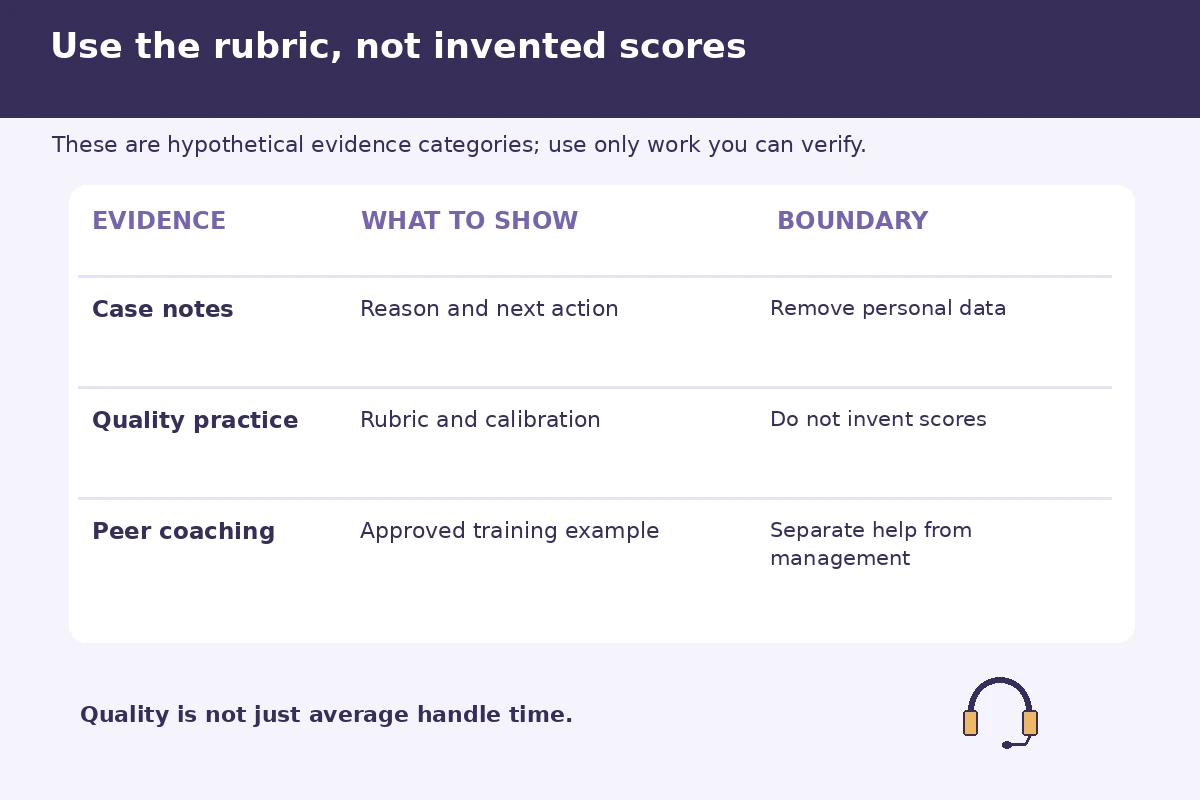
| Evidence area | Proof you can describe | Boundary to check |
|---|---|---|
| Case notes | Reason and next action | Remove personal data |
| Quality practice | Rubric and calibration | Do not invent scores |
| Peer coaching | Approved training example | Separate help from management |
Evaluate metrics in context
Contact centers may monitor handle time, first-contact resolution, service level, compliance, quality or customer feedback. Measures have different denominators, business goals and limits. An agent handling sensitive complaints should not assume that shorter calls always mean better work. Ask how the next role uses data and what counts as an approved sample. Never invent rank, score or improvement statistics to fill a résumé. Review how an organization handles exceptions and whether feedback is calibrated before volunteering to evaluate colleagues.
Propose a safe stretch assignment
Ask a supervisor whether you can draft a short internal FAQ, assist with a supervised quality calibration exercise, or present a fictional escalation to the training team. Choose a task that does not grant you unauthorized access to customer or colleague records. Agree on a reviewer and a result: the guide is accurate, the case has a correct handoff, or the session shows a clear coaching explanation. Document the feedback instead of claiming that one experiment improved the whole operation.
Make the promotion discussion practical
Bring one target job description, two actual work examples and a gap you want to close. Ask whether the role prioritizes policy knowledge, peer coaching, analytical consistency, schedule coordination or something else. An example question is: “What evidence would demonstrate readiness for a quality analyst opening here?” Request a small trial task and an agreed time to discuss it. If the employer has no route, compare service operations roles elsewhere without assuming the same title means the same authority.
Avoid overclaiming and unfair scoring
Do not describe approving credits or changing customer accounts if those actions belonged to another team. Do not say you managed employees when you provided occasional tips. Never publish a screenshot of a real customer case or present a colleague’s low score as your achievement. In interviews, explain how you followed the policy, what you documented and who had final authority. Advancement usually requires trust in your judgment about limits as much as visible confidence with difficult callers.

A fair coaching scenario to practice
Draft a fictional customer support case containing the request, the known facts, the required documentation and the precise point where an escalation is needed. Ask a trainer or quality reviewer how they would evaluate your response under the approved rubric. Record the feedback and compare it with your original decision. Do not use a real recording or copy an agent’s private scoring notes. This practice tests whether you can articulate standards, not just resolve a complaint yourself. A person considering team leadership should be able to explain a correction respectfully and consistently, while recognizing when a policy exception is outside their authority.
Build a focused development sequence
Select quality, escalation or leadership as the primary route. Study its written requirements, identify one transferable competency, and ask for a reviewed practice opportunity. Record what you personally learned and update your examples. If the role asks for supervisory experience that you lack, consider trainer support or process coordination as an intermediate assignment. Reassess the route using actual openings and supervisor feedback rather than chasing a general “promotion faster” formula.
How We Research and Check Career Advancement Guidance
We reviewed these occupational and professional sources on November 16, 2026: BLS explains customer support work, escalation, recordkeeping and contact center context. O*NET details customer service inquiries, transactions, documentation and referrals. O*NET describes administrative and customer service supervision and coaching duties. Roles, approvals and qualifications depend on the employer and jurisdiction. Illustrative scenarios are not reports of real candidates. Read our affiliate disclosure.
Explore Related Career Guides
Common possibilities include quality review, escalation support, coaching or team lead work. Actual structures and requirements depend on the employer.
Volume alone does not establish quality or leadership. Use verified outcomes, accurate records, policy adherence and the needs of the target role.
It is a possible route if the person learns the quality rubric, calibration and impartial review requirements and meets the employer’s criteria.
Not without explicit permission and applicable privacy safeguards. Use approved training material or a synthetic scenario.
Document which help was approved, what you taught and who reviewed it. Do not describe informal support as formal supervision.