
A bank can advertise teller, branch associate, customer service, sales and administrative support roles using similar language. Start with the job’s duties instead of treating every branch vacancy as cash-handling work. BLS describes tellers as workers who process routine transactions such as deposits and check cashing, under employer procedures. A role centered on advising about loans or handling complicated account decisions may use a different qualification and training route.
Check whether the posting is really for a teller
Record the actual employer, branch, city, role title and requisition number. Bank and credit union jobs are both possible, but do not assume that their portals or screening practices are identical. This guide helps you prepare a teller-style application, not obtain authority to handle customer funds before employer training.
Verify the bank careers portal
A job board listing should lead to the same opening, or an authorized application route, that the bank identifies on its own careers page. Confirm the role number and branch. Avoid giving a person who contacted you unexpectedly your bank credentials, Social Security number or other financial details just because they use a familiar bank logo. The FTC warns that impostors can copy employer identities and ask for sensitive records before genuine hiring.
A legitimate company may use an external applicant system, but the transition should be traceable from the employer’s verified website. If a posting disappears, do not send documents to an unsolicited address as a workaround. Use the organization’s public recruiting contact or its official job-support information.
Evaluate the actual work schedule
BLS notes that most tellers work full time during regular business hours, with some roles including evenings or weekends. This is a national occupational description, not a guarantee about any individual vacancy. Read the employer’s posted hours and training expectations. If you need part-time work or specific days off, apply to a posting that allows those terms instead of checking every availability box on an online form.
Commute to the branch matters as much as the employer name. If the role can move between locations, verify whether travel is listed as part of the actual job. Keep notes about branch, shift window, and required training site so the answers you give in an interview match what you submitted.

Show accuracy without inventing cash duties
Teller work values careful transaction handling and communication. Someone with retail cashier experience may describe reconciliation and following return procedures if they really performed those tasks. A student with no cash experience can use evidence from inventory records, registration checks or administrative accuracy, properly labeled. Do not claim vault access, bank-system expertise or financial authority because those terms appear in a posting.
An illustrative line is: “Compared daily sales entries with receipts and alerted a supervisor to discrepancies.” It is suitable only for someone who did that work. Specific evidence lets an employer consider transferability while preserving the important difference between working at a store counter and working under bank procedures.
Protect private data in examples
Never place former customer names, account numbers, payment details or screenshots of financial systems in a resume or application. A strong accuracy example explains the process instead: what was checked, what mismatch was identified and who was authorized to resolve it. The employer can evaluate your attention to detail without seeing anyone’s confidential records.
If an online interview or application requests financial documents through an unfamiliar link, independently verify the contact and stage. Legitimate background or onboarding checks may later require sensitive information through authorized channels; a general job article cannot decide whether a particular document request is genuine. You should not send it just because a message claims to be urgent.

Complete the form and qualification questions
Enter work history, education and skills exactly. Where the portal asks about cash handling, be precise about whether you balanced a register, observed a process, assisted a trained colleague or had no experience. Do not infer that everyday use of a personal bank account qualifies as professional financial-service experience. BLS describes employer training as part of teller preparation; do not describe training you expect to receive as a credential already earned.
Bank applications may ask about availability or prior employment. If an answer is uncertain, find the verified record instead of guessing. Use readable resume files and ensure that an auto-filled date or job title has not changed meaning. Treat each employment question as a factual field, not a place to optimize keywords.
Prepare a short role-specific response
A hypothetical note could read: “I am applying for the teller position at the North Branch. My retail duties included checking transaction totals, documenting discrepancies and directing policy exceptions to a shift lead. I can work the posted weekday schedule.” The branch name is fictional; replace it and every duty with the real posting and your experience.
The best note conveys fit without suggesting you already have access to banking systems. Avoid promising that you have never made a mistake; instead explain the checks you used and how you reported errors. Accuracy and candor can be demonstrated without fabricated statistics.
Inspect the final submission preview
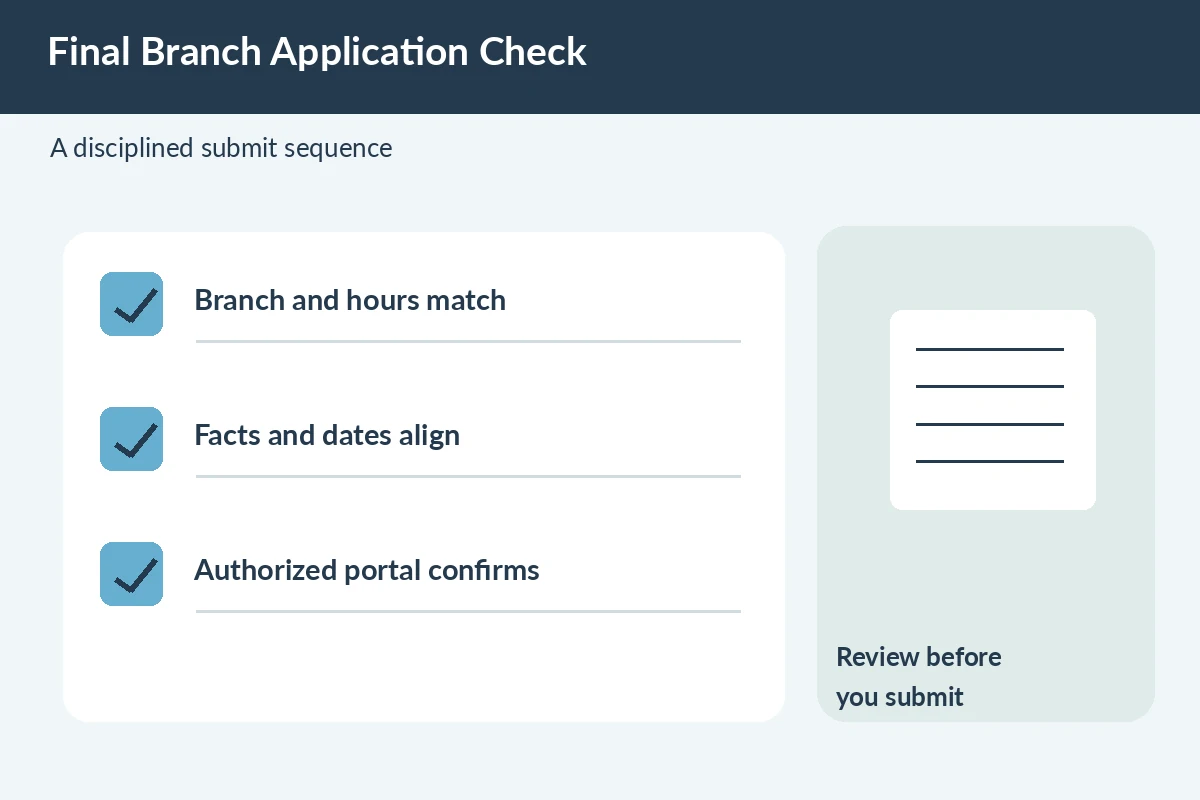
Read the title, branch and schedule once more. Confirm your email, contact information and document versions, then inspect every parsed work-history field. Verify required attachments and the confidentiality of any sample. An accidentally uploaded application for a different employer can create confusion and expose information unnecessarily; use descriptive filenames and a clean file folder.
After you submit, look for a status or confirmation tied to the exact bank requisition. Some portals store applicant profiles independently of applications. A saved account is not proof that a recruiter has the application. Note the official timestamp and job ID for later questions.
Respond to next steps within your real scope
If invited to an assessment or interview, review customer interaction, counting accuracy and respectful escalation of unusual transactions. Do not invent any bank-specific fraud procedure or assume that a trainee is free to waive verification steps. Explain your approach to following documented instructions and consulting someone with authority.
Continue to verify communications through the employer’s official career channels. A hiring process may include additional screening, but an online application by itself does not establish a job offer. Retain only the records you need and avoid circulating private documents to multiple unverified parties.
How We Research Online Job Applications
We reviewed U.S. occupational descriptions, university career-center guidance, and FTC consumer protection material as relevant to this specific online application. Our editorial examples and field labels are hypothetical, not screenshots of a live employer portal. The employer’s own posting and authorized application instructions determine eligibility, file types, deadlines, screening and training. The guidance is informational and cannot guarantee an interview or offer. Review date: November 10, 2026. We do not assume a saved profile is a completed application or that a candidate possesses access, certification or approval they have not earned.
Primary and reference sources reviewed November 10, 2026: www.bls.gov (BLS describes teller tasks, workplace schedules, employer training and customer data confidentiality.) consumer.ftc.gov (FTC recommends independently verifying jobs and protecting personal financial details from impersonators.) careerservices.upenn.edu (Penn Career Services recommends matching resume evidence to the specific qualifications of the opportunity.) Examples are fictional and should be replaced with the reader’s own dates, work history and documents. This independently prepared article does not imply paid placement or any employer endorsement. Read the JobAsk affiliate disclosure.
Related Job Search Guides
Yes, if the employer’s requirements allow it. Describe actual register accuracy, customer service and escalation work without claiming bank-specific systems experience.
No. BLS says most tellers work full time during typical business hours, but some shifts include evenings or weekends. Read the particular posting.
No. Show the checking and handoff process without disclosing names, account numbers or private transaction information.
It does not replace professional teller work. Describe relevant work or coursework honestly; distinguish familiarity as a customer from job duties.
Find the bank’s official careers website independently and confirm the branch, requisition and destination. Do not rely only on a logo or unsolicited recruiter message.