
A sales resignation letter can be short: state that you are resigning, identify your proposed final working day, thank the team if appropriate, and offer a reasonable transition within your role. The complex part is not the letter; it is transferring open opportunities and customer promises without taking client lists, copying the CRM to personal storage, or promising a deal will close after you leave. This guide gives a usable notice example and a sales pipeline handoff that a manager can assign safely.
Confirm Your Notice Date and Recipient Before Contacting Clients
Review your employment agreement, current notice policy and any agreed territory or account responsibilities before choosing a last working date. The familiar two-week convention is not an automatic legal rule for every U.S. employee or contract. If you have a commission or incentive plan, direct questions about eligibility, payout, draws or post-employment obligations to payroll or HR and the actual written plan. Do not publish a universal commission rule in your resignation message.
Tell the manager or required HR contact before notifying customers. A manager may choose an account transition timeline or assign a colleague to attend important calls. Keep the letter focused on employment dates, not a debate about pipeline credit. Ask for written acknowledgement if date or routing matters; keep a private copy of your own resignation correspondence, but not confidential customer records.
Send a Brief Sales Resignation Letter With a Real Final Date
Here is an illustrative message. Replace the bracketed details and date with your own facts: “Subject: Resignation — [Your name]. Dear [Manager], I am resigning from my role as [sales title]. My proposed final working day is [day, month date]. During my remaining time, I can help document open opportunities and transfer account responsibilities through our approved CRM and team process. Thank you for the opportunity to work with the sales team. Please confirm the transition owner and any priorities for my remaining days. Sincerely, [Your name].”
The message does not ask permission to keep customer information or guarantee particular sales results. It also does not assume that a resignation can be withdrawn later or that the employer must accept a preferred last day. If your manager requests a different date, handle it explicitly in a written reply instead of letting a calendar invite silently change the record. Keep any explanation of personal plans optional and concise.
Separate Open Opportunities From Confirmed Commitments
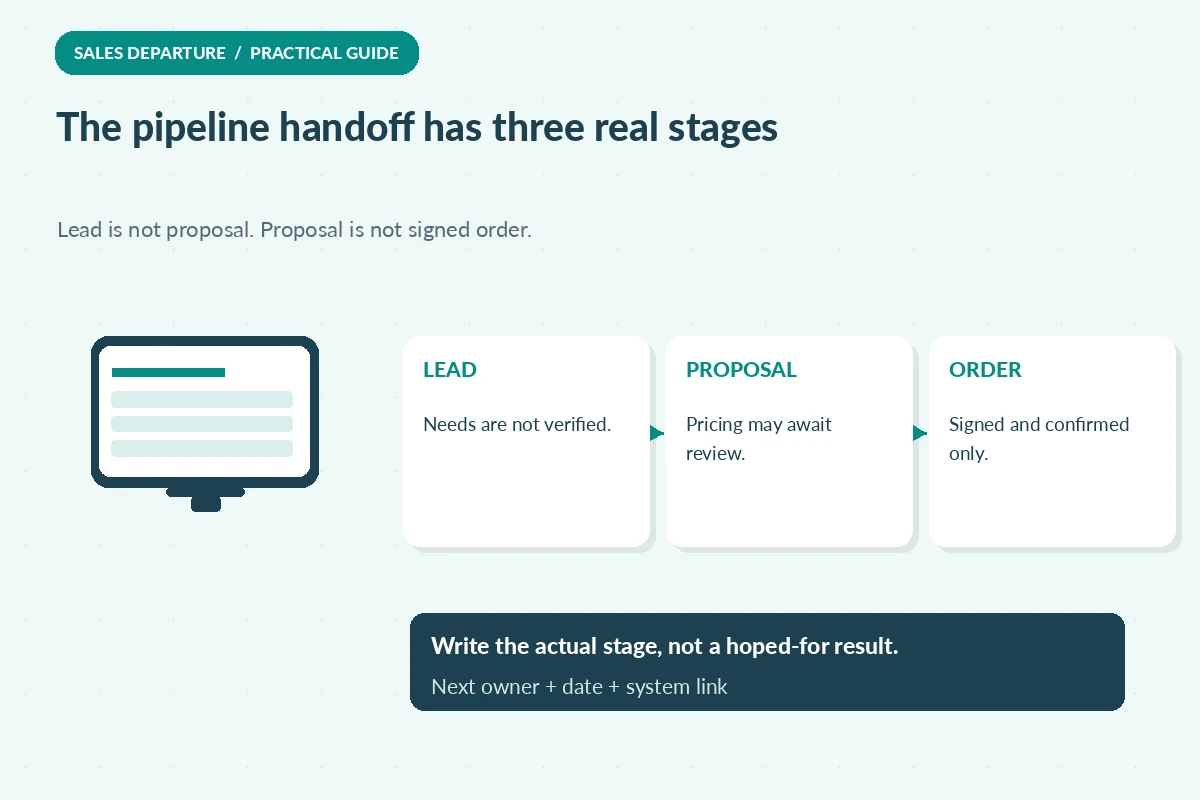
Build a handoff view inside the company’s CRM with one row for each active opportunity: account reference, current stage, last customer interaction, promised next action, deadline, relevant internal link and designated owner. An unqualified lead is not the same as a signed order; a verbal product question is not an approved discount. Label uncertainty. If you offered a callback by Friday, include the date; if pricing requires manager approval, record the pending approval instead of writing “approved.”
A useful example is “Opportunity A — proposal sent Tuesday; legal terms not approved; buyer requested an updated specification by next Wednesday; route questions to the assigned account owner.” This is hypothetical and uses no real customer identity. Avoid duplicating contact databases in a personal spreadsheet. Your successor should access records through authorized company permissions, and the manager must decide who owns the next action. A neat spreadsheet without owners does not complete a handoff.
| Pipeline item | Your record | Next owner |
|---|---|---|
| Proposal pending | Quote revision + approval stage | Assigned sales colleague |
| Customer callback | Promised date + open question | Confirmed account owner |
| Renewal approaching | Term + approved next step | Manager-designated owner |
| CRM access | No personal export | IT / account administrator |

Handle Renewals, Quotes, and Customer Messages Carefully
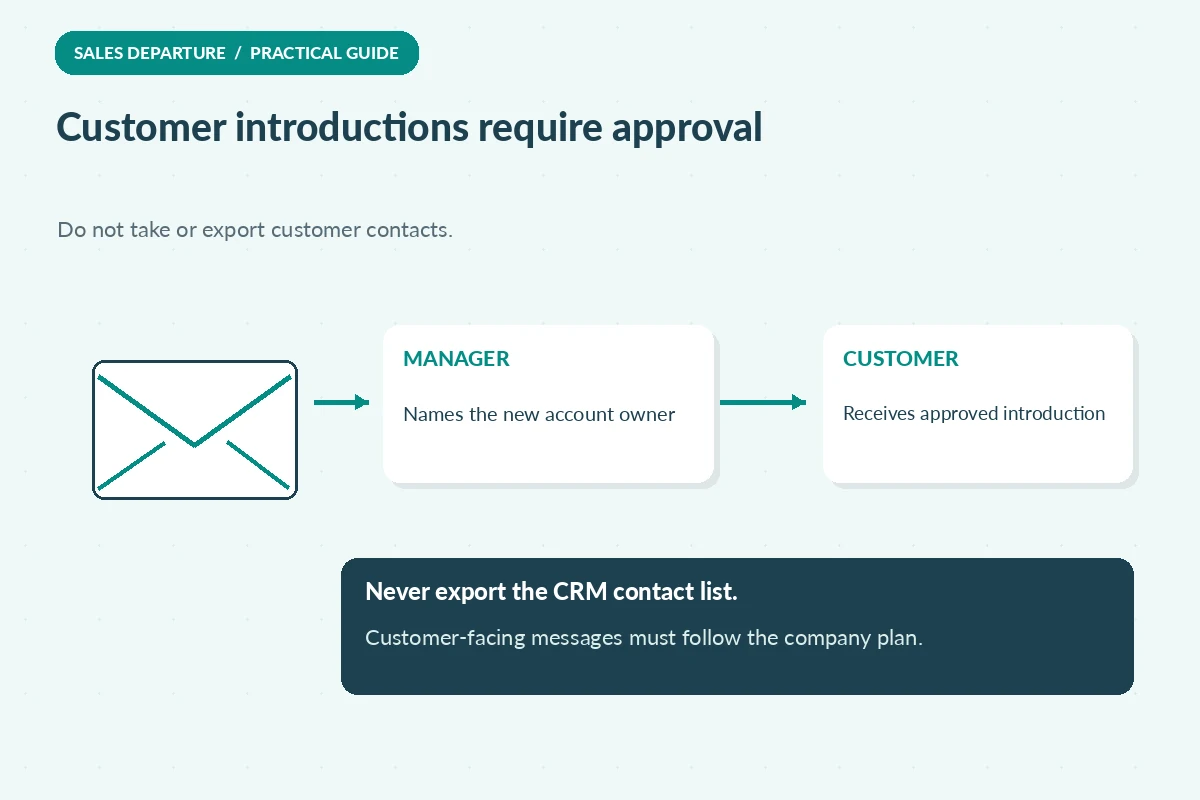
Prioritize time-sensitive customer commitments: expiring quotes, requested demos, delivery questions, open contract reviews and renewal dates. Use the existing company process to alert the manager about items that cannot realistically be finished. If you have to introduce a replacement, follow company communication guidance and wait for the authorized owner’s name and message. Do not send a goodbye blast that reveals customer addresses or suggests the clients should follow you to a new employer.
When a buyer asks why you are leaving, a neutral response is enough: “I am transitioning out of this role. [Company/team] will confirm your new contact; I have recorded your open request in our system.” Do not speculate about the employer, colleague performance or private account issues. If the CRM, contract system or shared inbox uses delegated access, report the current owner and next action, not passwords. Security settings and access removal belong to authorized administrators.
Use a Deal-Stage Decision Grid for the Final Week
Sort each open item into one of three outcomes. Finish it only when its requirements and approvals fit your remaining time. Hand it to the assigned colleague when the work will continue after departure. Escalate it when a deadline, contractual question or safety/privacy concern prevents a clean transfer. Put the decision and next owner in the company record; do not leave unexplained flags or move a record just to improve your own dashboard metrics.
A responsible sales exit does not guarantee booked revenue or renewal rates. A manager owns the territory redistribution and any client-wide announcement. If you encounter a potential compensation dispute, retain only your own permitted employment documents and seek individualized HR or qualified advice; don't export protected business records to build a personal case. Your aim is a traceable operational transfer, not a private copy of the business.
Complete a Last-Day Sales Handoff Checklist
Before your final working day, review active opportunities with the new owner and confirm that follow-up tasks, dates and approvals are clear. Mark which company equipment, demo items, keys or badges have been returned under the employer’s procedure. Verify when work account access will end; do not attempt to preserve access afterward. Reconcile personal calendar invitations for customer meetings and ask the organizer to reassign them through approved systems.
Keep the resignation note distinct from the pipeline document. The letter establishes that you gave notice; the handoff documents open work. If the manager is unavailable, follow the defined reporting chain. Confirm that your own contact and payroll details are current in HR systems without sending sensitive identity documents to an unverified email. The clean finish is one dated letter plus an assigned, accessible list of next actions.
A final quality check is to open the CRM as the intended successor would, with the appropriate permissions, and confirm that each important opportunity links to its source record. If a quote or call log is unavailable to that person, identify the access problem for IT rather than sending a private copy. Use the same test for customer meetings and renewal reminders: can the new owner see the status and next date without relying on a departing employee's account? A transfer meeting is not proof of completion until the owner accepts the action. This check also helps expose cases where a proposal was discussed but not actually approved or sent.
How We Research and Maintain This Guide
We reviewed the relevant public career and occupational guidance as of 2026-11-13: University of Houston career center U.S. Bureau of Labor Statistics Federal Trade Commission University of Missouri System HR. The sample resignation note, transition grid and example records are illustrative, not promises of a particular employer policy, license requirement, compensation outcome or legal right. Check your own contract, employer rules and jurisdiction-specific requirements. JobAsk does not claim endorsement by those sources. For relationship information see our affiliate disclosure.
Explore Related Career Guides
Usually a brief date-and-role notice is sufficient unless a specific process calls for more. Explain privately if you choose; do not criticize clients or colleagues in the letter.
No, do not assume permission. Use the approved company CRM and let authorized staff manage client data and access.
Ask your manager to select the new account owner and approve customer-facing communications; do not promise an unconfirmed replacement.
Record its exact status, approval dependency and deadline, then assign the next action through the sales process.
No general answer fits every plan and jurisdiction. Review your written plan with payroll or HR; seek individualized advice if necessary.