
A sales representative’s career goals can cover better discovery conversations, accurate account notes, timely agreed follow-up and responsible customer handoffs. These skills are useful even when a territory, product price or sales target is set by someone else. Start by separating outcomes you influence from behaviors you directly control. Meeting a revenue quota may be a business expectation, but it is not the same as an individual learning goal for asking clearer questions or confirming customer constraints. Never invent a benchmark or imply that following a script guarantees a sale.
Define the sales skill you can actually influence
The U.S. Bureau of Labor Statistics describes wholesale and manufacturing representatives identifying customers, discussing product needs and sustaining client relationships. Actual duties differ across industries: a retail associate, B2B account representative and regulated-product salesperson may have very different permissions. Read your role description and existing sales playbook. If your employer already defines a qualification framework, use it rather than replacing it with an unapproved system.
Practice discovery questions without manufacturing demand
Select one skill gap observed in call coaching: perhaps the conversation jumps to a product description before clarifying the customer’s actual requirements. An illustrative development goal is: “For assigned practice conversations this month, use the approved discovery guide to ask about use case, constraints and decision timing; review a sample of notes with my manager.” Use the employer’s approved review process for any live conversations. Do not record calls, store customer details or use outside AI tools without explicit authorization.
Good discovery notes distinguish what the customer said from your interpretation. “Customer is reviewing options next month” is different from “customer will buy next month.” Mark uncertainties and follow-up questions as open. A helpful review asks whether you heard the need accurately, whether the product may address it, and whether the next contact was agreed to. These checks develop professional judgment without asserting customer consent, purchasing authority or conversion results that have not happened.

Make follow-up a quality goal rather than a volume contest
A follow-up process should reflect the customer’s stated preference, company policy and applicable requirements. A career goal can focus on sending the accurate information promised, using approved channels and keeping the next action clear. Example: “After the next set of manager-reviewed discovery calls, prepare a short recap with the customer’s stated issue, agreed materials and next step; request coaching on any ambiguous claims.” The target is accuracy and ownership, not an arbitrary number of messages.
Avoid statements like “I will contact every prospect daily until they respond.” That may be intrusive, conflict with instructions or violate applicable outreach rules. If a customer does not want contact, follow the organization’s suppression and privacy procedures. Record only information the team is entitled to hold. A consistent, permission-aware follow-up is stronger professional evidence than a high activity count that hides poor fit.
Design a handoff that service teams can trust
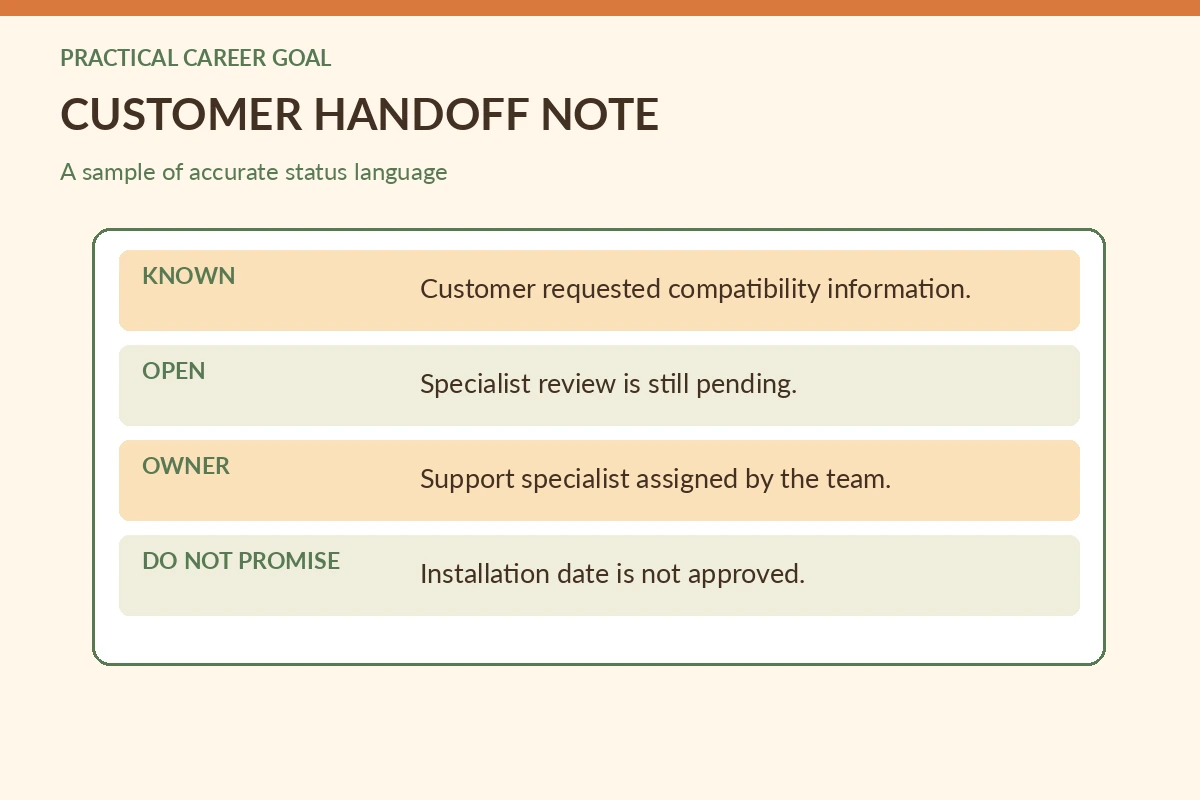
Many customer problems happen after the initial sales conversation. A development goal can make handoffs safer: summarize the product or service actually discussed, outstanding questions, permitted customer preferences, promised next steps and who owns each item. Do not promise delivery dates, special prices or technical capabilities that have not been approved. If the record involves a regulated product or complex specification, use the required specialist or compliance review.
Hypothetical handoff note: “Customer requested compatibility information; technical review pending; support specialist assigned; do not confirm installation timing yet.” It tells the next worker what is known and what remains undecided. Ask the receiving team which fields are missing from current transfers. Your progress might be documented as a better-reviewed note format, not a fabricated reduction in complaints or guaranteed retention.
Choose evidence that a manager can review fairly
For a skill-based development plan, review a small permitted sample with a supervisor using criteria the team already values: accurate customer need, complete next step, compliant claims, and timely escalation of unknowns. If live call material cannot be used for coaching, work with a fictional role-play. Label it as practice; do not pass it off as a real client interaction. Make an improvement log that records the feedback and the change you made in the next exercise.
Separate promotional aspirations from current responsibilities. “Prepare for account management” might mean learning how to maintain long-term notes under supervision; it does not mean taking over an account without authorization. If your employer has quotas, let the manager explain the official metrics and how they connect to the job. Development activities can support business outcomes but cannot by themselves prove that they caused a revenue increase.

Review progress and choose the next career path
After an agreed review cycle, compare the original coaching issue with the quality of your latest permitted sample. Have your questions become less leading? Do handoffs clearly identify unresolved items? Can you explain product limitations without inventing a commitment? The best next goal often depends on that evidence. Someone with strong discovery but weak documentation may focus on account records, while someone with precise notes may practice more complex stakeholder conversations under supervision.
Long-term directions may include specialist product knowledge, account management, customer success or team leadership, depending on employer structure. Research the actual expectations for the desired path before spending money on courses. Ask for a relevant shadowing opportunity or approved training task. Your plan should say what you can demonstrate today, what you still need to learn and who will assess the work—not promise that a promotion, commission or particular client outcome will follow.
How We Research and check these examples
This guide uses occupation or competency descriptions from the primary organizations linked below. The hypothetical goals are teaching examples, not reported employee results, prescribed quotas, legal advice or guaranteed promotion pathways. Work duties, approved tools, private records and supervisor authority differ by employer. Confirm your team’s actual procedures before using a template.
Primary sources consulted on November 9, 2026: BLS occupational profile. BLS occupational profile. U.S. OPM career development. For transparency, see the JobAsk affiliate disclosure; this article includes no paid affiliate recommendations.
Explore Related Career Guides
It can be a business performance target. Pair it with a specific skill goal and do not claim you control every external factor.
Improving the accuracy of discovery notes and confirming next steps in approved practice conversations is concrete and coachable.
No. Use actual approved baselines if available, or define a reviewable behavior and period without invented results.
Not without permission. Use fictional role-plays or sanitized approved examples and observe company privacy rules.
Meet required business expectations separately and ask which controllable skills would help you improve toward them.