
For “Tell Me About Yourself for a Career Change” during a career change, say what you do now, identify a real capability from previous work that the new role needs, describe any actual preparation you have done, and close with a specific reason for the transition. You do not have to disown your earlier career to sound committed to the new one.
A career-change introduction should answer the listener’s likely question: “How does this background help you do this job?” It is not permission to claim industry experience or qualifications you have not earned. The examples below are hypothetical illustrations and are not statements about actual candidates or employers.
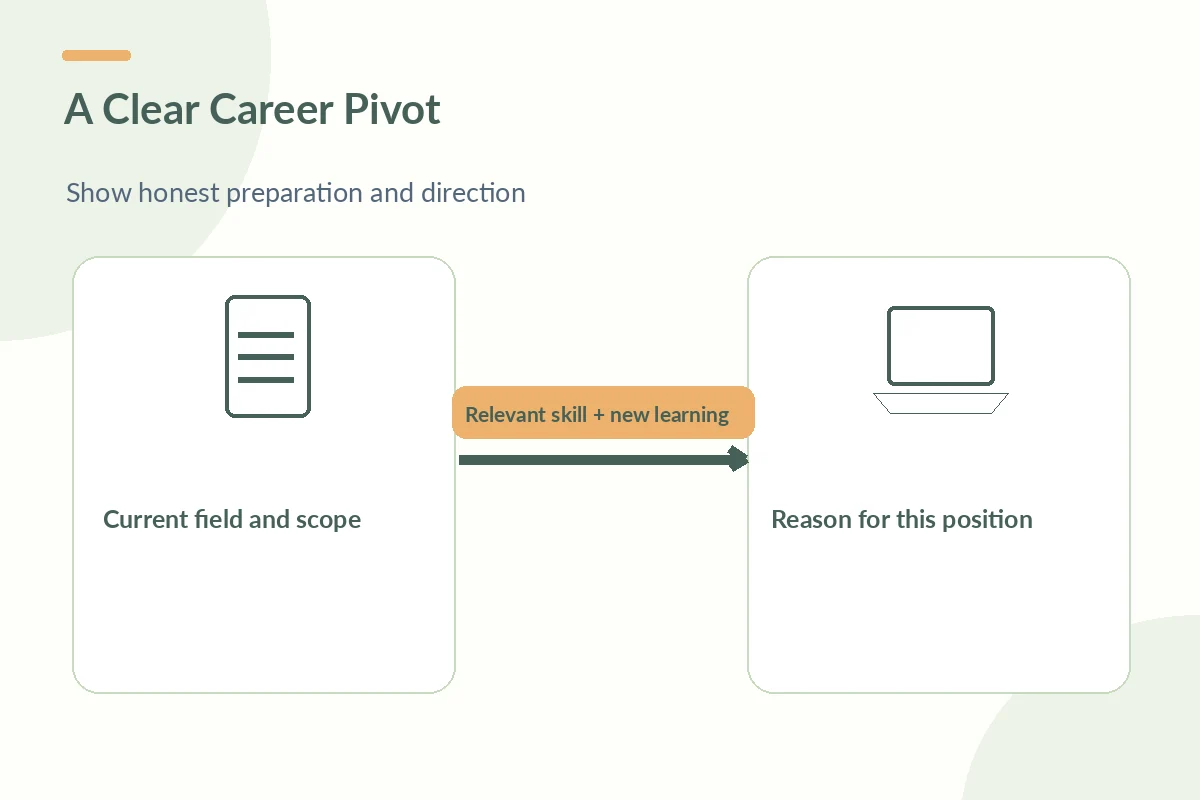
State the Direction of the Change Positively
Open with your current work and the area you want to move into, without delivering a long complaint about a supervisor or former industry. For example, the transition from retail operations to office coordination may have a genuine link through scheduling and customer communication. State the link without implying the two roles are identical; acknowledge where the new position has different responsibilities.
An interviewer may ask for more reasons later. In the opening, one honest sentence is enough: you want to focus on a kind of work that you have explored and that fits your demonstrated strengths. Do not manufacture a lifelong passion for the new field. Motivation is clearer when you can point to an actual task, course, informational conversation, or project that led to your interest.

Make a Skills Bridge Instead of a Job-Title Swap
Create three columns: what you actually did, the transferable ability, and how the target role uses that ability. Scheduling staff shifts can support an example of coordinating competing priorities. Handling customer escalations can support listening and accurate documentation. Those links are useful only if your role genuinely involved the action; different titles do not automatically make skills interchangeable.
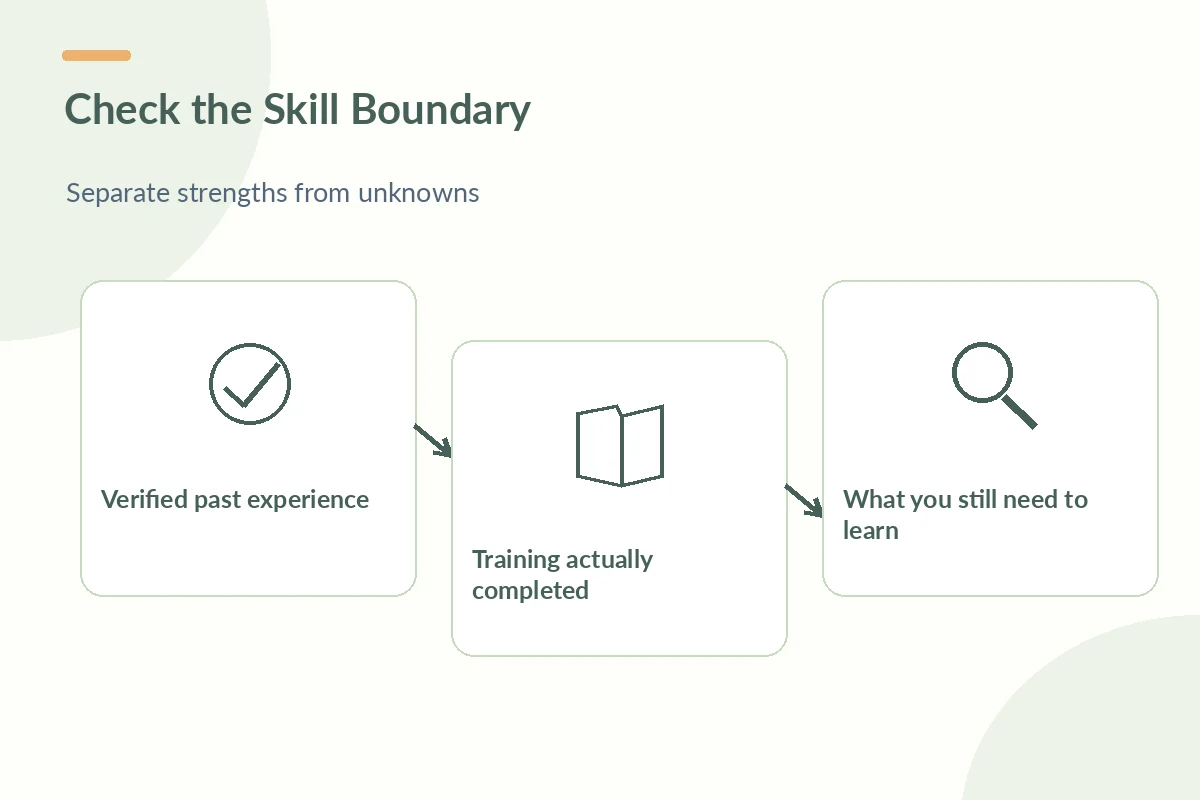
Duke Career Hub includes a specific rubric item about explaining why a person is changing fields and how the new opportunity aligns with their interests and abilities. It does not say transferable skills replace licensing or required professional training. A defensible opening separates what you already know from what you are learning.
Choose One Contribution That Survives the Industry Shift
Avoid saying “My last role was unrelated.” Instead select a task that maps to the new posting: organizing schedules, documenting requests, teaching new colleagues, testing a workflow, or preparing reports. Describe your action and evidence in terms any interviewer can understand. Explain how you checked accuracy or coordinated with others if that was an essential part of the task.
Hypothetical example: “In a store operations role I tracked incoming requests and coordinated handoffs among shifts.” A person moving into office administration could use this to demonstrate organization if it is true. The sentence does not establish expertise in specialized payroll software or other tools the candidate has never used. Keep the boundary between transferable and new skills visible.
Explain Recent Preparation With Precise Labels
If you took a course, finished a workshop, built an independent project, earned a credential, or completed a supervised placement, identify the type and status accurately. “I am studying introductory database concepts” is different from “I am a certified database analyst.” The same goes for shadowing, volunteering, or interviewing people in the occupation: those experiences can show learning without implying a professional title. For the fuller picture, see our guide “Tell Me About Yourself as an Experienced Professional”.
Use a brief description of a real task from your preparation. A project you can show or describe supplies stronger context than a string of tools you have encountered once. When the posting requires a license, certification, or degree, do not suggest that enthusiasm or unrelated experience makes the requirement optional. Confirm credentials and dates before the interview. For the fuller picture, see our guide “Tell Me About Yourself in an Internal Interview”.
Connect Your New Direction to This Particular Position
Compare your bridge with the job description. Choose one duty of the new role that matches your past evidence and another that matches your recent preparation. Your closing sentence can point to both, but avoid saying you are ready to perform every task independently unless you can support that claim. Employers may use the opening to decide which follow-up questions to ask.
Penn Career Services advises a tailored and focused account rather than an identical introduction at every interview. An honest career-change answer often includes a short explanation of what you want to learn next. That is stronger than falsely asserting you already mastered the new field or promising unrealistic immediate results.
Use a Hypothetical Career-Change Answer as a Pattern
Hypothetical answer: “I currently coordinate customer requests in retail operations, where I keep records and help teams resolve handoff problems. I have recently been studying spreadsheet reporting and completed a personal practice project to organize sample service records. I’m interested in this operations assistant position because it combines careful documentation with team coordination.” Treat all activities as invented demonstration content.
To adapt it, substitute your actual present role, one transferable example, an accurately described learning activity if applicable, and a genuine role-specific motivation. A candidate with no separate course should not add one merely for symmetry. A straightforward story with two credible pieces of evidence is preferable to a polished story that collapses under the first question.
Prepare for Follow-Up Questions About the Transition
After the introduction, an interviewer might ask which abilities are still new, how you gained interest in the occupation, or how you intend to adapt. Answer plainly, with boundaries around your experience. Prepare a work example that shows learning or adjustment; it is not necessary to present your former colleagues or workplace negatively to justify changing direction. Our guide “Tell Me About Yourself With No Experience” goes into more detail.
Practice the opening with someone unfamiliar with your industry. Ask whether they can name the old task, the transferable capability, and why you chose the target role. If any link is missing, simplify the middle sentence. Do not stretch the answer into a full chronological autobiography or use jargon from your former field without explaining it.
How We Research Interview Guidance and Examples
We compared the scenario with publicly accessible university career guidance and, where needed, occupation-specific information, reviewed on October 22, 2026: Duke Career Hub, Penn Career Services, UT Dallas Career Center, Indeed Career Guide. These resources support general interviewing practices and occupational duties, not the alleged effectiveness of a particular script or any sample person’s qualifications. All answer samples are hypothetical.
This is general U.S. career guidance, not a promise of an interview or employment. We do not recommend affiliate products here. See the affiliate disclosure.
Related Guides
- Career Change Cover Letter: Prove Transferable Skills for a New Role
- Career Change Resume Summary: Connect Transferable Skills to a New Role
- Career Change Resume: Show Transferable Skills Without Hiding Work History
- Career Change Job Search: Target Roles and Prove Transferable Skills
- Transferable Skills: Identify Real Evidence and Apply It to New Roles
Briefly give a positive, truthful reason for your new direction and focus on relevant preparation rather than criticizing the past job.
No. Describe transferable evidence separately from credentials, training, and other role-specific requirements.
Do not imply you have. Discuss actual exploration, relevant past tasks, or active learning accurately.
Yes when you explain a real transferable responsibility and connect it to the target position.
Use a clear present-role statement, one concrete example, and a specific reason for the next step rather than vague claims.