
List certifications on your resume when they relate to the role, especially if a vacancy requires or prefers them. Write the actual credential name, issuer and relevant completion, expiration or renewal information. A certificate of attendance is not automatically a professional certification, and a planned exam is not a credential already earned. This page helps decide placement and honest status wording.
CareerOneStop says important certifications or licenses may merit a separate section; less prominent ones can sit with Education. Harvard FAS Career Services republishes detailed advice on when credentials matter and how to list them. The key editorial test is relevance plus accuracy, not a long list of certificates.
Distinguish Four Kinds of Credentials
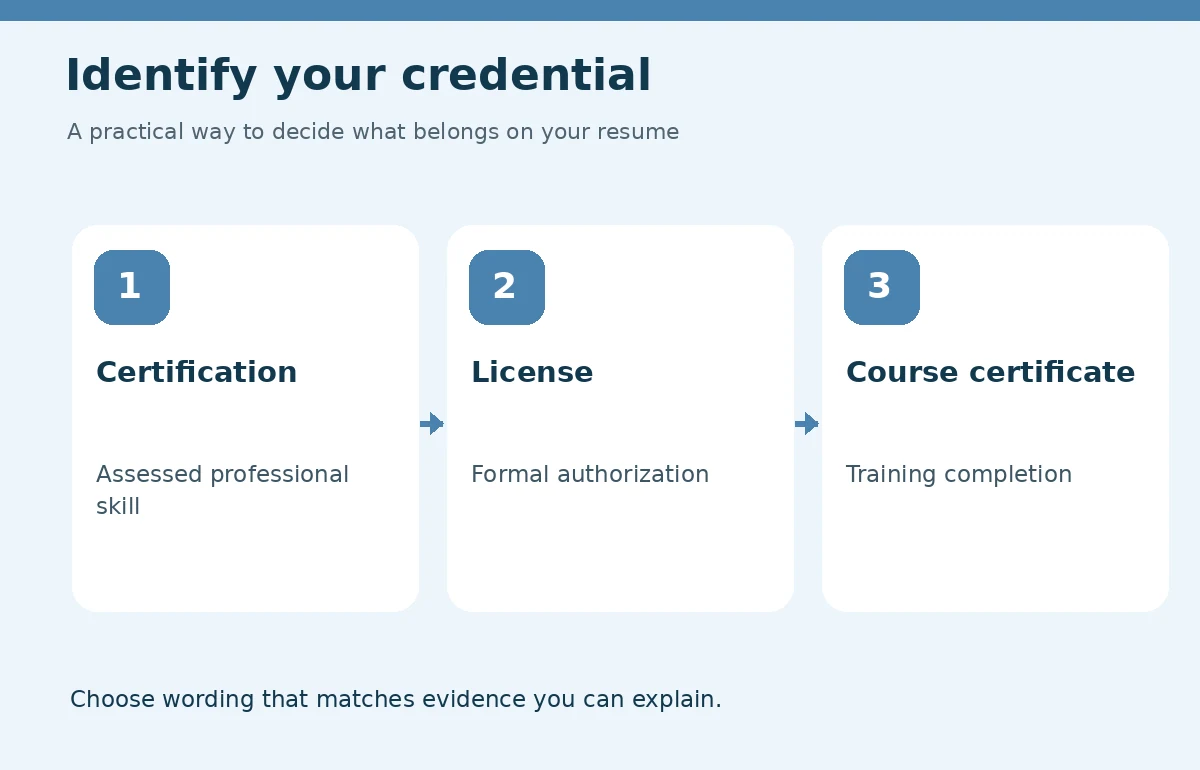
A professional certification often indicates that an issuing organization assessed a defined set of skills. A license is an authorization subject to requirements from the relevant body. A course-completion certificate confirms a training activity and may or may not include an assessment. An incomplete course or planned exam is training in progress. Do not use these labels as interchangeable proof.
Write down exactly what the issuer calls the credential and whether it remains active. When a hiring requirement says a particular license is mandatory, completing a related online class is not the same thing. Requirements vary by occupation and jurisdiction; verify the employer’s wording and the issuing body’s record rather than making a universal claim.
Choose the Right Resume Section
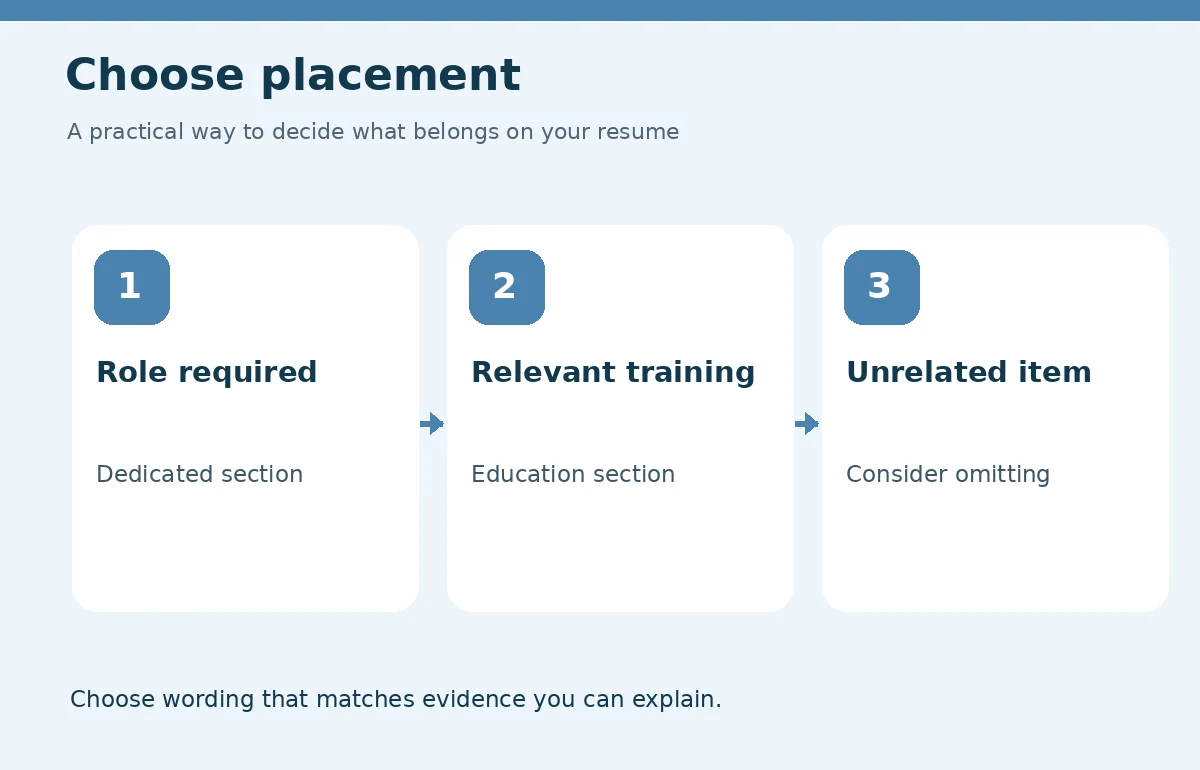
If a credential is directly required, put it where a reader can find it quickly, often in a dedicated Certifications or Licenses section. If it is modestly relevant, Education or Professional Development may be a better home. Do not push current relevant work achievements below a large list of unrelated training badges.
Use clear headings. “Certifications” should not hide courses that did not grant certifications. An “Education and Training” label can accommodate learning activities without implying formal recognition. For mixed sections, distinguish each item’s type so the reviewer can interpret it accurately.
| Situation | Recommended approach | Accuracy check |
|---|---|---|
| Current required certification | Certifications | Name + issuer + active status |
| Regulated professional license | Licenses | Confirm applicable jurisdiction |
| Short completed training | Education and Training | Call it a course or certificate |
| Planned exam | Professional Development | Do not say credential earned |
Record the Issuer and Status Clearly
A practical credential inventory has columns for the exact title, issuer, date first earned, renewal or expiration status, and reason it is relevant to the target posting. This inventory stays private; the resume should display only the items readers need to judge suitability. For example, the credential might have a short brand name that sounds identical to a general course, while the full title clearly identifies a professional exam. Use the issuer’s approved wording. If a badge was awarded for participation but does not attest assessed competence, call it a certificate of completion. When a credential has multiple levels, verify your own level rather than borrowing the language of a more advanced holder. This extra step helps prevent subtle misstatements that would be easy to overlook in a template. Our guide to interests on a resume goes deeper into when a short section helps and when to skip.
A useful entry gives the full credential name, issuing body and—when relevant—the date awarded or expiration. If the credential has an identifier, include it only if appropriate and safe; no resume needs a private login or full sensitive record. Keep the spelling consistent with the issuer’s official language.
For example, “Hypothetical Safety Certification — Example Training Board — earned June 2026” demonstrates format but is not a real credential or endorsement. Use your own legitimate details in an application. When the certification has expired, avoid displaying it as currently held; consider whether it has any relevant historical training value and label status precisely.
Handle Courses and Exams Not Yet Completed
If you are currently studying for an exam, a phrase such as “Preparing for [credential] exam” may communicate training plans in a Professional Development section, but it does not meet a requirement to hold that credential. Only say “Exam scheduled” when the test is actually booked. Avoid projecting a pass date or suggesting your candidate status is an approved certification.
Completed courses can be relevant when they give demonstrable skills. Use the actual course provider, name and completion date if the space is justified. Link the learning to a project or work example rather than using a course title as proof that you have mastered a skill you have not yet practiced. Our guide “Military Experience on a Civilian Resume” adds more detail on this.
Match Every Item to the Job Posting
Compare your credential list with the posting’s mandatory and preferred qualifications. Start with required, currently valid credentials, followed by those that substantiate the responsibilities listed. If nothing relates to the role, remove the section rather than padding the resume. A hiring manager can assess relevance more easily when each item has a recognizable name and issuer. Our guide to certifications on a resume adds more detail on this.
If the position specifies licensing in a particular state, do not assume an authorization from another state automatically qualifies you. Check the employer and appropriate issuing authority. This guide is a resume-writing resource, not a statement of licensure, reciprocity or renewal rules.
Verify the Credential Before Submission
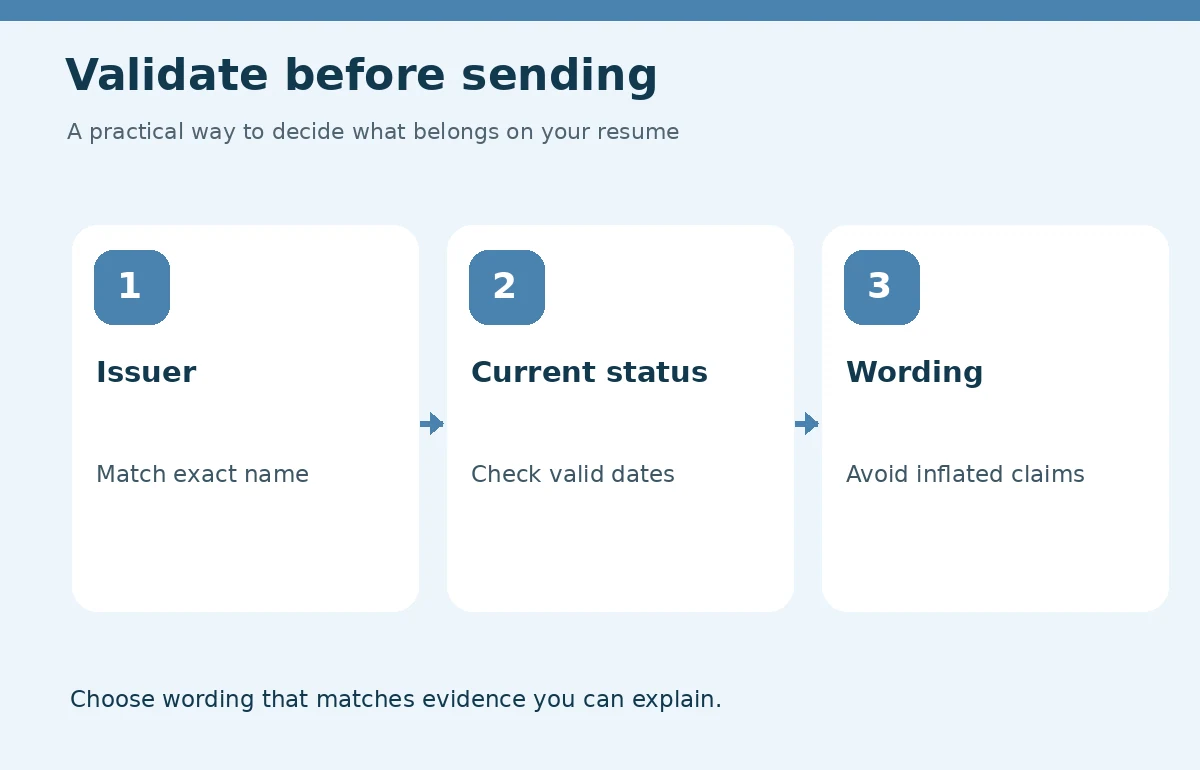
Open the original certificate or issuer portal and check spelling, dates, active status and exact organization name. Then compare the resume wording against your actual record. Do not copy somebody else’s credential name or ID; do not invent an advanced level because it sounds better. Save your evidence privately for any authorized verification request.
Finally, preview the exported resume for legibility. Some templates squeeze credential dates into narrow columns, hiding an expiration marker. A simple full-width line is safer than abbreviations that turn a training certificate into an apparently higher professional designation.
How We Research These Resume Decisions
We reviewed current public guidance from relevant U.S. career services and checked how each recommendation applies to this narrow resume-writing question. Our examples are hypothetical and describe possible wording rather than verified achievements of real applicants. Before copying any format, check your own records, the job posting and applicable institutional or issuer requirements.
Sources, Scope, and Relationship Disclosure
Sources: CareerOneStop Education; Harvard FAS Career Services. Research checked 2026-10-21. See our affiliate disclosure; this guide contains no affiliate links. The availability of internal site pages and any WordPress preview was not confirmed in this environment.
More Resume and Cover Letter Guides
- Certifications on a Resume: Show the Issuer, Status, and Relevant Dates
- Nursing Resume Format: Put Credentials and Clinical Evidence First
- Medical Assistant Resume Summary: Confirm Credentials and Patient-Care Scope
- How to Write a Resume That Shows Relevant Work Clearly
- Projects on a Resume: Describe School, Personal, and Team Work Clearly
Put essential role-specific credentials in a visible Certifications section; minor relevant training can go under Education.
Include validity details where relevant, and never imply an expired credential is active.
Not necessarily. Use the accurate name and status from the issuer and avoid implying a standardized professional credential.
You may truthfully describe preparation or a scheduled exam, but do not list it as already earned.
Verification processes vary. Make every claim accurate and be prepared to provide appropriate proof if requested.