
Quick answer. List a relevant certification using its official title, the actual issuing organization, and its truthful completion or validity status. Put required credentials where a reader can find them, but never describe an online course, planned exam, expired license, or practice badge as a current professional certification. This guide focuses on verifying credential claims; general resume structure belongs in a different article.
Identify the Credential You Actually Earned
A completed course, a certificate of attendance, a professional certification earned through an assessment, and a license authorizing regulated activity are not interchangeable. Begin with the original certificate or issuer record, not a shortened label saved in an old resume. Copy the credential title as issued and confirm whether the document represents completion, qualification, membership, or authorization. If you cannot find evidence of award, do not assume a practice class gave you professional credentials.
Test the claim by asking what an interviewer could verify. If you attended an eight-hour workshop, “Completed introductory workshop” may be accurate, whereas “Certified specialist” may not be. Never append a protected professional abbreviation to your name without holding that qualification. For licensing and regulated roles, check the issuing authority directly; this general resume guide does not interpret a state board’s rules or grant permission to practice.
Create a Credential Record Before Editing the Resume
Build a private checklist with exact credential name, issuing body, earned date, optional identifier, expiry date when relevant, and proof location. Verify details in the issuer portal or original certificate, not from a memory of a social profile. Include a license number publicly only if appropriate and needed; do not upload sensitive IDs into an unrelated job application. Career-center recommendations emphasize the issuing organization and date, which help an employer understand what was actually completed.
A fully hypothetical entry is “Sample Spreadsheet Operations Certificate — Example Training Center — completed March 2026.” Here, both the center and credential are inventions used to illustrate order and clarity, not a claim that this award exists. A real candidate would replace every element with their exact record. If the course provider differs from the body that confers the credential, name the correct issuer rather than treating the marketing platform as the awarder.

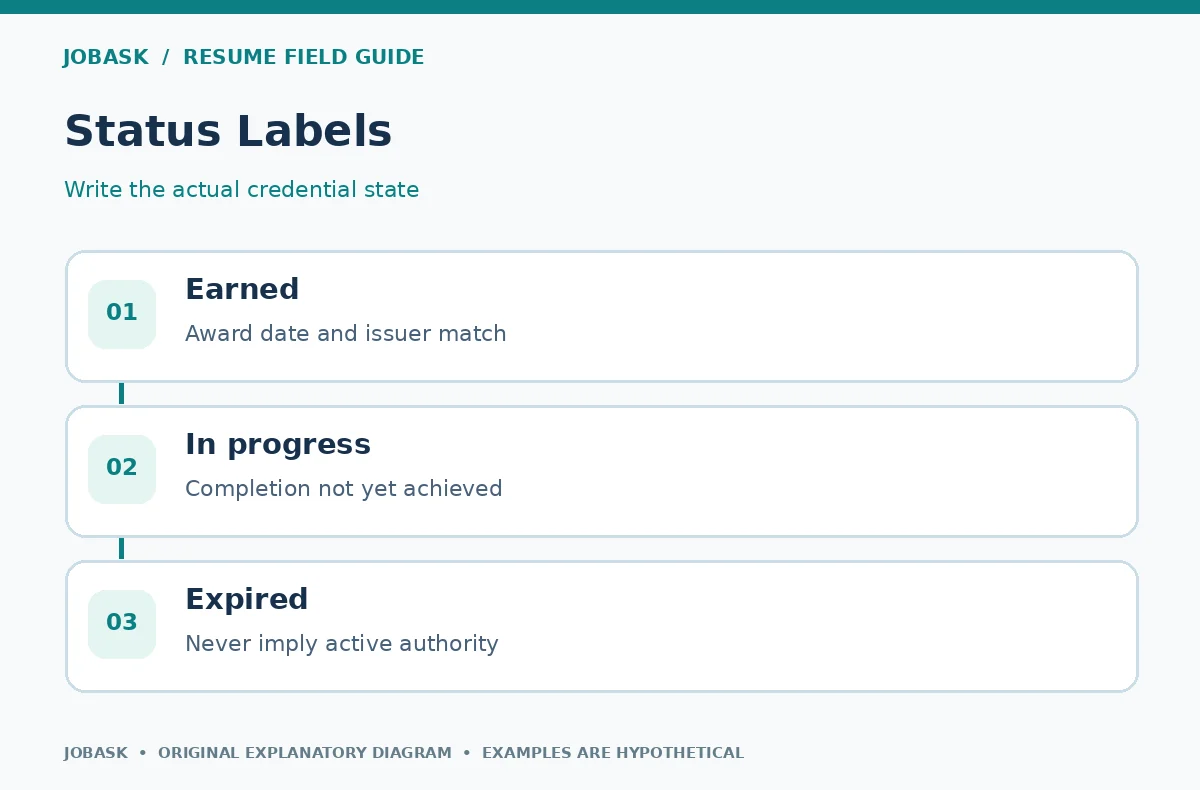
Mark In-Progress, Scheduled and Expired Status Honestly
An exam scheduled for November is not a credential earned in October. If you have enrolled and the information is relevant, describe the status explicitly: “In progress; exam planned for November 2026,” and remove the planned date if it is uncertain. If you have only considered enrolling, it normally does not belong in a certifications section. University of Florida and Harvard guidance both stress making the unfinished state clear to avoid misleading an employer.
For expired credentials, examine whether the employer wants evidence of earlier training or requires a credential that is currently valid. An old certificate may belong under prior training, labeled with the historical dates, rather than in a list of active certifications. A pending renewal is not necessarily permission to use an expired license. Do not infer renewal requirements or grace periods from this article; confirm the credential status with its specific issuing body. For the fuller picture, see our guide to certifications on a resume.
Place the Section According to the Job Requirements
When a posting clearly treats an active credential as essential, a prominent section near the top can make your actual qualification easy to identify. If it merely adds context, place it after skills, experience, or education according to the role. With a single minor course, a separate oversized section can distract from stronger evidence. The goal is readable prioritization, not repeating a credential everywhere to satisfy an imaginary applicant-tracking formula.
Compare the job description with the issuer record. Create three labels: required and held, preferred and held, and relevant learning that is not a certification. Only the first two justify a certifications entry by themselves. Relevant learning may appear in a training section instead. An employer may evaluate the same credential differently in different roles; no universal credential ranking or ATS pass rate can be claimed.
Write Evidence Without Inflating the Skill Level
A certificate can confirm that a program was completed without demonstrating independent performance in every situation. Pair a relevant credential with honest project or work evidence if you have it, but keep the claims separate. For example, a learner may hold a spreadsheet course certificate and have built a fictional inventory practice sheet; label that second item a personal exercise, not paid enterprise analytics. Do not manufacture scores, audit outcomes, patient interactions, clients, or professional responsibilities.
Before publishing an entry, read it aloud as if a recruiter asked “What did you have to do to earn this?” Prepare a factual answer about the assessment or training. If you cannot explain what the award measured, revise the claim to something narrower. A credential section should reduce ambiguity: the issuer validates the award, while the work examples demonstrate your specific behavior and should never be presented as issuer-endorsed.
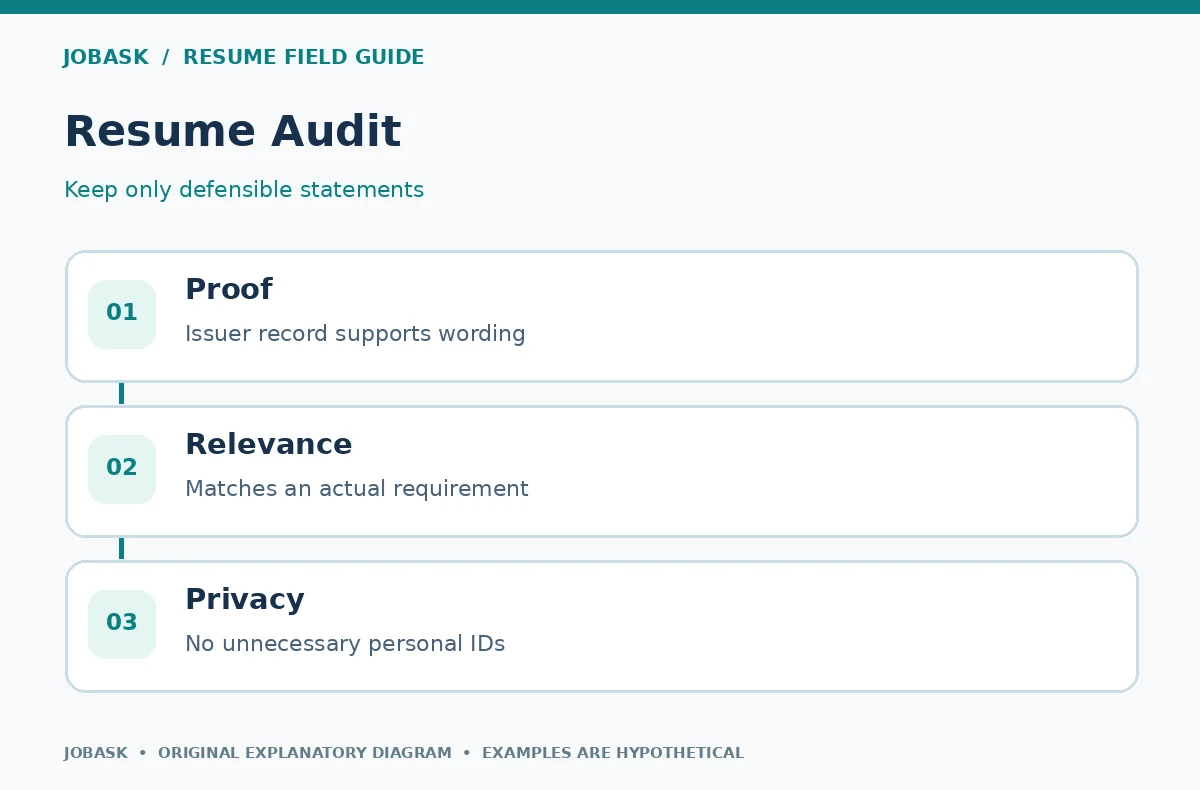
| Review question | What to confirm |
|---|---|
| Proof | Issuer record supports wording |
| Relevance | Matches an actual requirement |
| Privacy | No unnecessary personal IDs |
Perform a Final Credential Verification Audit
Check spelling against official documents, make dates consistent with your education history, and confirm that the certification is still relevant to the application. Review each acronym on first use, especially if an industry uses the same letters for multiple qualifications. Remove obsolete entries that crowd out strong experience. If a credential requires verification through a restricted portal, follow that issuer’s instructions rather than sharing a password or private certificate number in public.
Use a four-column audit: claim, proof, status, and job relevance. If proof is missing, pause or delete the statement; if status is pending, mark it pending; if relevance is weak, move the entry lower or omit it. Ask a second reader to identify whether the resume suggests an active credential when none exists. The outcome is a transparent list, not a promise of a recruiter response or automatic qualification for regulated work. Our guide to hobbies and interests on a resume covers a relevance-first decision guide.
How We Research Resume Writing Advice
We compared University of Florida credential-listing guidance against Harvard advice on position and in-progress status, then checked UC Santa Barbara for common resume-section placement. The examples use wholly imaginary training names so they cannot be mistaken for a real certification. The editorial contribution is a credential-state matrix, not a directory of approved certifying bodies. We checked the linked sources on October 20, 2026.
Sources, Evidence and Editorial Disclosure
Career-center resources consulted October 20, 2026: careerhub.ufl.edu resume guidance; careerservices.fas.harvard.edu resume guidance; career.ucsb.edu resume guidance. Credentials are presented with issuer and award-state distinctions; none of the imagined certificate names denotes a real professional authorization. This is a resume-writing exercise, not legal licensing guidance or an employer eligibility decision. No credential verification portals were accessed. See our affiliate disclosure; this guide contains no affiliate links.
More Resume and Cover Letter Guides
- Certifications on a Resume: Show the Issuer, Status, and Relevant Dates
- Resume Education Section: List Degrees, Training and Incomplete Study
- Resume Contact Section: Make It Reachable Without Oversharing
- Resume Work Experience Section: Show Roles, Dates, Duties and Scope
- Resume Accomplishments Section: Select Outcomes You Can Actually Prove
Yes, when the work is truly underway and relevant, but explicitly label it “in progress” or give a truthful anticipated date; never present it as earned.
Not always. A prominent section helps for job-critical credentials; a single minor training course may fit better under education or training.
Only when the history is relevant, its expired status is clear, and doing so would not misrepresent a requirement for a current license.
No. Describe each award by its actual issuer and assessment, rather than assuming course completion conveys industry licensure.
No. Employers assess their own requirements and the relevance and truthfulness of all application evidence.