
Hospitality Skills for a Resume belong on your resume only when they match the position and describe work you can genuinely demonstrate. This guide shows how to choose specific tasks, assign yourself accurate responsibility, and write supporting examples without fabricated outcomes. Start with the actual job description and a short inventory of authentic experience.
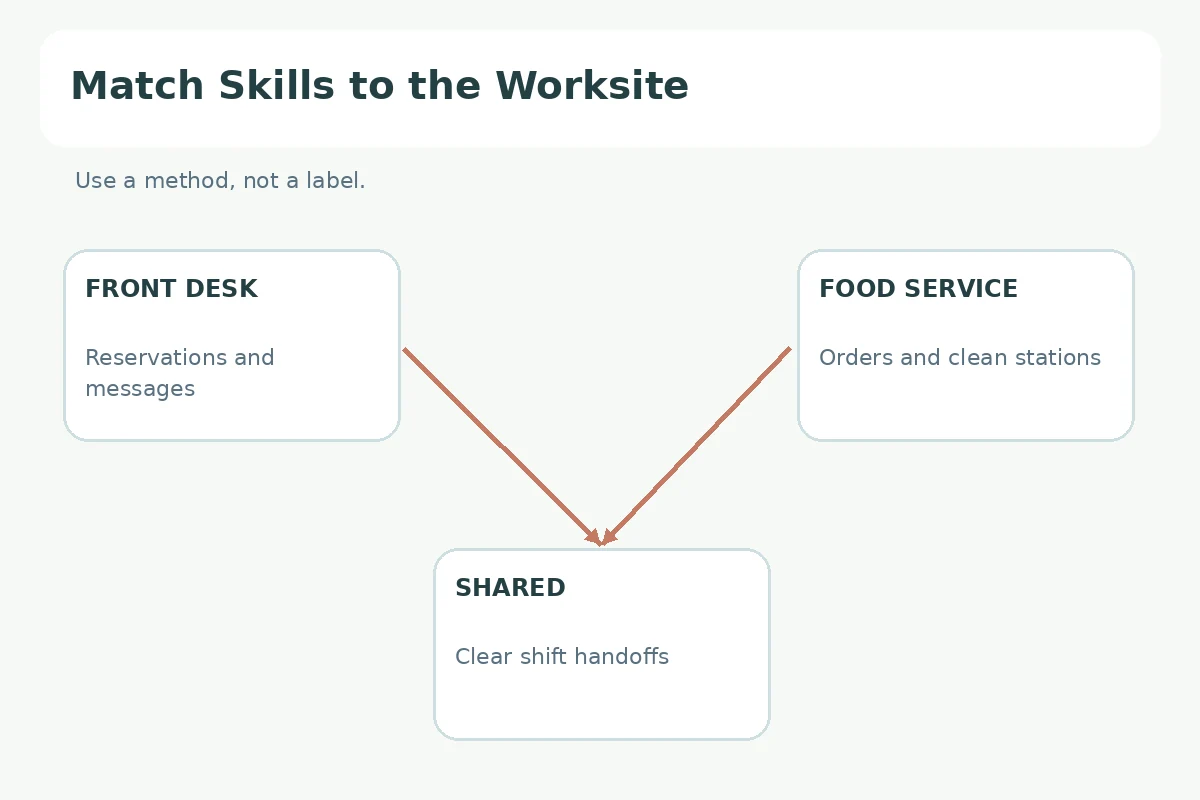
The practical route is FRONT DESK → FOOD SERVICE → SHARED. These are decision prompts, not proof that an applicant is certified, will pass an automated screening system, or will receive an interview. The examples are hypothetical unless explicitly described as official-source statements.
Start With the Hospitality Setting and Actual Job Scope
Hospitality covers different functions: lodging front desk, reservations, guest services, restaurant service, housekeeping coordination, event support, and management. A skills list borrowed from all of them can accidentally assign you work you never performed. Begin with the setting, job title, and shift duties you truly handled. Read the vacancy to determine whether it needs reservations, guest communication, payment handling, service timing, or safe food workflows.
The BLS information-clerk profile describes hotel front-desk tasks such as check-in, room assignments, reservations, and guest messages. That description is not a reason for a restaurant worker to claim room-assignment experience. Likewise, a hotel worker who directed guests to the dining area should not automatically claim food preparation or beverage-service duties. Specificity makes your experience more transferable.
Turn Guest Communication Into Observable Actions
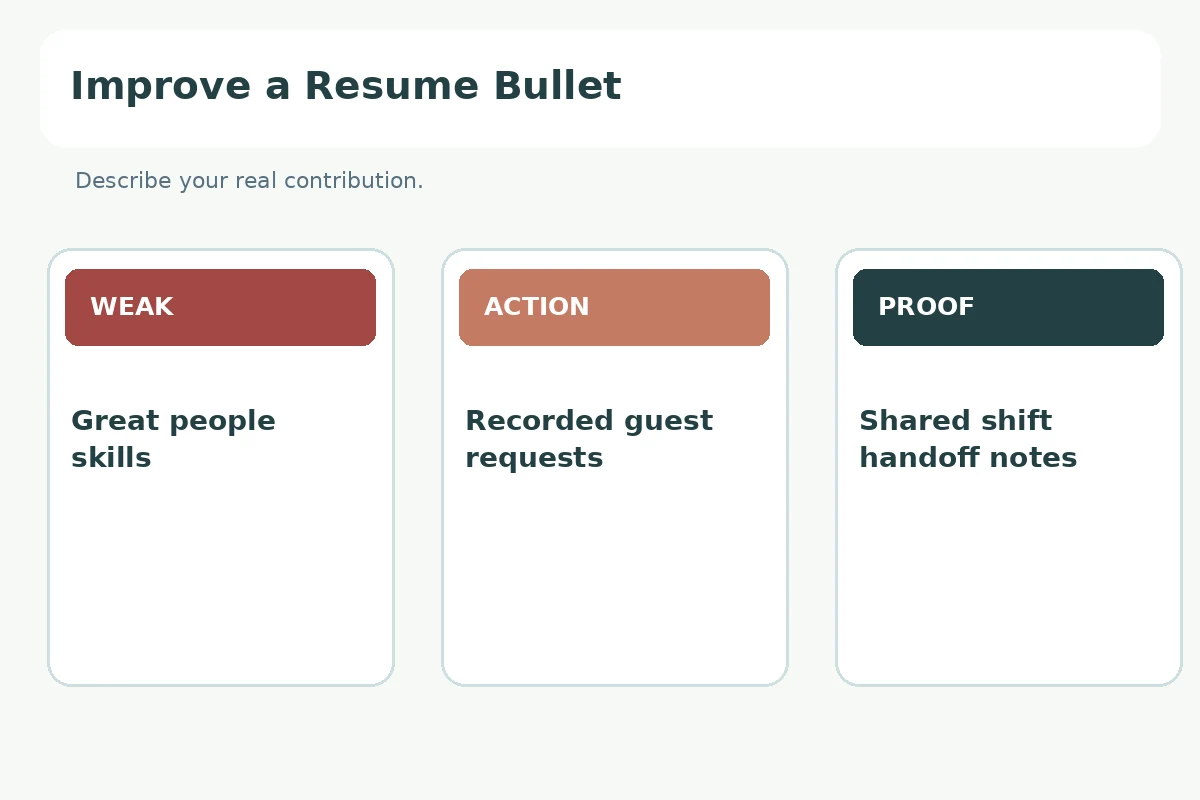
“Friendly” and “good with people” are positive qualities but not enough to tell a hiring team what you can do. Think about listening to a guest request, confirming details, documenting a preference, explaining the next step, or handing a concern to the appropriate staff member. Those observable actions can support communication skills without inventing customer-satisfaction statistics or implying that you personally resolved every complaint.
A hypothetical front-desk bullet reads: “Recorded guest requests in the shift notes and relayed unresolved items to the next desk attendant.” Use this only if it matches your experience. If a manager decided on compensation or exception to a policy, you should not say that you approved it. A responsible handoff may be more relevant to a guest-service role than a broad claim that you always made customers happy.
Separate Reservations and Payments From Guest Relations
Reservations, check-in, room assignments, receipt handling, and bill adjustments involve different system permissions. When a position lists booking software or point-of-sale experience, name only systems you actually used and the tasks for which you had authorization. You can say that you confirmed booking details without claiming to have configured the reservation platform or overridden rates.
For example, “Checked reservation dates and communicated changes to the assigned supervisor” describes a specific process without suggesting independent pricing authority. If you supported payment processing under supervision, be clear about whether you handled a register, balanced a drawer, or simply passed a receipt. Avoid inventing error rates or cash totals. The distinction matters because employers may test system knowledge or ask about confidential guest data handling.
Describe Food Service and Cleanliness With Real Procedures
Restaurant and banquet roles may involve taking orders, preparing simple items, serving food, restocking stations, clearing tables, and coordinating with kitchen staff. The BLS food-service profile outlines these types of duties. If you worked in dining service, choose concrete tasks relevant to the opening rather than general hospitality adjectives.
Food handling and workplace safety have task- and jurisdiction-specific requirements. Do not claim food safety certification or authority to supervise regulated procedures unless confirmed. A truthful bullet may mention following an employer’s sanitation checklist or alerting a manager to an issue, if that occurred. Do not imply you created official safety rules merely because you cleaned a station. Where procedures involved customer allergies, describe information transfer and escalation without making unverified medical or safety promises.

Use Shift Handoffs to Prove Organization
Many hospitality teams rotate across early, late, and weekend shifts. Good handoffs may require documenting unfinished requests, inventory needs, guest messages, pending reservations, and the person responsible for follow-up. The resume value is not that you were “organized”; it is the specific continuity of information you supported. You can describe creating or following a handoff checklist if it was part of your work.
An illustrative bullet is “Updated the end-of-shift log with open guest requests and next-shift contacts.” It makes no claim that the hotel had zero mistakes or that you managed the entire property. If a manager signed off, keep that approval with the manager. You might also mention coordinating a dining station reset or restocking handoff, but do not substitute one type of task for another without firsthand experience.
Show Transferable Hospitality Experience Honestly
School events, volunteering, food service, retail, and reception can all provide transferable examples, but you must label the original setting. Helping direct guests at a school event is not identical to hotel property management. The skill may still be relevant: greeting arrivals, maintaining a check-in list, answering routine questions, or explaining where to go. A good bullet identifies the original event and the portion you handled.
If you are moving from restaurant counter service to a front-desk role, emphasize accurate communication, calm handling of queues, transactions within your responsibility, and documented follow-up. Do not list reservation systems you have never opened. The CareerOneStop guidance favors relevant, concrete skills; this is especially useful when an applicant must translate a past service setting into a different one.
Check Your Hospitality Resume for Role Inflation
Complete a final role audit. Underline every verb implying authority—approved, managed, trained, supervised, resolved—and ask whether you held that responsibility. Replace unsupported assertions with assisted, recorded, relayed, or coordinated where accurate. If a specific license or certification is necessary, name it only when you actually have it. Never include confidential customer records, payment details, or identifiable guest information as proof.
Put the most relevant genuine tasks near the top of the experience section. A concise skills list can mention reservation records, front-desk support, POS transaction handling, shift logs, or service coordination where demonstrated. The goal is a credible picture of guest service and operational reliability, not an attempt to look qualified for every hotel and food-service job at once.
How We Research Skills and Their Limits
For this guide, we compared resume-writing standards and relevant professional task descriptions: professional source 1, professional source 2, professional source 3, professional source 4. Source descriptions support specific features or professional duties, not the success of hypothetical resume wording. No employer has confirmed a hiring outcome or a particular ATS result for any example here. Check the current job posting, local requirements, and documentation before applying.
Examples marked hypothetical are teaching examples, not accounts of real hires. There are no confirmed affiliate relationships for any named products or organizations in this article. See the affiliate disclosure and replace every illustrative detail with facts from your own experience. Local structural checks are separate from independent human editing.
Related Guides
- Research Skills on a Resume: Show Methods, Sources, and Your Contribution
- Childcare Skills for a Resume: Supervision, Routines, and Verified Training
- Microsoft Office Skills on a Resume: Name the Apps and Prove Your Work
- Project Management Skills on a Resume: Show Scope, Milestones, and Risks
- Entry-Level Hospitality Jobs: Compare Front Desk and Guest Service Work
Yes when relevant, but back it with a guest interaction or handoff task you actually performed.
Yes. Highlight transferable tasks while keeping the original restaurant setting accurate.
Name a system only if it is relevant and you can truthfully explain how you used it.
Only describe the part you actually handled. Do not claim policy exceptions or refunds authorized by another person.
Only if genuine, documented, and fairly attributable to your role; otherwise use observable work instead.