
Research Skills on a Resume belong on your resume only when they match the position and describe work you can genuinely demonstrate. This guide shows how to choose specific tasks, assign yourself accurate responsibility, and write supporting examples without fabricated outcomes. Start with the actual job description and a short inventory of authentic experience.
The practical route is Search → Collect → Analyze. These are decision prompts, not proof that an applicant is certified, will pass an automated screening system, or will receive an interview. The examples are hypothetical unless explicitly described as official-source statements.
Use Research Skills That Match the Kind of Role
Research can mean finding reliable policy documents, comparing scientific literature, organizing survey responses, conducting customer interviews, or examining business records. Those activities require different judgment and may have different privacy rules. Do not write “research expert” as a substitute for explaining how you obtained evidence and what decision the work supported. Read the posting first: an academic research assistant and a consumer-insights coordinator may both use research skills but apply different methods.
Make a role-specific inventory with four fields: question investigated, source or method used, your contribution, and the deliverable. If the posting calls for literature review, highlight searching and evaluating published work; if it calls for user research, include interviews only when you actually conducted them. A college literature review should be called coursework or a student project, not a paid analyst assignment. These distinctions create a more trustworthy application.
Distinguish Source Evaluation From Simple Searching
Searching the web is only a starting point. Credible research involves deciding which sources are relevant, checking their dates and origin, comparing definitions, and noting what a source does not establish. A job-relevant bullet could describe building a comparison table of regulatory publications or reconciling definitions across reports. Avoid suggesting you independently certified the truth of an entire industry because you reviewed several pages.
Texas A&M’s resume guidance says research and projects can be included as experience with clear context. A hypothetical example is “Compared public agency reports for a course paper and documented differences in measurement definitions.” That statement makes no unverified causal claim. Replace course and outcome details with your own. If you only summarized source material, describe a summary rather than claiming original field research.

Name Data Collection Methods Without Inflating Scope
Research methods may include surveys, structured observations, desk research, interviews, transcription, coding, spreadsheet cleaning, or instrument calibration. Include a method only if you can describe what you did and what instructions or approvals governed it. Preparing interview notes under supervision is not the same as designing an approved study. Similarly, entering data is not necessarily statistical modeling or hypothesis testing.
A defensible bullet specifies the input and your action: “Organized anonymized survey responses into a codebook for a supervised class assignment” is an example of precise scope, if true. Do not add invented respondent counts or claim that participants consented through a procedure you did not control. When confidential material was involved, discuss the workflow without including identifiable records or exposing research subjects.
Show Quality Checks and Limits of the Findings
Strong researchers verify what data can and cannot show. Depending on the task, that may mean logging missing values, comparing dates, checking repeated entries, resolving ambiguous categories, or recording limitations in a summary. You can describe these controls without inventing a percentage reduction in errors. A check does not prove the result was perfect; it documents a thoughtful method.
For example, a hypothetical student project might read: “Reviewed dataset field definitions, flagged ambiguous values, and recorded exclusions before preparing a summary table.” This does not claim any particular statistical conclusion. Be clear whether you performed the check, recommended it, or only reviewed someone else’s analysis. If the source data belong to an employer or lab, do not publish restricted files as portfolio evidence without authorization.

Present Team Research With Correct Ownership
Research projects often involve investigators, assistants, collaborators, or classmates. A candidate who recruited participants should not claim to have designed the experiment or authored the conclusions unless those responsibilities were genuine. Describe your specific work first and use team context second. For example, “Assisted with transcription and thematic coding under a supervisor’s protocol” can demonstrate care without implying principal-investigator responsibility.
UC San Diego’s resume guide recommends emphasizing what you contributed, not merely listing assigned duties. For a group project, you might name the shared deliverable while identifying your section: a search strategy, an annotated bibliography, a chart review, or an interview guide. If your work was preliminary and not published, do not suggest that a journal accepted it or that the findings were implemented.
Put Methods and Outputs in the Right Resume Sections
When research is the core of the role, a Research Experience or Projects section may carry dates, institutions, research questions, and two or three evidence bullets. Technical methods or tools can be grouped in a Skills line, but vague qualities such as “curious” or “detail-oriented” need supporting examples. UC Davis explicitly lists research techniques and relevant projects as useful resume material when presented accurately.
A project entry can say that it was a class assignment, independent analysis, or supervised laboratory activity. Do not rename a course project as consulting experience. Match terms in the advertisement only where your actual method supports them. You may list an analysis tool separately, but avoid treating tool familiarity as proof that you made a sound scientific finding.
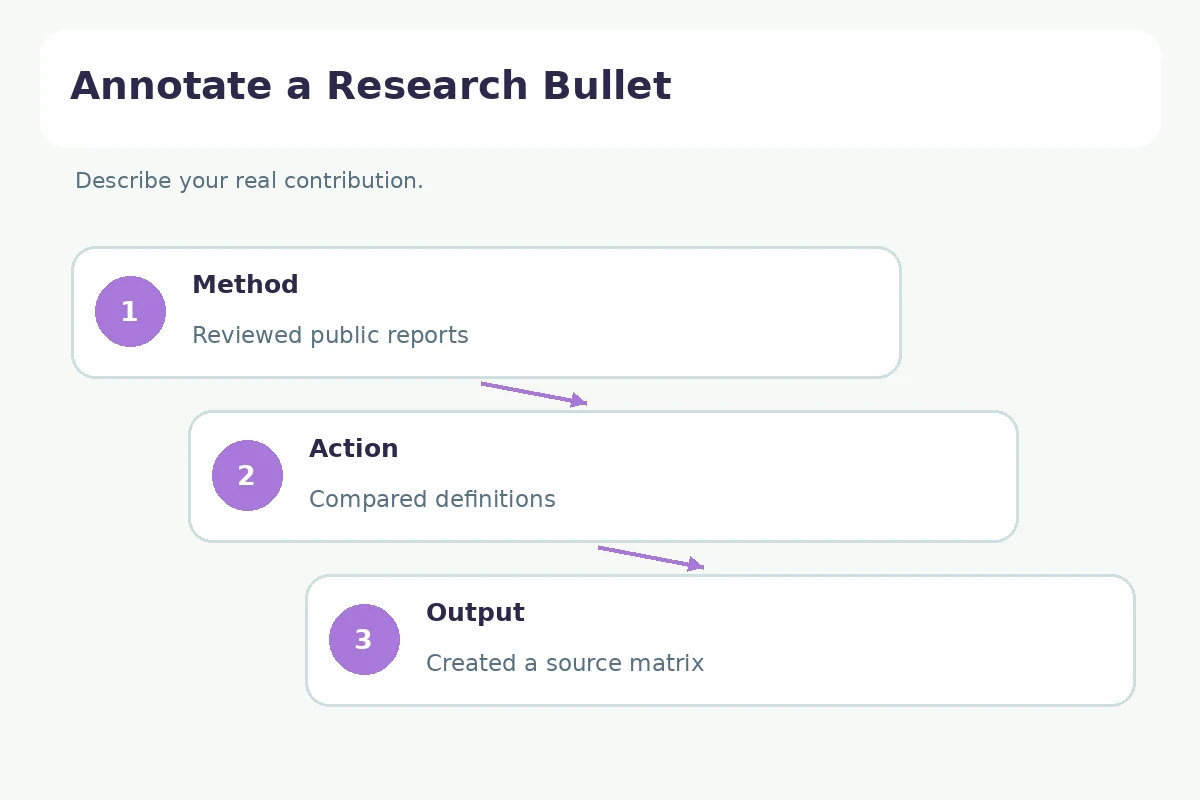
Use a Three-Step Research Evidence Audit
Read each research bullet as if a reviewer could ask for the underlying method. Can you name the source category? Can you explain the action? Can you point to a permitted deliverable or a nonconfidential description? If not, revise the line until the scope is clear. Remove statistics that come only from memory or attribution that belongs to a team rather than you.
Finally, examine the interpretation. “Identified themes in interview notes” does not establish that a policy improved or that customers changed their behavior. State a decision or recommendation only when your work actually produced it, with limitations where necessary. Save examples you are allowed to share. This approach builds an honest record of research competence, not a promise of being hired or passing automated screening.
How We Research Skills and Their Limits
For this guide, we compared resume-writing standards and relevant professional task descriptions: professional source 1, professional source 2, professional source 3, professional source 4. Source descriptions support specific features or professional duties, not the success of hypothetical resume wording. No employer has confirmed a hiring outcome or a particular ATS result for any example here. Check the current job posting, local requirements, and documentation before applying.
Examples marked hypothetical are teaching examples, not accounts of real hires. There are no confirmed affiliate relationships for any named products or organizations in this article. See the affiliate disclosure and replace every illustrative detail with facts from your own experience. Local structural checks are separate from independent human editing.
More Resume and Cover Letter Guides
- Childcare Skills for a Resume: Supervision, Routines, and Verified Training
- Research Experience on a Resume: Explain Methods, Records, and Your Contribution
- Hospitality Skills for a Resume: Guest Service, Handoffs, and Accuracy
- Microsoft Office Skills on a Resume: Name the Apps and Prove Your Work
- Project Management Skills on a Resume: Show Scope, Milestones, and Risks
Yes. Label the project as coursework and describe your own research methods and outputs.
Only describe the actual process; evaluating sources and explaining how evidence was used is stronger than a broad claim.
You may describe genuine work accurately, but do not call it published or peer-reviewed unless it is.
Only if you are authorized to disclose the data and it does not expose confidential or identifiable information.
State your own contribution and the team context separately, without claiming supervisory or authorial responsibilities you did not have.