
Look for support roles, not unsupervised investigator work
Someone with no clinical research employment may be able to enter through administrative or data-support positions, but not every role in a trial is beginner-level. Search for clinical trial assistant, study assistant, research program assistant and assistant coordinator, then inspect the actual tasks. Stanford’s assistant clinical research coordinator description illustrates a supervised role involving participant scheduling, documents and data checks, while also describing procedures that require appropriate training or certification. Do not assume a title containing ‘assistant’ guarantees no prerequisite education. The useful decision is which parts of a study you can support reliably today and which require formal preparation or delegated authority.
Understand the roles behind a clinical trial
A principal investigator has responsibilities for conducting an approved study and protecting participants. Coordinators may handle essential study processes under organizational procedures, while data or administrative staff may organize forms, appointments and records. These positions are connected but not interchangeable. HHS Office for Human Research Protections explains responsibilities concerning informed consent and institutional review board approval. A new employee should not claim they can approve a protocol change, decide a participant is eligible or conduct clinical care merely because they are comfortable using spreadsheets. Ask who supervises your work and what training is required before contact with participants.
Search for duties instead of impressive titles
Search both the profession name and concrete tasks: study scheduling, research data entry, questionnaire administration, regulatory document support or recruitment administration. Compare the required degree, prior research hours, software experience and patient-facing duties. A posting requiring independent phlebotomy, electrocardiograms or clinical assessments is not the same as one limited to appointment reminders and clerical records. Some assistant roles combine both and state that clinical tasks require training or certification. Read every bullet and create a two-column list: ‘evidence I can show’ and ‘requirements I need to verify.’ Avoid applying to specialized posts by treating missing credentials as optional.
Show basic data quality with a real example
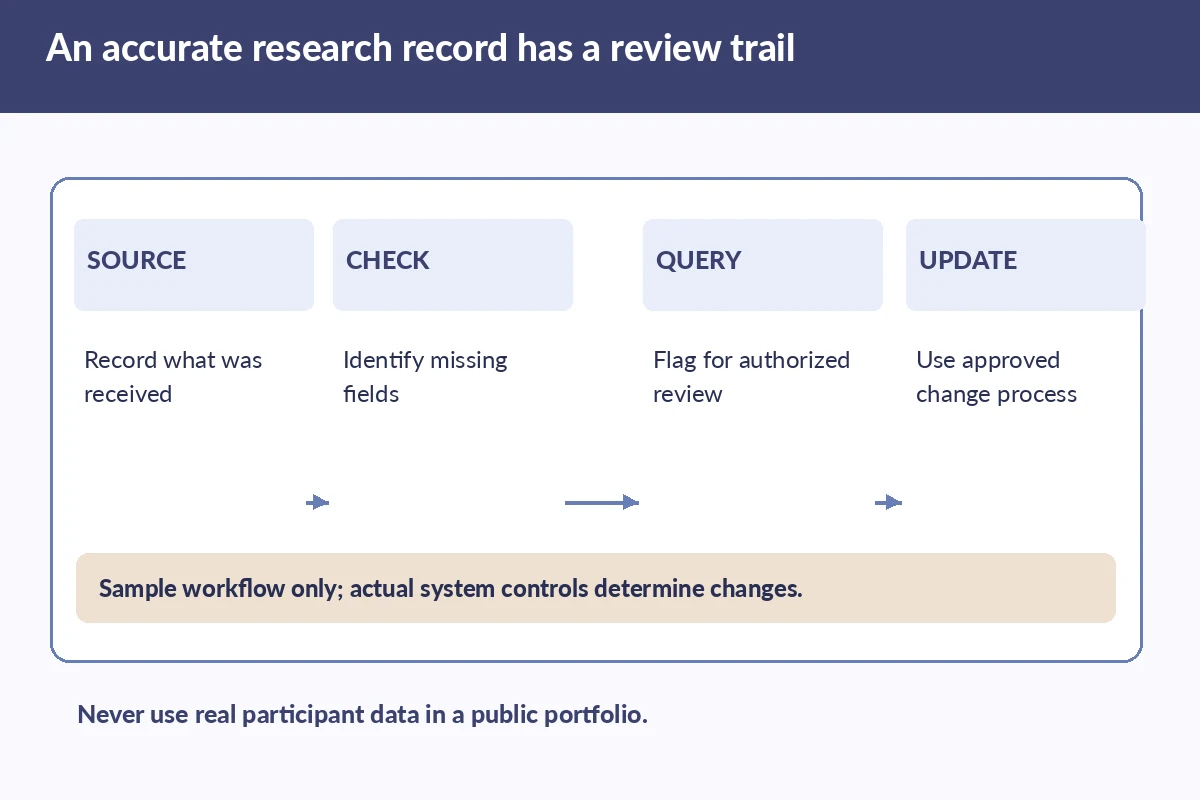
Research teams value accuracy and version control. A course project may provide valid evidence if you can explain how you organized a dataset, checked missing entries, documented changes and identified limitations. A clinic volunteer may describe nonconfidential administrative responsibilities without disclosing patient information. A hypothetical portfolio exercise can use fabricated survey responses labeled as synthetic data. Never submit actual participant records, copied consent forms or screenshots from a restricted study. Present clear steps instead of exaggerated results: ‘Compared entries with the source sheet and recorded unresolved differences for review’ is more trustworthy than saying you independently validated an entire clinical trial.

Recognize the line around participant contact
Some positions call participants to confirm schedules, distribute questionnaires or provide approved administrative information. Others include screening interviews, informed-consent procedures and clinical measurements. Your employer must establish who can do what under the study’s protocol, training and supervision. If someone asks a medical question, do not offer treatment advice outside your role. If eligibility or consent is unclear, take the issue to the authorized research lead. HHS guidance makes the investigator’s oversight central to participant protection. An applicant should be comfortable admitting a knowledge gap and learning the escalation process rather than improvising an answer.
Check the documentation workflow before the start date
Ask how study logs are maintained, what versions of protocols and forms are controlled, who reviews corrections and what data systems new staff may access. Clinical research requires accurate documentation, but you should not infer that you may edit or approve every record. Confirm whether the job includes protected health information and what privacy training is provided. Ask whether records are entered into a validated system and who handles discrepancies. Your goal is to understand how to maintain traceable, authorized work. Informal personal spreadsheets or email attachments may be inappropriate for sensitive information unless expressly approved by the organization.
| Role or task | Realistic entry evidence | Boundary to verify |
|---|---|---|
| Study administration | Scheduling, forms, logs | Use approved processes and oversight |
| Research data support | Source checks, discrepancy notes | Respect access and version controls |
| Consent or clinical tasks | Protocol-specific responsibility | Require authorization and training |
Write a focused first research resume
Lead with relevant facts: statistics coursework, structured data projects, careful recordkeeping, regulated-environment experience or customer scheduling. Use action statements that identify the dataset or process and what you personally checked. For example, an illustrative student project could say, ‘Reviewed synthetic survey data for missing responses and logged corrections for instructor review.’ Make the project status explicit. Do not present simulated case report forms as records of real study participants. If you have no experience with a particular electronic data capture system, write that you are prepared to learn it instead of listing it as a skill. Accurate modest evidence is better than a clinical credential you do not possess.
Read an assistant coordinator description carefully
A single employer posting can show why reading tasks matters. Stanford describes supervised scheduling and study data support in an assistant coordinator role, but also mentions consent assistance and some patient tests after suitable training or certification. That does not mean every new hire performs each task immediately or that a degree requirement can be ignored. Highlight the tasks you meet, ask which ones are trained in-house and identify qualifications that must already be held. A listing from another institution may define the role differently. Current vacancy requirements, the protocol and organizational rules are more reliable than a generic career-list article.
Prepare interview answers about accuracy and escalation
You might be asked what you would do after finding a mismatch between a questionnaire and the source record. A credible answer is to preserve the original information, document the discrepancy using the authorized procedure and request review rather than altering the data silently. For a participant asking whether to join, you should refer to the approved consent process and appropriate qualified staff rather than persuading them. Use a real or clearly hypothetical example that shows careful listening, traceability and respecting participant choice. Do not claim experience monitoring adverse events or approving deviations unless those were genuinely part of your authorized duties.
Avoid posts that promise shortcuts around ethics
Be cautious if a purported employer says you may recruit participants and use private medical information without formal training, or promises ‘instant investigator certification’ for a fee. Ask for the study’s sponsoring institution, supervisor, work location and official application link. An unfamiliar remote-data posting should still have verifiable organizational identity and controlled access procedures. The FTC cautions against fake recruiters demanding payments or early sensitive personal data. A legitimate new-to-research employee will need onboarding and defined responsibilities. You can decline a position that cannot explain who protects participants or reviews your work.
Plan a learning route without inventing qualifications
If you lack research methods background, begin with basic ethics and data management coursework from trustworthy providers, and practice with nonconfidential or synthetic datasets. Look for volunteer or trainee opportunities only when their conditions and supervision are clear; unpaid work is not automatically required. Keep records of genuine courses and projects, including what you actually completed. Ask schools, hospitals and universities how they classify their study-support openings. A research position may require a degree or relevant experience even at the assistant level. Check that before investing in a course advertised as a guaranteed job ticket.

Make a targeted application decision
For each vacancy, identify the core duty, minimum qualification, permitted data access, participant contact level and reporting supervisor. Apply when your experience meets the essentials and a clear training path covers the rest. Prepare a brief example of accurate data handling and one question about protocol training. Keep a record of the official requisition number and correspondence. If an opening demands independent clinical procedures you cannot perform, select a narrower administrative role. Your immediate goal is a supervised, ethical entry point with specific work—not an inflated title or a guarantee of becoming a coordinator after a fixed number of months.
How We Research and Verify These Entry Routes
We reviewed authoritative occupation, employer, and safety guidance on November 16, 2026. A Stanford assistant clinical research coordinator posting provides a real example of supervised administrative and study-data duties. HHS OHRP describes investigator responsibility for informed consent, IRB approval, and oversight of research with human subjects. O*NET details coordinator responsibilities and the separation of clinical research administration from investigator oversight. The FTC explains warning signs of fraudulent employment offers and requests for upfront money. The comparisons and sample statements are educational, not real offers or an assurance of hiring. We checked the supplied JobAsk WordPress title export (published and draft entries) and previous local batches for overlapping search intent; specific requirements change by employer and location. Read our affiliate disclosure.
Related Job Search Guides
Some study-administration and data-support roles do not involve nursing practice. Read the required education and duties for each institution.
Not necessarily. Employers use titles differently; the task list, supervision and education requirements determine the actual scope.
Do not assume that authority. Consent activities must follow the approved protocol and organizational delegation and training rules.
Yes, if it is a real course or practice project and clearly labeled. Use synthetic or appropriately shareable data, not private participant records.
Some jobs require specific systems and others teach them. State honestly what you have used and confirm which systems the employer trains new staff on.