
To find remote insurance claims assistant jobs, start with the work rather than the word ‘remote.’ A legitimate listing should describe how the role handles its core tasks, who checks the result, where employees may work, and what equipment and training are available. For claims assistant candidates, the immediate distinction is between ‘intake support’, ‘file follow-up’, and ‘adjuster review’. Those are not always the same person’s decisions. This guide helps you compare live job descriptions, build truthful application evidence and ask a targeted question before accepting a position. The examples in this article are educational hypotheticals, not verified vacancies or promises that an employer will hire you. Verify each opening on the employer’s official careers site and follow actual workplace policies rather than an internet checklist alone.
Start with the actual job behind the remote label
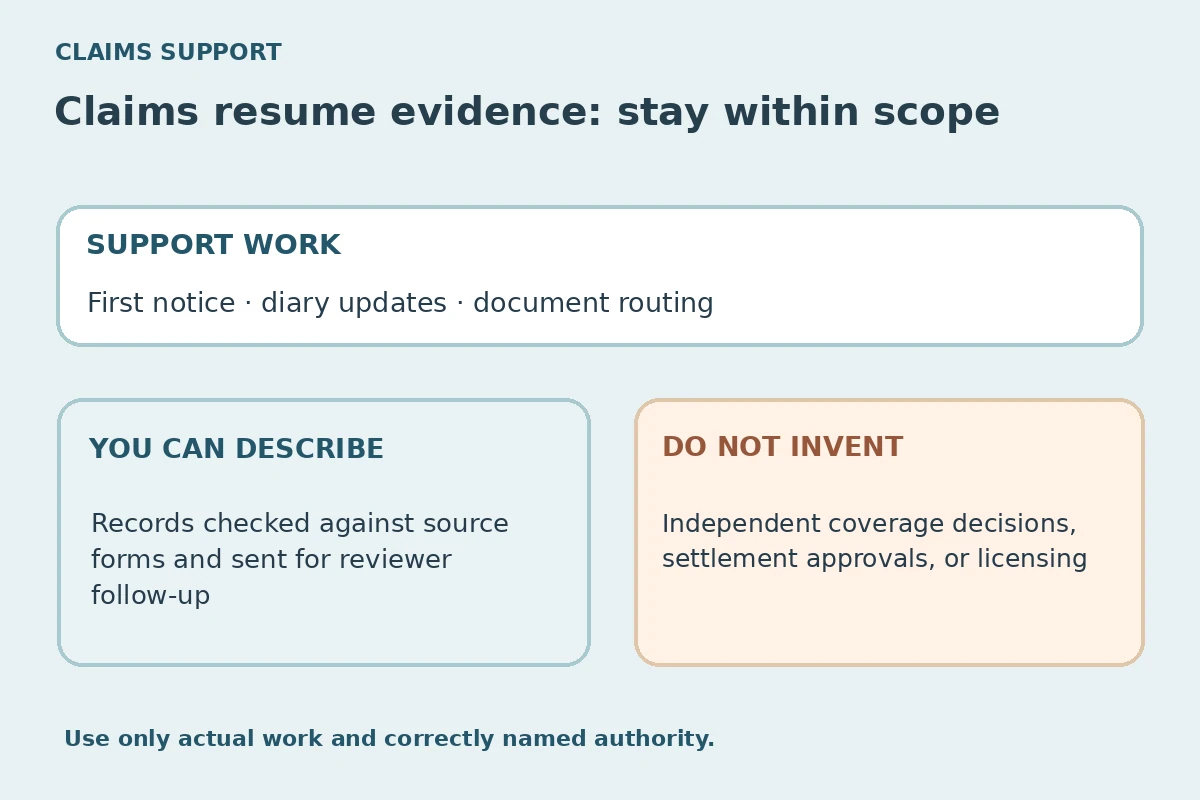
Remote insurance claims assistant jobs are not the same as independent claims adjuster jobs. An intake representative may take a caller’s first report, confirm basic contact information and open a file. A claims support assistant might request missing documents, maintain diary entries or track correspondence. An adjuster may investigate coverage, assess a loss or settle a claim under an assigned authority level and applicable state requirements. Compare the verb in each posting with the authority it implies. If the ad says ‘approve claims’ but describes only clerical training, ask who makes the final decision before applying.
Search for the three distinct routes, not one title
Use separate searches for ‘claims assistant remote,’ ‘first notice of loss remote,’ and ‘claims support specialist remote.’ A results page may also show field adjusters, licensed auto appraisers, workers’ compensation examiners or medical bill reviewers. Those are different workflows. Save only listings that match your qualifications and the work you want. Look for the claim type—auto, property, liability or workers’ compensation—and whether calls, document indexing or outbound claimant contact dominate the day. A title alone is weak evidence of suitability.
Check state location and license requirements before preparing documents
Remote does not always mean work-from-anywhere. Insurance companies can restrict hiring by state, service territory, training site or the location in which staff will handle claims. BLS notes that licensing rules for adjusters vary by state; some insurance-company adjusters operate under a company license where permitted. Do not infer that an assistant needs a license or that an adjuster is exempt. Write down the states in which the employer hires, the exact credential requirement and whether the job requires onsite onboarding. Ask the recruiter to clarify any conflict with the official posting.

Use case-note accuracy as application evidence
A strong entry-level application can demonstrate accurate timestamps, document names, queue updates and clear handoffs without claiming settlement authority. For example, a hypothetical office assistant might describe maintaining records for a high-volume service team and escalating missing information. If you have never worked with claims, say so. Explain how you verified source details and kept sensitive customer information out of informal tools. Describe the actual system or spreadsheet you used only if you really used it; do not insert an insurance platform name to look experienced.
Evaluate the first-notice-of-loss shift and call duties
Some remote openings begin with first notice of loss, often a time-sensitive conversation following an accident or other incident. Check whether the job is inbound-only, includes outbound document requests, or covers weekends and rotating shifts. The responsibilities and emotional demands differ from back-office indexing. Ask what scripts and escalation paths are provided when a caller is distressed or requests a coverage answer. You should not reassure a caller that a claim will be paid merely because you logged their report. In a job interview, explain that you would document and route the question to the authorized claim owner.
Understand why claims records require approved access
Claim files may contain financial, identifying, property and sometimes health-related information. An applicant should ask whether the employer provides secure equipment, approved document systems, role-based permissions and a private workspace expectation. Do not use personal email, public file-sharing or screenshots of real case records as portfolio samples. If a prospective employer sends files before hiring, verify who sent them and why you are permitted to view them. For a practice sample, invent anonymous data and label the exercise hypothetical rather than showing a real person’s report.
| Requirement to check | What to record before applying |
|---|---|
| Job duties | Intake support / Record the first report |
| Supervision | Adjuster review / Coverage and settlement |
| Remote location | Employer-allowed states and working hours |
| Risk or permissions | State license check; No independent settlement |
Distinguish evidence gathering from authorization
Claims workflows commonly separate gathering information from interpreting coverage, changing reserves or authorizing payment. A support role can be valuable precisely because it preserves an accurate file for the licensed or delegated decision-maker. When evaluating an advertisement, underline every action word: ‘collect,’ ‘verify,’ ‘recommend,’ ‘approve’ and ‘settle’ are not interchangeable. A question worth asking is, ‘Which decisions can this role take without adjuster review?’ If the employer cannot define the decision boundary, request the written job description instead of assuming responsibility that may require licensing or training.
Build a practical application tracker around claim type and location
Create one row per employer requisition and record the claim line, allowable states, training format, shift, licensing language, core tools and application status. Keep an official careers-page link alongside the job-board link because remote postings can be copied or impersonated. Do not attach customer documents or a personal identification number to an unverified recruiter message. After applying, save the confirmation and any assessment deadline in a private folder. If the employer changes the role from intake support to independent adjusting, revisit the licensing and experience criteria rather than carrying over the original assumption.

Prepare to explain one careful administrative handoff
Interviewers may ask what you would do if a report lacks an incident date or the caller disputes a prior entry. A credible support-level answer identifies the missing field, checks available authorized sources, notes the discrepancy without silently rewriting the record, and routes the issue to the assigned reviewer. Explain how you would update the diary or ticket while maintaining confidentiality. Do not invent a claim outcome or suggest the assistant can reverse a coverage decision. Your evidence can come from another record-sensitive job, provided you accurately describe its context.
Assess the offer and ongoing supervision
Before accepting, confirm which equipment and secure connections the employer supplies, how calls and files are audited, who reviews escalations and what hours the team covers. Separate a company’s remote-work policy from the insurance licensing rules for the duties. Check whether the first weeks include supervised practice and whether quality metrics measure both accurate records and timely response. The goal is not to promise that every remote claims job is suitable for a beginner; it is to identify a real support position whose authority, training and location align with your situation.
How We Research Remote Claims Assistant Jobs
JobAsk reviewed the following occupational and government sources on November 17, 2026: BLS explains claims occupations and state-dependent adjuster licensing requirements. O*NET describes claim-record review, evidence collection, adjustments and approvals within assigned authority. FTC warns that work-from-home scams seek upfront payments or personal information and recommends independent verification. We compared the described duties with typical job-search terminology and distinguished employer-controlled conditions from general occupational guidance. Neither these sources nor a public search result confirms that any particular vacancy remains open or that an employer hires in your state. Sample work records and interview responses here are explicitly hypothetical; use your own documented skills and follow the actual employer’s instructions. This page does not promise hiring, eligibility, compensation or legal clearance. We have not claimed any specific affiliate partnership. See the JobAsk affiliate disclosure for transparency.
Related Job Search Guides
No. Assistants often handle intake, records and handoffs; adjusters may investigate and make claim decisions under assigned authority and applicable rules. Read the specific posting.
It depends on the exact job duties and jurisdiction. Check the state insurance regulator and employer rather than assuming every assistant is licensed or exempt.
Yes, if you accurately show applicable record accuracy, document tracking, customer contact and secure-handling experience without claiming insurance expertise you lack.
Not necessarily. First-notice intake and claimant follow-up can involve substantial telephone coverage; verify call expectations and shifts.
Unverified hiring contacts, requests for upfront payment or sensitive identity records before legitimate verification, and vague duties that hide decision authority.