
A verbal job offer is a good time to thank the employer and confirm what was discussed, not a reason to guess about unmentioned terms. If you are ready to accept the actual offer, communicate that honestly and request written documentation. If major details are still unknown, express interest without accidentally saying you have accepted. Your follow-up should capture the job title, proposed start date, work arrangement, compensation terms as discussed, and who will send the formal letter.
The relevant public guidance includes career or credential guidance and an additional authoritative source. Those resources explain sound offer practices, not the legal meaning of your individual agreement or the private preferences of a particular employer.
Write Down the Conversation While It Is Fresh
Immediately after the call, note the speaker’s name, date, job title, work location or remote arrangement, expected schedule, compensation language, and any agreed timeline. Record the exact facts mentioned, including qualifications such as “tentative” or “subject to approval.” A recruiting conversation often contains enthusiasm and possibilities along with specific promises. Your first task is to separate those statements accurately without interpreting encouraging comments as a finalized commitment.
If a number, benefit, schedule, or reporting line was not discussed, write “not confirmed” in your private notes. Do not fill the gap using an older job posting or a conversation with a different interviewer. Berkeley’s guidance specifically recommends following up when a formal written offer does not arrive after a verbal offer. The purpose of the written record is to align both sides on the same proposal, not to create terms unilaterally. For a step-by-step method, see how to accept a teaching job offer after checking your assignment.
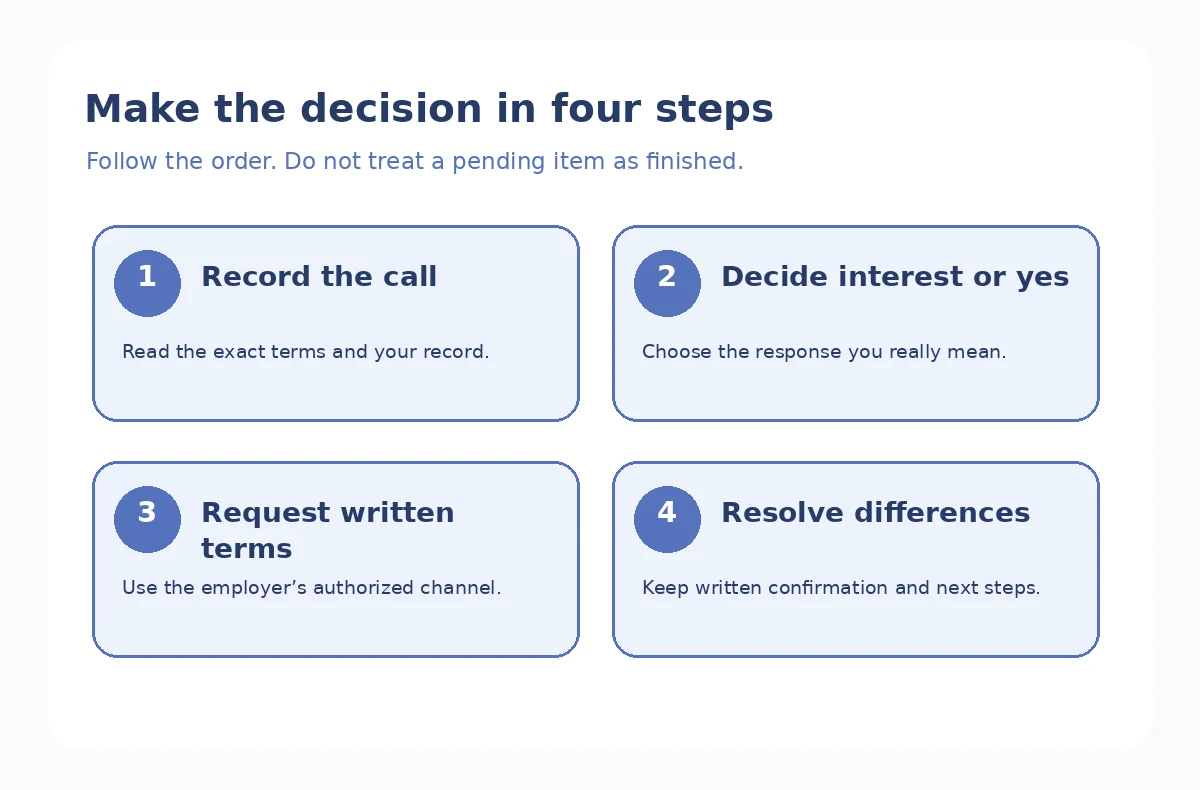
Choose Between Interest and Acceptance
These messages are different: “Thank you, I am interested and would appreciate the formal details” does not mean the same thing as “I accept the position on the agreed terms.” Use the first when details remain unresolved or you need decision time. Use the second only if you have decided to take the job based on the offer you actually understand. A candidate should not say “I accept” merely to keep an employer interested while shopping for other offers.
Harvard career guidance treats both verbal commitments and signed acceptances as meaningful professional promises. That is an ethical practice warning, not a claim that every spoken sentence has identical legal consequences. If an employer needs a decision before sending a full letter, ask specifically which terms are final, what paperwork follows, and what deadline applies. You can be enthusiastic while still asking for clarity.
Ask for a Written Summary of Core Terms
A good follow-up requests the documents needed to verify the position, proposed compensation, start date, supervisor or reporting relationship, schedule, location, and any conditions. Not every offer letter contains every one of these elements; ask separately where something important is missing. Do not assume a company’s oral benefits description includes all limitations, eligibility rules, or plan documents. Only the authoritative employer materials can settle those details.
If your notes conflict with the employer’s letter, identify the discrepancy precisely: “On Tuesday’s call I understood the position would begin on [Date]; the letter shows [Different Date]. Could you confirm which applies?” This is more effective than silently signing and hoping someone will resolve the issue later. Keep the exchanged messages together so you can refer to the same version of the terms.

Use the Right Follow-Up Email
Hypothetical example when you have not yet accepted: “Subject: Follow-Up on Verbal Offer — [Role]. Hello [Name], thank you for speaking with me about the [Role] position. I am excited about the opportunity. My notes show a proposed start of [Date] and a [Location/Schedule] arrangement. Could you please send the formal written offer and confirm any conditions and the response deadline? I will review the details promptly. Best, [Name].” This example intentionally stops short of acceptance.
Hypothetical example when you are genuinely ready: “Thank you for offering me the [Role] position. I am pleased to accept based on our discussion of [confirmed terms]. Would you please send the formal offer and any onboarding instructions so I can check the details and complete the required steps?” Do not combine the two examples into a vague message that leaves your commitment unclear. If the employer sends a portal invitation, confirm it through a known contact before sharing private information. For a step-by-step method, see how to accept a counteroffer from your current employer carefully.
Check the Letter Against Your Notes
Once the written offer arrives, compare it item by item with the phone discussion. Pay attention to start dates, worksite expectations, hours, named contingencies, and any document needing a signature. If the letter differs materially, request clarification before assuming it is a clerical error or an intentional change. Asking a precise question does not require a confrontational tone. It simply ensures you understand what you are being invited to accept.
For a job with variable shifts, a generic “full-time” description may not answer which schedule applies. For a remote position, ask which location or travel requirements are confirmed. If a recruiter described a potential bonus rather than an agreed bonus, do not present it as guaranteed in your email. These examples illustrate why a written term audit adds value beyond sending a basic “thank you” note. If you want the full process, read how to accept a conditional job offer and track its requirements.

Close the Loop With an Accurate Record
After the employer answers your questions, reply through the instructed channel and retain the final agreement and acceptance. If you are still considering the offer, communicate your decision deadline rather than pretending acceptance is complete. If your acceptance is confirmed, ask about any further forms, onboarding tasks, and whom to contact if instructions do not arrive. Keep business communication professional and avoid posting the offer letter publicly. Our walkthrough on how to decline a job offer after accepting without misleading anyone sets out each step.
The final record should answer three questions: what did you agree to, which terms were written down, and which steps remain incomplete? Those questions are more useful than trying to force a universal rule about when verbal offers become legally binding. If you believe the conversation created a contract dispute, obtain qualified advice based on your jurisdiction and the actual communications.
How We Research Job Offer Decisions
We reviewed the public career-center and professional sources linked below on 2026-10-21 and separated verified general advice from examples written specifically for this page. Each sample is hypothetical and must be adapted to real documents. Readers should check their own terms and obtain qualified advice where necessary.
Sources reviewed on 2026-10-21: career-center or program guidance (Berkeley advises getting clearly defined terms in writing after a verbal offer.) career-center or program guidance (Berkeley lists relevant offer details and notes that written offers can follow verbal conversations.) career-center or program guidance (Harvard describes prompt acknowledgement and careful acceptance practices when offers arrive by phone.) The sources do not imply that any named employer or institution endorses JobAsk.
This article contains no confirmed paid partner link or affiliate recommendation. For the site-wide policy, see the JobAsk affiliate disclosure.
Related Workplace Guides
- Verbal Job Offer Follow-Up: Get Written Terms Before Accepting
- How to Accept a Job Offer by Phone and Follow Up in Writing
- Accept a Job Offer by Text: Confirm the Terms in Writing
- How to Accept a Job Offer After Reviewing the Written Terms
- How to Accept a Job Offer by Email After Checking the Details
They are different forms of communication. Ask for written terms and do not assume every detail of a verbal conversation is final.
Yes. You can thank the employer, show interest, and request the terms you need for an informed decision.
Reference the conversation, the role and known details, and request documentation or clarification of missing terms.
Identify the specific discrepancy and ask the hiring contact to clarify it before relying on either version.
No, not unless an authenticated employer process specifically requires it; ordinary follow-up email rarely needs them.