
A cover letter with an employment gap should still be a letter about why you fit the job—not a detailed explanation of the time between roles. You may mention a substantial break briefly if it helps the reader understand your transition, but you do not have to disclose personal medical, family or financial information. Put the role and relevant skills first, add a one-sentence bridge where useful, and close with current readiness. The examples below are hypothetical and should be changed to reflect your real circumstances. There is no single gap length that automatically requires an explanation in every application.
Decide Whether the Employment Gap Needs a Sentence
Look first at what the employer actually needs to know: the qualifications for the open job, your recent relevant work, and your ability to meet the expected duties. A short gap may need no mention in the letter at all. A longer or more visible break might benefit from one sentence that gives context and pivots to your current fit. USC's career-expert guidance explains that a cover letter can address a career break but does not automatically have to. You should not treat a job-search blog's month thresholds as a binding hiring rule; the answer depends on your history and the application.
If a posting or application form specifically asks about dates or employment history, answer accurately there. Do not cover an extended break by changing dates or combining different employers into an invented continuous role. If the reason for your break is private, a short neutral statement can preserve that privacy: “After a planned career break, I am returning to roles that use my experience in customer scheduling and records.” Only use “planned” if it was actually planned. You do not owe a narrative of sensitive events just to make a letter feel complete.
Place the Explanation After the Role and Your Strongest Evidence
A practical arrangement is opening interest and role match, a brief evidence paragraph, a short optional bridge about the break, then a forward-looking close. Putting the entire gap in the first sentence can hide the evidence that makes you qualified. Consider this hypothetical example: “I am applying for the Office Coordinator position. Before my career break, I maintained appointment logs and reconciled scheduling changes with a team lead. I am ready to return to work requiring careful records and dependable follow-through.” This makes the actual skill visible without disclosing the reason for time away.
The sentence must be truthful for you. If you have little directly related employment before the break, use a genuine course project, volunteer activity or other permitted evidence and label it honestly. CareerOneStop notes that a cover letter may help explain a gap while still drawing attention to role-specific skills and experience. A letter that spends several paragraphs defending the time away leaves too little room for the actual job. Keep the chronology consistent with the resume so the two documents support, rather than contradict, each other.

Choose Neutral Language Without Inventing Activities
A caregiving break could be described simply as “I stepped away from paid employment for family responsibilities and am now seeking a return to [role type],” if that is accurate and you want to share it. A break taken for study might be “During a period away from full-time work, I completed [real course or program] and am now applying those skills to [role task].” If the break involved recovery or another private personal matter, you may choose “Following a period away from paid work, I am ready to resume [relevant duties].” Do not use a canned explanation that misstates your situation.
A cover letter should not imply that caregiving automatically provides a particular credential or formal professional experience. Those activities can require planning and judgment, but translate them into evidence carefully and avoid invented employer-style duties. Similarly, do not claim “freelance consulting” for informal help to friends or unpaid occasional tasks. If you pursued credentials, list only what you completed or the accurately stated ongoing status. You can be positive and forward-looking without manufacturing a continuous career record or promising that a hiring manager will overlook a gap.
| Question | Useful approach | Avoid |
|---|---|---|
| Short or irrelevant break | Keep focus on job fit | Unnecessary backstory |
| Helpful context needed | One neutral bridge sentence | Detailed private history |
| Recent activity | Name actual evidence | Invented consulting role |
| Credentials | State verified status | Claiming expired license |
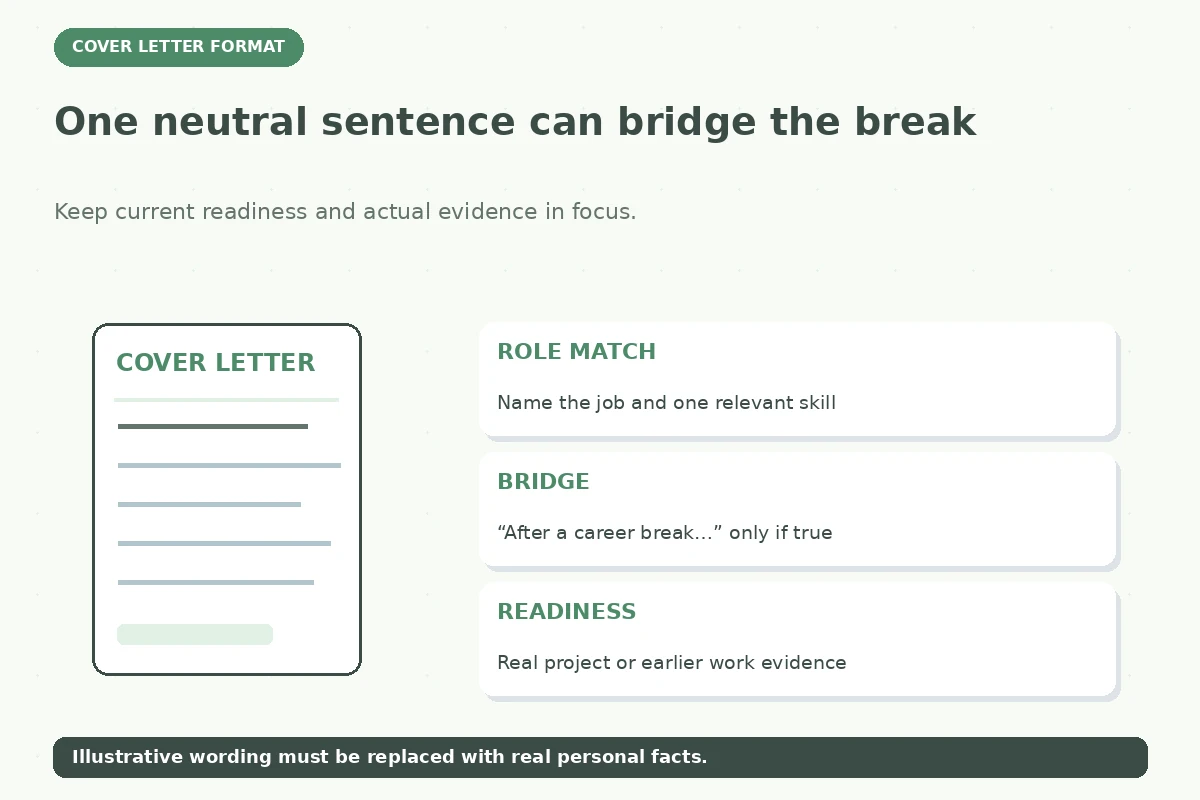
Show Current Readiness With a Checkable Example
Hiring teams may care more about whether you can do the work now than why you paused. Select a recent and true activity: using a current scheduling tool in a course, preparing a sanitized writing sample, completing a supervised volunteer project, or updating your knowledge through a legitimate training program. Explain what you did and what you can show, not an invented outcome. For example, “In a recent spreadsheet course, I checked formulas against sample input records and documented correction notes” is specific and bounded if it really happened.
If you have not completed recent training, do not insert it. You can instead highlight durable evidence from earlier work and say you welcome employer training on current systems. Distinguish openness to training from claiming a current certification. An applicant returning to healthcare, regulated work or technical equipment should verify license, authorization and training requirements before suggesting they can immediately perform restricted tasks. Tailoring the paragraph to the job's actual duties makes the letter useful even without a recent job title.
Protect Personal and Workplace Information
You can choose how much personal context to provide. A cover letter is not a medical questionnaire, and you should not casually include a diagnosis, a family member's details, financial hardship, immigration records or another person's private information. If a law or employer process raises a specific disclosure question, use an appropriate official source or qualified professional rather than making assumptions from a generic example. The letter generally needs enough to explain the professional transition, not the sensitive underlying story.
A safe review question is: if this sentence were forwarded to a group of recruiters, would it reveal more than is needed to assess my relevant skills? If so, shorten it. Use a simple statement such as “I am returning to work after a career break” when that fits your circumstances, and follow it immediately with job-specific evidence. Avoid criticizing a former employer or describing disputes in detail. Do not include a private performance review, client report or confidential work document as supposed proof of readiness. Employers can request suitable evidence through their normal process.

Check the Timeline, Tone and Specific Job Match
Before uploading, compare the cover letter and resume dates. Are titles, training periods and credential status consistent? Have you made a gap disappear by accident through an incorrect start or end month? Is the letter addressed to the right organization and job? Does it identify your relevant skills within the first paragraph or two? Read the note aloud to ensure the bridge sentence is matter-of-fact, not apologetic or defensive. Proofreading should cover facts as well as spelling.
A usable letter remains short enough for a recruiter to see the role, real evidence and the next step quickly. USC's discussion of career breaks encourages brevity and a positive focus on the return. That does not guarantee that every employer responds the same way. Your goal is accurate context while keeping attention on the work. If the application does not ask for a cover letter, follow the employer's directions rather than sending an unsolicited personal explanation. The same restraint applies at interview: answer required questions honestly without feeling obliged to volunteer unrelated private details.
How We Research and Maintain This Guide
This guide was reviewed against the linked U.S. university and professional career resources on 2026-11-13: USC Career Experts CareerOneStop University of Maryland Career Center Tufts Career Center. Every template, role, organization and decision example is illustrative unless expressly attributed; adapt it to the actual employer instructions and your true experience. See the affiliate disclosure for relationship transparency. No hiring outcome or employer approval is implied.
More Resume and Cover Letter Guides
No. Mention a break if it clarifies your transition or the application requires relevant context; a gap alone does not mandate a detailed explanation.
Usually after a brief role-specific opening and relevant evidence, so the letter remains focused on your qualifications.
Not in a generic cover letter. Keep sensitive details private unless a specific legitimate process requires information you choose or must provide.
Yes, if you describe them honestly as coursework, volunteering or personal projects rather than paid employment.
Correct the records before submitting. Never change history to make a break appear shorter or to create continuous employment.