
You can write a convincing cover letter without percentages, revenue figures, or made-up performance statistics. Show what you actually did, how you approached a real task, and what record, handoff, or decision resulted. If you lack measured outcomes, do not invent them. Replace vague claims such as ‘excellent teamwork’ with a short description of work you could explain in an interview.
Separate what you did from what was measured
Look through past job descriptions, project notes, course assignments, and your own recollection. Identify tasks you carried out, tools you personally used, and the people who reviewed or depended on your work. A meaningful example can be non-numerical: checking missing invoice fields, resolving a calendar conflict, documenting a lab observation, or escalating a complaint to the right team. You do not need to infer a customer satisfaction score from these activities. A description is evidence only when the task actually occurred.
Keep three columns in a private note: situation, your action, and verifiable evidence. In the evidence column list a type of proof rather than attaching confidential content: a shift checklist, coursework deliverable, approved public portfolio piece, or supervisor-reviewed log. If you cannot retain employer records, you can still accurately explain your process. Never reveal private client information to make the example sound more impressive. The role of the letter is to clarify why your experience is relevant, not to reproduce proprietary documents.
Use the task-method-handoff structure
Choose a job requirement and write three short answers. Task: What needed attention? Method: What steps did you personally take? Handoff: What did you document, check, or route to another person? For example, ‘When customer orders had incomplete address details, I checked entries against the permitted order record, documented unresolved fields, and flagged them for supervisor review.’ This is specific without claiming the applicant eliminated all errors or accelerated every delivery.
Methods reveal judgment. They show whether the applicant verified details, listened to customers, followed a checklist, or knew when to ask for approval. The handoff reveals scope. If a supervisor made the decision, say so. If a team delivered a final product, identify your contribution instead of adopting the entire result. A careful, credible sequence often provides more useful context than a decorative number that the candidate cannot justify.

Show the hiring manager why the example matters
A cover letter needs a bridge from the example to the specific posting. Suppose a role mentions careful records, changing priorities, and customer communication. Select one genuine example that illustrates two of those needs rather than three unrelated stories. A concise linking sentence might say, ‘That work strengthened my habit of checking source details before updating shared records—an approach relevant to your scheduling support role.’ This adds fit without promising how well you will perform after hiring.
Avoid using employer praise as a substitute for evidence. ‘I am passionate about accuracy’ is hard to evaluate; ‘I compared changes against source requests before posting calendar updates’ tells the reader what you actually did. If you have course or volunteer experience instead of paid work, label the context accurately. Let the employer see your process and boundaries, not a polished claim of expertise you have never practiced independently.
Illustrative rewrite: remove a fictional percentage
Weak and potentially misleading: ‘Improved data quality by 40% and reduced processing time across the department.’ If no measurement exists, do not keep those numbers. A truthful alternative for someone who actually did the work might be: ‘Reviewed spreadsheet entries against source forms, flagged discrepancies, and prepared a correction list for the team lead.’ The alternative is less flashy but documents action and review scope. Only use it if you can personally attest to the steps.
The rewritten example does not assume all errors were found, that the team’s outcomes improved, or that the applicant held approval authority. If you do have recorded, attributable measurements, you may use them with correct context; the rule is not ‘never quantify.’ It is ‘never manufacture.’ Document the source, time period, and your role before deciding a number belongs in the letter. A modest but true example can survive follow-up questions better than an unsupported statistic.

Handle regulated or confidential work with precision
Healthcare, finance, education, and technical support examples can demonstrate judgment but also demand boundaries. A trainee who prepared information for a licensed professional should not say they independently approved treatment or decisions. An assistant who handled billing records should not imply they authorized payments. A support worker should not disclose actual customer details to prove skill. In these contexts, the review or escalation step is not a weakness; it explains that you understand proper responsibilities.
Use hypothetical details only in an explicitly labeled example section. Do not copy an illustrative scenario and present it as your own history. If you cannot describe a work sample safely, write about the steps, quality checks, and communication at a higher level without revealing private data. Discuss your real contribution in ordinary language that a non-specialist recruiter can understand. This helps the letter remain informative without pretending that every applicant needs a numerical success story.
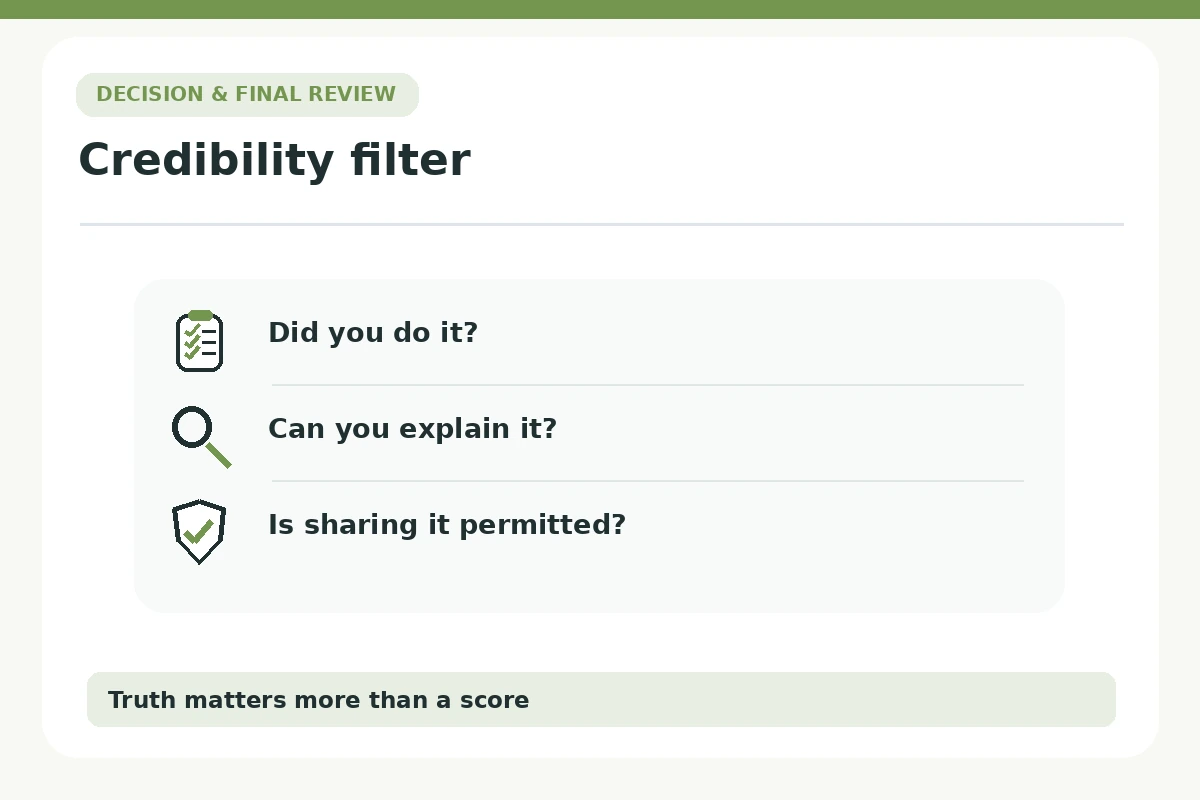
Edit for credibility and relevance before submitting
Read the final letter and underline every measurable claim, causal claim, and senior verb. Can you substantiate the number? Did you personally cause the result, or was it a wider team outcome? Were you authorized to decide, or did you prepare material for review? Replace claims you cannot support with observed actions. Then check that the selected experience addresses a real duty from the posting. One good example, clearly tied to the job, is often enough for a concise middle paragraph.
Keep a master evidence bank as you gain more experience: completed tasks, dates where relevant, projects, supervisor-approved public samples, and any legitimate recorded outcomes. This reduces the temptation to invent achievements when you are under pressure to apply quickly. The goal is a statement the recruiter can understand and you can defend in an interview. Clarity, honesty, and relevance are more dependable than a universal formula for how many metrics a cover letter must contain.
How We Research and Verify This Guidance
We compared the distinctions in this article with public guidance published by US career-service organizations and CareerOneStop. We checked specific statements about cover-letter structure, job targeting, supporting evidence, and submission practices rather than using unverified templates. All applicant and employer scenarios above are illustrative. Requirements may differ by hiring organization, platform, or profession, so follow the real vacancy instructions and verify personal facts against your own records.
This guide provides general US-oriented job-search writing information, not a promise of an employer response or an application-system outcome. We do not know any reader’s individual work history and do not imply that described samples are real applicants or endorsed hiring results.
Source: HARVARD career guidance — Harvard career guidance on truthful examples, concise middle paragraphs, and document checks.
Source: BERKELEY career guidance — UC Berkeley guidance on connecting specific experience to employer needs and careful writing.
Source: USC career guidance — USC guidance on explaining role alignment rather than copying resume bullets.
Source: UMICH career guidance — University of Michigan guidance on focused qualifications and error-free professional communication.
For information about site funding and relationships, read the affiliate disclosure. The informational examples in this article do not represent paid endorsements or confirmed hiring outcomes.
More Resume and Cover Letter Guides
No. Include measurements only when they are genuine, relevant, and supportable. Specific tasks, processes, and handoffs can show skills without numbers.
Explain the task, steps you took, what you checked, and where you handed off or documented the result. Do not infer a percentage.
Yes. Identify it as coursework or a personal project, describe your real contribution, and avoid implying it was paid employment.
Avoid unsupported estimates. If a measurement was genuinely tracked, state the source and scope accurately; otherwise use descriptive evidence.
Describe methods and responsibilities at a safe general level. Do not expose customers, patients, students, private documents, or proprietary details.