
A nonprofit program evaluation internship cover letter should show how you can organize survey records, check a spreadsheet or summarize participant feedback without claiming that you proved a program’s impact. Evaluation-related roles vary: some emphasize questionnaires and Excel, some focus on interviews or reporting, and some expect only basic data support under direction. Read the nonprofit’s project description, choose a genuine class or volunteer example, and explain how you kept questions and evidence separate. Do not imply access to confidential participant records or authority to approve published findings.
Distinguish program activities from evaluation findings
A nonprofit may deliver workshops, meals, tutoring, outreach or other services. Its program outputs count events or participants; outcomes require evidence about changes and may have limitations. An internship letter should not claim an organization changed lives merely because an attendance sheet has many names. Instead, explain how you would support accurate reporting by tracking which definition each measure uses, checking missing responses and asking staff before interpreting trends. This makes your role in evaluation visible without claiming causal proof.
A university-hosted program evaluation internship description from Each Green Corner mentions spreadsheets, surveys and research as useful background and flexible hours. The posting illustrates that some internships welcome applicants with limited professional experience. It is not evidence that all nonprofit evaluation internships are remote, unpaid or structured alike. Check current details and consider whether you have an example of organized records or feedback analysis that matches this particular organization.
Select a useful student dataset or volunteer project
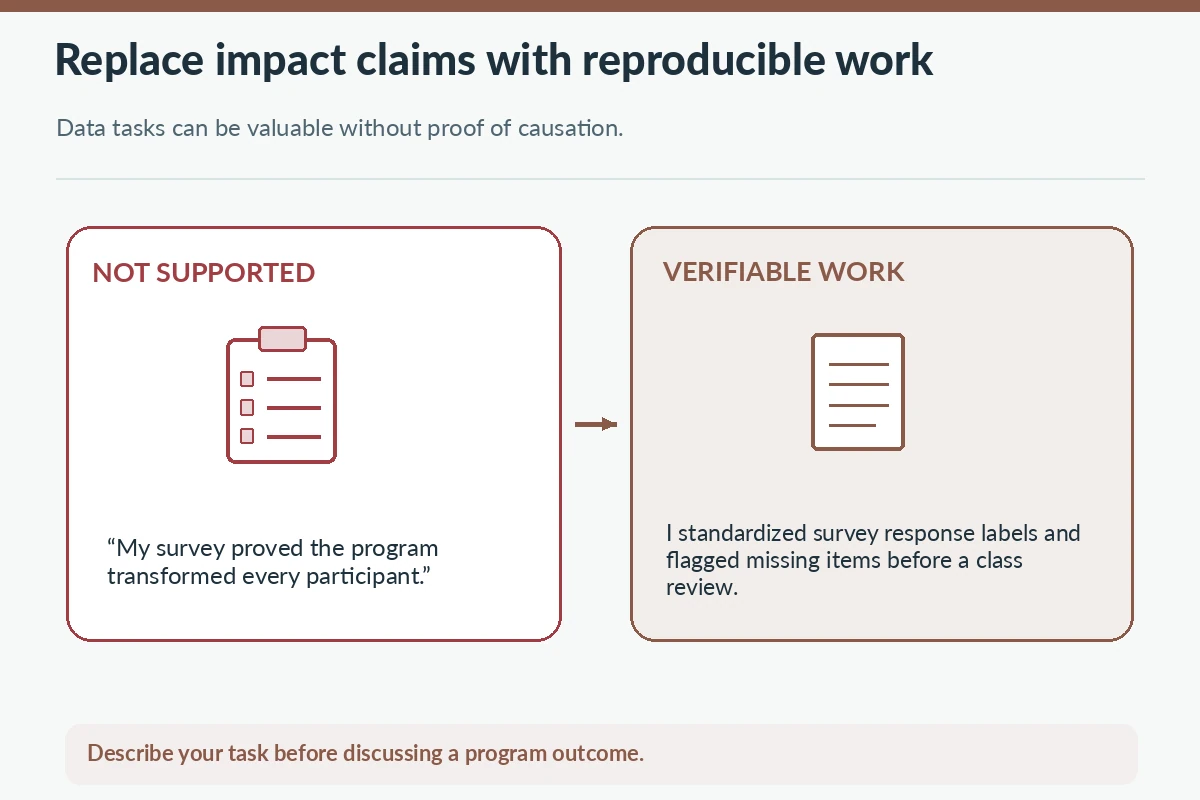
A survey project from a statistics or sociology class can demonstrate the right habits. For instance, you might have standardized answer categories, documented skipped questions or created a table summarizing responses. Be explicit about the scope: ‘I cleaned survey response labels for a class project and documented which entries needed instructor review’ is stronger than ‘I evaluated program success’ when you did not design a valid evaluation. Name the tool only if you used it and can discuss your task.
If your experience is volunteering rather than coursework, describe what you could observe and record. ‘Logged attendance against a sign-in sheet’ establishes an output-tracking task, not an outcome assessment. For sensitive populations, do not paste screenshots of names, phone numbers or personal stories into a letter or shared portfolio. Write about the method and any permission you obtained, without exposing identifiable responses or making a claim unsupported by the data.
Explain survey care and privacy limitations
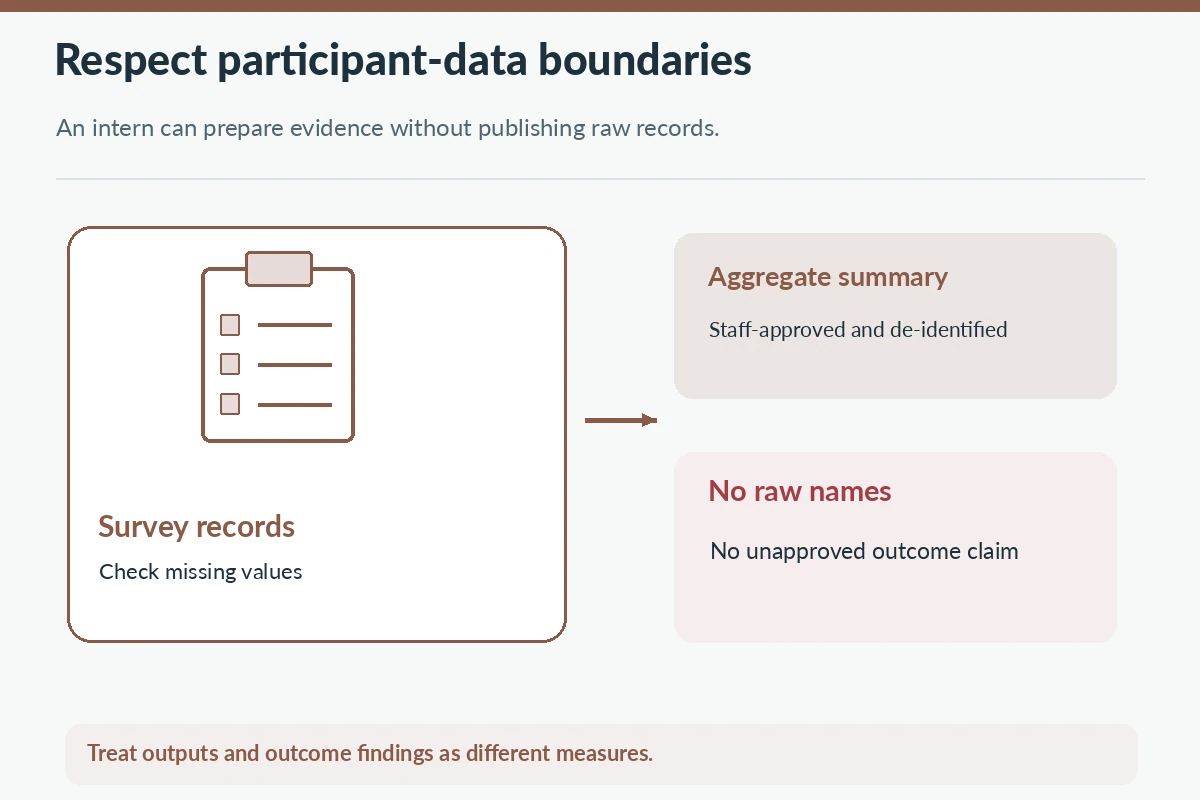
Survey results may contain free-text details, contact information or health-related facts. A new intern should not promise to export raw participant records or contact respondents independently. Describe how you use approved files, follow supervisor instructions and protect access. If your course project used anonymous mock responses, call them fictional practice data; if the real data were restricted, do not display them. Volunteer coordinators and supervisors control authorized access, retention and disclosure, not applicants writing cover letters.
If a posting mentions evaluation frameworks, identify what you actually studied and how you applied them. You can say ‘I learned to compare a question’s wording with the measure it is meant to capture’ without claiming professional research design expertise. The strongest evidence often concerns transparent limitations: a small response group, missing forms or a changed question can restrict interpretation. Show that you know how to raise those concerns instead of making confident but unsupported findings.

Use a nonprofit evaluation letter with one verifiable example
Illustrative letter: Dear Program Evaluation Hiring Team, I am applying for the internship supporting your program review and reporting work. Your description of using feedback and program records to improve services caught my attention. In a university survey-methods course, I standardized response categories in a shared spreadsheet and made a short table showing where unanswered questions affected the totals. I noted the limitations for my instructor rather than describing the results as representative of a broader community.
I would welcome the opportunity to help organize permitted records, learn your team’s definitions for program measures and prepare clear summaries for staff review. My project was completed for class using an approved dataset, and I have not independently conducted a nonprofit impact evaluation. I value the care needed when reporting community information and would follow your confidentiality and review procedures. Thank you for your consideration. Sincerely, [Applicant]. This example is hypothetical: replace the course, software and methods with your actual experience and follow the employer’s application instructions.
Show how a data check supports better decisions
Recruiters may value the ability to notice an inconsistent date, duplicate participant identifier or mismatch between a survey item and the reporting table. Explain your verification path: compare the entry to the approved source, record the issue, then ask the authorized person to decide whether to correct or exclude it. You do not need a fabricated percentage improvement to make this useful. Describe the quality step you took and the person who checked the result.
If you helped with a campus club survey, separate analysis from decisions. Perhaps you compiled feedback and the club officer selected which suggestion to pursue. Your letter can mention preparing the organized summary, not deciding program policy. This distinction matters when working with social-service organizations whose decisions affect participants. An intern can contribute dependable data work while keeping interpretation, reporting and outreach within the assigned permissions.
Link interest to the organization's actual program
A broad sentence about wanting to help people is not enough. Read the nonprofit’s public program description and identify a concrete service or evaluation question, such as how workshops track attendance or how feedback reaches staff. Show that you understand a difference between what the organization does and what its available data can actually establish. Do not claim insider knowledge of participants, donor records or ongoing research simply from the website.
The University of Washington’s guidance for employers notes that intern postings should describe learning outcomes and practical logistics, including location, hours and supervision. An applicant should check those details in the real posting. If you need academic credit, ask your institution about its own approval process; do not declare credit guaranteed because the organization offers a placement. Tailor the closing to a specific skill you can contribute and a procedure you hope to learn.
Proofread claims about impact and percentages
A major mistake in evaluation applications is to manufacture an impact figure or treat correlation as proof of cause. If you only prepared charts, say that you made charts; if your team performed a preliminary descriptive analysis, call it preliminary. Replace ‘increased student outcomes’ with a supported statement such as ‘summarized response counts and missing categories for review.’ Explain any denominators when you use real statistics and never invent numbers to make an entry-level profile appear sophisticated.
Be cautious with sensitive case studies. If you helped a nonprofit under a confidentiality agreement, ask whether you can discuss the workflow. You can often describe checking a de-identified spreadsheet or preparing an aggregate table without revealing records. The letter should demonstrate judgment about safe communication: what you know, which details are public and which conclusions require staff authorization.
Finish with an application-ready evidence table
Before submitting, write three rows: requested task, one real example and the boundary you will respect. For survey cleaning, the boundary may be not changing responses without review. For participant contact, the boundary may be using only approved outreach channels. For reporting, it may be labeling uncertainty. Use that table to remove generic adjectives and turn them into observable actions. Keep the final letter short enough to read easily and leave your detailed data work to an appropriate interview or requested portfolio.
Match the résumé, attachment instructions and any applicant-specific prompt. If the nonprofit requests a brief statement about weekly hours or learning goals, include truthful information rather than attaching a generic personal essay. Do not circulate participant lists, internal assessment data or unapproved evaluations. A practical letter shows that you can support careful work now and learn more advanced methods under staff supervision.
| Area | Useful evidence | What not to imply |
|---|---|---|
| Activity | Workshops delivered | Does not prove outcome |
| Output | Attendance or responses | Check complete records |
| Outcome | Defined change measure | Needs suitable evidence and review |
How We Research Internship Cover Letters
We compared general career-center cover-letter guidance with role-specific institutional internship materials and the JobAsk topic inventory. We reviewed the sources listed below on 2026-11-05. Job and program descriptions illustrate tasks, not guaranteed current openings or universal eligibility. All sample letters and candidate histories in this guide are hypothetical. Follow the current official posting and protect sensitive records. For affiliations and funding transparency, see our affiliate disclosure.
Sources checked: University of Washington Career & Internship Center — A university career-center posting for an entry-level nonprofit evaluation internship lists survey, spreadsheet and research tasks.; University of Washington Career & Internship Center — UW guidance emphasizes real internship learning tasks, schedule and application expectations.; CareerOneStop — CareerOneStop recommends tailoring cover letters to specific duties and evidence without unnecessary length.. Verify the latest instructions for the exact internship you are considering.
More Resume and Cover Letter Guides
Yes. Explain which questions or data fields you handled, your actual analysis and the limits of the dataset.
Not by itself. A dashboard is a reporting tool; explain its data source, measures, limitations and who reviewed conclusions.
Only with authorization and appropriate privacy protections. Normally describe the method rather than expose identifiable responses.
That depends on the posting. Some intern roles are learning opportunities and accept relevant coursework, volunteer work and spreadsheet skills.
State what was completed, what remained open and what supervisor or instructor reviewed. Do not invent final findings.