
Critical thinking behavioral interview questions test how you evaluate information before drawing a conclusion. A strong answer shows a real problem, the evidence you had, what remained uncertain, the checks you performed, and the decision or recommendation you could responsibly make. Do not turn a simple discrepancy into an invented major business crisis. The clearest examples often involve comparing a record with a source, noticing that two explanations are possible, and asking for review before acting beyond your role.
Distinguish the evidence from your first interpretation
Questions may include “Tell me about a time you analyzed conflicting information” or “Describe a problem you solved by checking the facts.” Choose a true situation with at least two plausible explanations: a schedule might be outdated, a form might have a typo, or a count may exclude canceled entries. Start with what you saw. Then state what you initially considered, keeping it separate from what you knew for certain.
Critical thinking is not the same as doubting every coworker or making decisions alone. If a date differs across two records, you do not automatically know which document is wrong. An authentic answer explains how you checked the original source and when you requested clarification. The OPM definition of problem solving emphasizes the accuracy and relevance of information as well as the comparison of options.

Choose a check that matches the actual work
A valid evidence check may involve reading a current procedure, comparing two authorized source records, testing a sample on a training system, or asking the accountable owner for missing context. Describe the specific check you performed, not just “I used data.” Data can be stale, incomplete, or defined differently. Explain why the check was relevant and whether you were allowed to access the information.
Avoid implying that you performed a statistical analysis or external audit unless you truly did. If you were a reception volunteer, confirming the current sign-in sheet against the coordinator’s updated list is a sensible example. If you were a student researcher, indicate which data were from a class exercise. Context matters more than impressively named tools.
Use STAR to tell a reasoning story
Under Situation, mention the conflicting evidence. Under Task, define the decision you needed to support. For Action, show the order of checking sources, identifying gaps, and discussing alternatives. Under Result, state what was actually confirmed and who made the final decision. That sequence tells the interviewer how you reasoned. The result can be a clarified record or a documented recommendation rather than a headline achievement.
Do not omit the Action section by saying “We investigated and fixed it.” Interviewers need to understand your actual part. If a colleague provided the crucial information, acknowledge it. If the final choice was made by a team lead, name that boundary. Accurate collaboration and a well-evidenced recommendation demonstrate more sound thinking than pretending you made all decisions.

Study a hypothetical comparison before writing your own
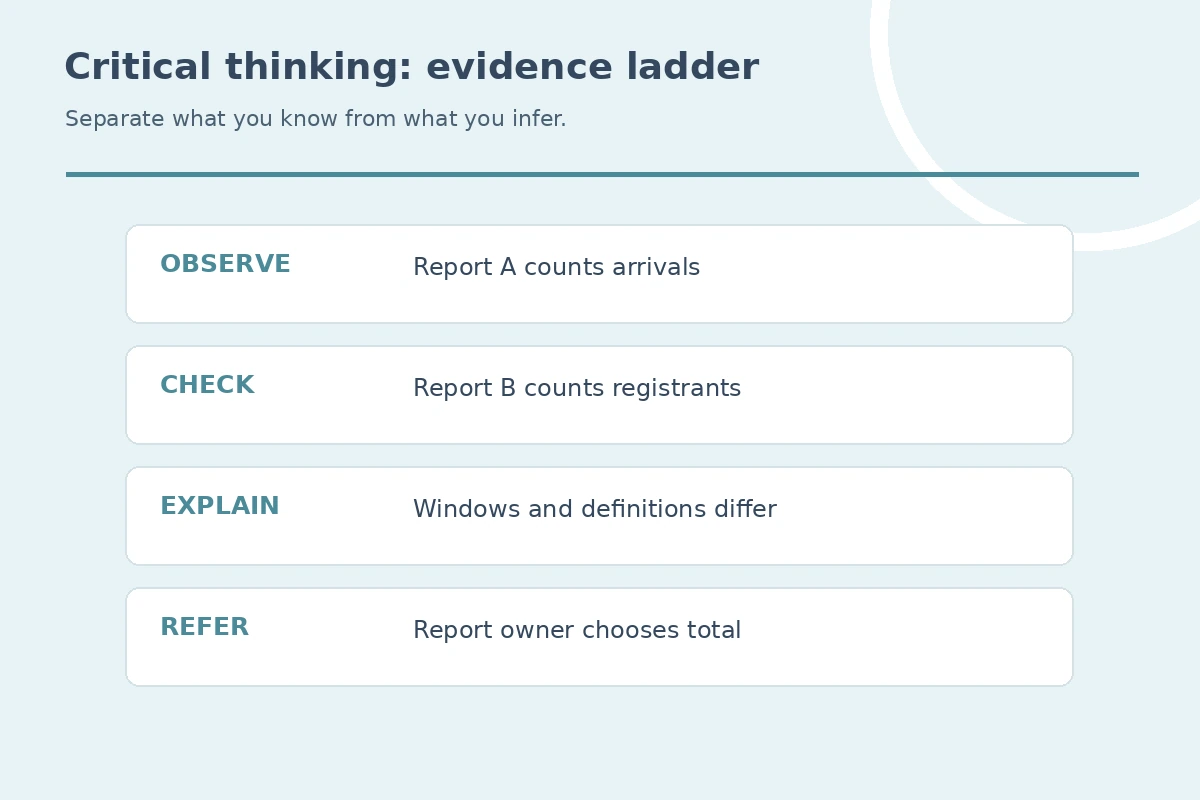
Fictional example for a community-event assistant: “Two sign-in totals did not match, and we needed a count for the event lead. I checked whether both lists covered the same time period and noticed one excluded late arrivals. I explained the difference, gave the lead both counts with their definitions, and the lead chose which figure to report.” The action is comparing definitions and making the uncertainty visible.
This is an illustrative exercise, not a true applicant story. It does not claim that the assistant audited a nonprofit, discovered fraud, or had authority to publish official attendance figures. A candidate with a real similar event should keep the exact sources and scope accurate. If the discrepancy stayed unresolved, say you documented it and escalated it rather than inventing a neat answer.
Use this evidence and scope check before practicing
| Part of your story | What to verify | Boundary to keep |
|---|---|---|
| Observation | What can you verify firsthand? | Separate inference |
| Alternate reason | Could definitions or timing differ? | Do not accuse others |
| Check | Which source resolves the gap? | Use authorized data |
| Recommendation | Who makes the final decision? | No invented authority |
Show how you evaluated more than one option
A strong story includes at least two reasonable next steps, even if one quickly became less suitable. You might verify with the source owner, hold the report pending clarification, or report separate clearly labeled totals. Explain the condition that made you choose or recommend a path. A decision matrix can list the evidence needed, risk of error, responsible owner, and whether the path is reversible.
Do not use a decision matrix to fake a formal tool you never used. You can describe mentally comparing options, checking a documented procedure, and seeking approval. When uncertainty remains, saying “I did not know yet” is a useful fact. Critical thinking involves recognizing uncertainty and resolving it honestly where possible, not projecting confidence without evidence.
Make the outcome precise and appropriately limited
The conclusion must be no broader than what the evidence supports. If you confirmed that two reports counted different date windows, say that. You cannot infer that the organization’s whole reporting system was faulty. If the result was a corrected internal note, that is a legitimate outcome. Do not add a fabricated percentage improvement or claim that an employer later adopted a procedure without confirmation.
Some interviews ask what you learned when your original assumption was wrong. Answer with the verification step you would use next time and the reason it matters. The best stories make correction possible. Avoid naming private customers, internal system screenshots, or proprietary details. You can describe a record as “an approved spreadsheet” without displaying protected information.
Check that your answer sounds like analysis, not conflict
Read the story and identify the observation, competing explanations, test, recommendation, and outcome. If you spend most of the time describing a difficult coworker, the story may fit a conflict question better than a critical thinking question. Move the emphasis back to reasoning and relevant facts. A short, accurate comparison is more useful than complex terminology with no clear purpose.
As a final check, ask someone which detail persuaded you that one explanation was more credible. If the answer is unclear, add the missing source comparison. Your STAR response should fit the role, use only actual experience, and acknowledge who owned the final decision. It cannot guarantee a hiring outcome; it simply makes your decision process easier to evaluate.
Try a safe, fictional practice scenario
Make a fictional event report with two attendance lists: a door count that covers the first hour and a digital registration count that covers the entire day. Write down what each count measures, what additional source would resolve the discrepancy, and who may choose the final public number. Draft a STAR answer focused on matching definitions, asking the report owner, and communicating uncertainty. Make sure the example is not described as a professional experience if you have not done it. For a real answer, substitute an authentic situation in which you verified a source or questioned an assumption responsibly.
How We Research Behavioral Interview Answers
For this guide, we reviewed interview-assessment resources and relevant professional or workplace guidance on November 7, 2026: www.opm.gov (Structured interview questions should focus on job-relevant competencies and explain individual actions.); www.opm.gov (OPM defines problem solving around accuracy and relevance of information, alternatives and recommendations.); www.opm.gov (OPM distinguishes questions about past behavior from situational questions about hypothetical choices.). General guidance does not establish the procedures or authority of any particular employer. All example candidate stories and illustrative results in this article are fictional learning exercises, not personal testimonials. Adapt the framework only to genuine, shareable experiences and confirm applicable workplace procedures and job requirements.
This is independent interview preparation guidance; it does not promise interview performance, hiring, or any employer-specific outcome. Do not disclose private records or proprietary systems during an interview. See the JobAsk affiliate disclosure for site transparency.
More Interview Preparation Guides
No. A small authentic discrepancy with a sensible verification step can clearly demonstrate reasoning.
State how you documented the uncertainty and involved the responsible reviewer rather than inventing a final conclusion.
Not when the help is an appropriate source check or decision escalation. Explain your own analysis before and after the request.
Yes. Identify it as coursework and describe the actual evidence, methods, and team roles.
Only if it was. Distinguish making a recommendation from approving or publishing an outcome.