
Custodian interview questions test whether you can follow a cleaning route, maintain accurate work notes, secure areas only when authorized, and report problems beyond your training. A strong answer explains what you would inspect, which task you own, and how you would communicate a hazard or repair need. It does not claim you can fix electrical systems, enter restricted rooms, or use unfamiliar chemicals without training.
What custodial interviewers want to learn
Custodial work involves more than making a space look tidy. Janitors and building cleaners may empty trash, clean and restock restrooms, maintain floors, report repairs, and sometimes secure buildings, according to the Bureau of Labor Statistics. The exact mix depends on the building and contract. An interviewer wants to know whether you use the assigned route, follow training, notice problems early, and leave a clear record for the next person.
Describe work you truly performed, including volunteer facility care, classroom cleanup, maintenance support, or prior cleaning roles. Separate routine cleaning from tasks such as electrical repair, hazardous spill response, or specialized equipment operation that may need different authorization and training.
How would you prioritize a custodial work order?
Start with the supervisor’s schedule and the building’s service requirements. A blocked public restroom, a spill, and a routine dusting task have different operational implications, but the employer determines priority and who may handle particular hazards. Explain how you would identify an urgent issue, make the area safer only within your training, inform the proper person, and avoid quietly dropping the remaining work.
A hypothetical response: “I would review the work order and assigned route, check whether there is an immediate safety concern, notify the lead if the task needs special handling, and update my progress before moving on.” Avoid claiming that you may classify or remediate every spill on your own.
What if a room is locked or restricted?
The correct answer is not to borrow a key or enter because the cleaning is overdue. Check the authorized access list or contact, document the incomplete task, and ask the designated person for directions. Restricted rooms may contain private records, equipment, or other risks. A good custodian protects the building and respects the boundaries of the role even when the schedule is tight.
Describe how you would record “access not available” with enough information for a supervisor to plan follow-up. Do not suggest photographing confidential documents, searching drawers, or using found access badges to finish the route.
How do you respond when you notice damage?
If you find a leaking fixture, broken lock, damaged equipment, or unexplained odor, describe the factual observation and who should receive it. Do not invent a diagnosis. If the problem creates an immediate concern, follow the building’s emergency and isolation procedures within your training. Otherwise, document the location, observed condition, and the action you took.
A useful response distinguishes “I reported a leaking sink to the facilities lead” from “I repaired the plumbing.” Some custodians may perform minor repairs, but a candidate should never take credit for trades work not performed or imply authorization that was not granted.
How would you choose and use cleaning products?
Say you would use the employer’s approved product list, labeling, training, and protective equipment instructions. Do not describe mixing chemicals, substituting unknown products, or ignoring area-specific requirements. The interviewer may be testing judgment rather than requesting a recipe for a cleaning process. Ask how new employees are trained on equipment and procedures in that building.
If you have relevant experience, explain how you checked the supply label, confirmed the assigned equipment, and reported a missing item. A specific example of following a procedure is stronger than “I know every cleaning chemical.”
How do you keep a route on schedule?
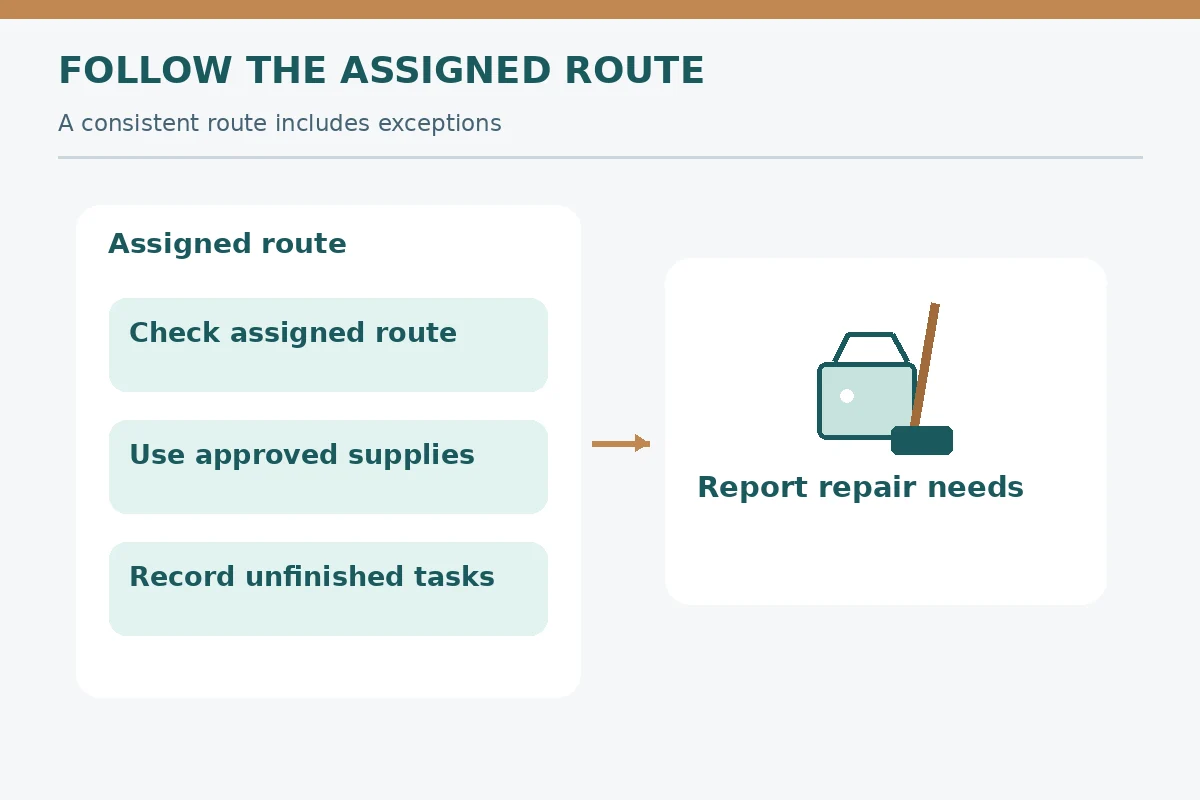
Explain a sequence you have actually used: inspect the assigned area, prepare authorized supplies, complete tasks in a consistent order, verify that required stations are stocked, and record exceptions. Time management should not mean skipping security or quality checks. The scope of a route may change with building occupancy, so communicate when a room is unavailable or a priority request interrupts the plan.
For evidence, you could describe a volunteer shift where you checked rooms against a list and passed unfinished work to a coordinator. Do not invent square footage cleaned or inspection scores. When a metric exists, be able to identify its source and the period it covered.

What if someone asks you to open a locked door?
Access may be delegated through formal rules, but a familiar face or urgent-sounding request is not sufficient by itself. State that you would follow the site’s identification and access policy, refer unauthorized requests, and avoid revealing access details. If keys or badges are issued to you, account for them according to the employer’s chain-of-custody procedure.
If the interviewer asks whether you have opened doors for staff in a prior role, answer with your true scope. Working in a public building is not proof that you were authorized to manage access to every restricted area.
A truthful custodian answer for new applicants
A first-time applicant can use building setup, school janitorial volunteering, warehouse cleanup, or facility support. Identify the setting as it was and explain what you did: followed an assigned list, used provided supplies, checked the area, and reported damage rather than attempting unknown repairs. That shows dependability without fabricating a custodial job history.
Hypothetical answer: “At a community center I helped prepare rooms for events. I checked the assigned rooms against a list and informed the coordinator when a restroom supply was missing. I would bring that same checking habit to this job while learning your building and safety procedures.”

How We Research and Verify Interview Advice
We compare each question with occupation-specific duties described by the Bureau of Labor Statistics and the U.S. Office of Personnel Management structured-interview guidance. CareerOneStop recommends preparation with evidence from actual experience. We distinguish past-experience questions from hypothetical situations, check that examples do not imply permissions beyond the job, and avoid promising hiring results. Specific employer procedures may differ. See our affiliate disclosure; this informational article does not presume an affiliate arrangement.
More Interview Preparation Guides
No. State what equipment you have actually used and what you would need training on. Never claim access or safe operation you have not demonstrated.
Follow the site’s hazard reporting and restricted-area procedures. Do not experiment with products or attempt an unfamiliar cleanup without authorization and training.
Yes. Label it as volunteer experience and explain specific checklists, cleanup tasks, and any issues you reported.
Only by the organization’s approved access rules. Refer unverified requests rather than relying on a person’s claim.
Explain what was completed, the factual obstacle, who was notified, and the status left for follow-up. Do not mark the task complete if it is not.