
Data entry clerk interview questions usually ask how you work with source documents, catch discrepancies, keep records organized, and protect restricted information. The best answers explain your verification method, what you do when a field is unclear, and when an exception goes to a supervisor. Typing quickly without checking the source is not an adequate answer to an accuracy question.
What employers test in data entry interviews
The job may involve scanned forms, spreadsheets, invoices, customer records, or inventory updates, but the essential challenge is translating source material into accurate fields. O*NET identifies preparing and checking data, comparing entries to documents, correcting or reporting errors, and storing records as typical tasks. The interviewer wants to know what you do when a document is incomplete, a value appears twice, or two records disagree.
Start by separating entry, verification, correction, and approval. In some workplaces a clerk may fix a straightforward typing error; in others an authorized record owner must correct the original. Do not present yourself as able to edit every source document or override established review steps.
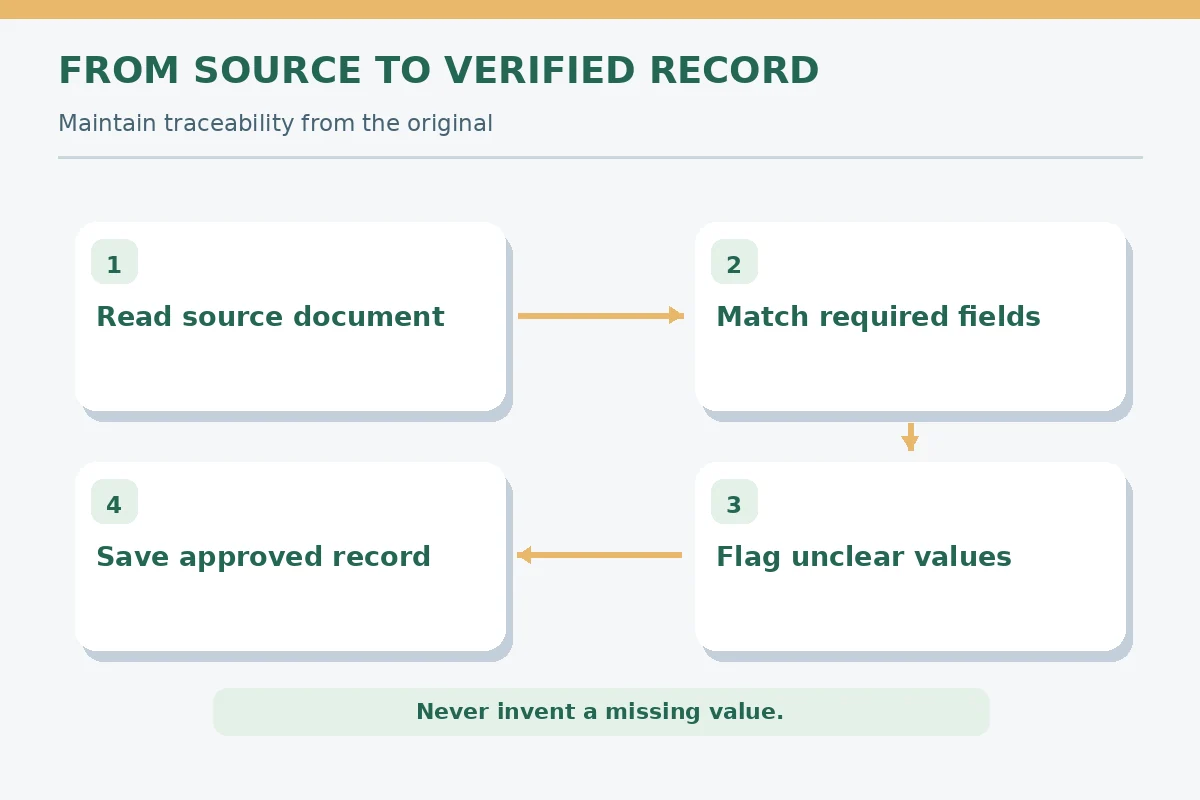
How do you prevent mistakes when entering records?
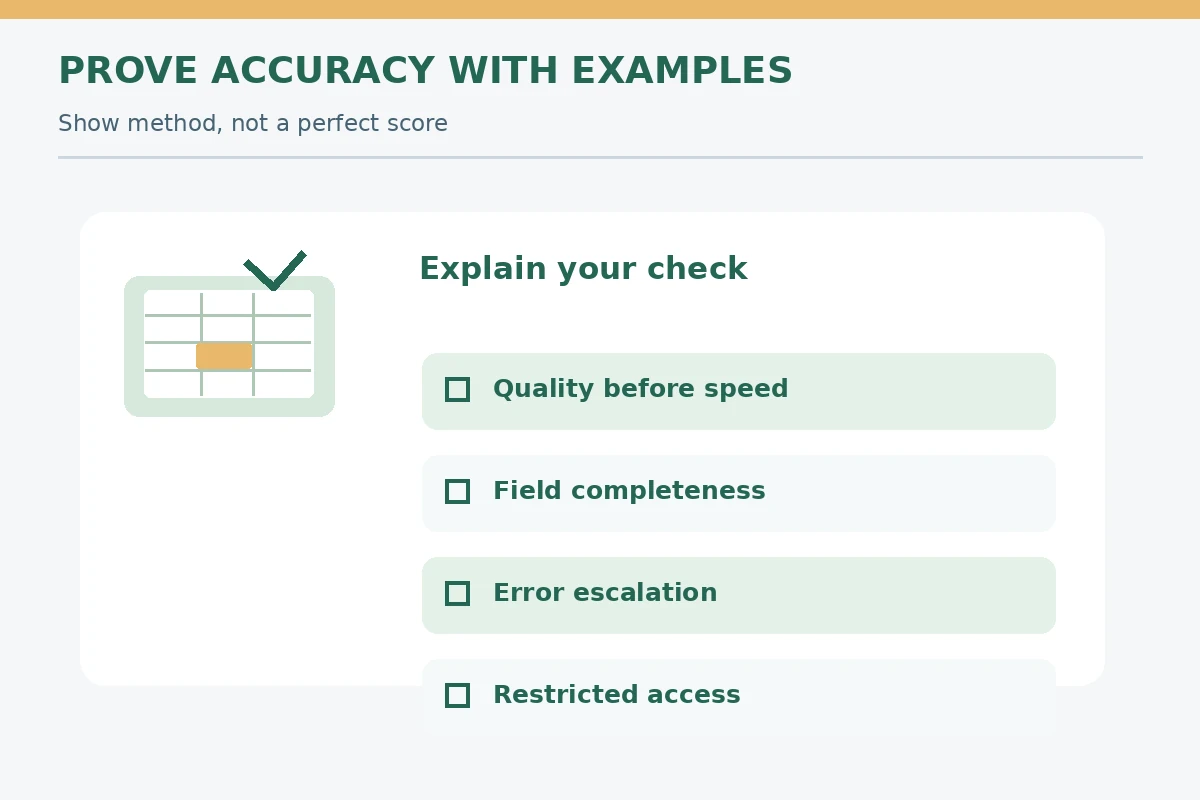
Explain your actual checks, not a claim of flawless accuracy. You might sort incoming records by type, confirm required fields, enter information in a consistent order, compare totals or dates with the original, and review unusual values before marking a task complete. Some roles have double-entry or second-person review; say you would use those only if the system provides them.
A hypothetical answer: “I first check that the source is complete, enter the required fields, then compare the saved record with the source. If something conflicts, I flag it with a reference instead of guessing.” This describes a method an interviewer can evaluate. Replace the method with what you have really used in school, office, or volunteer work.
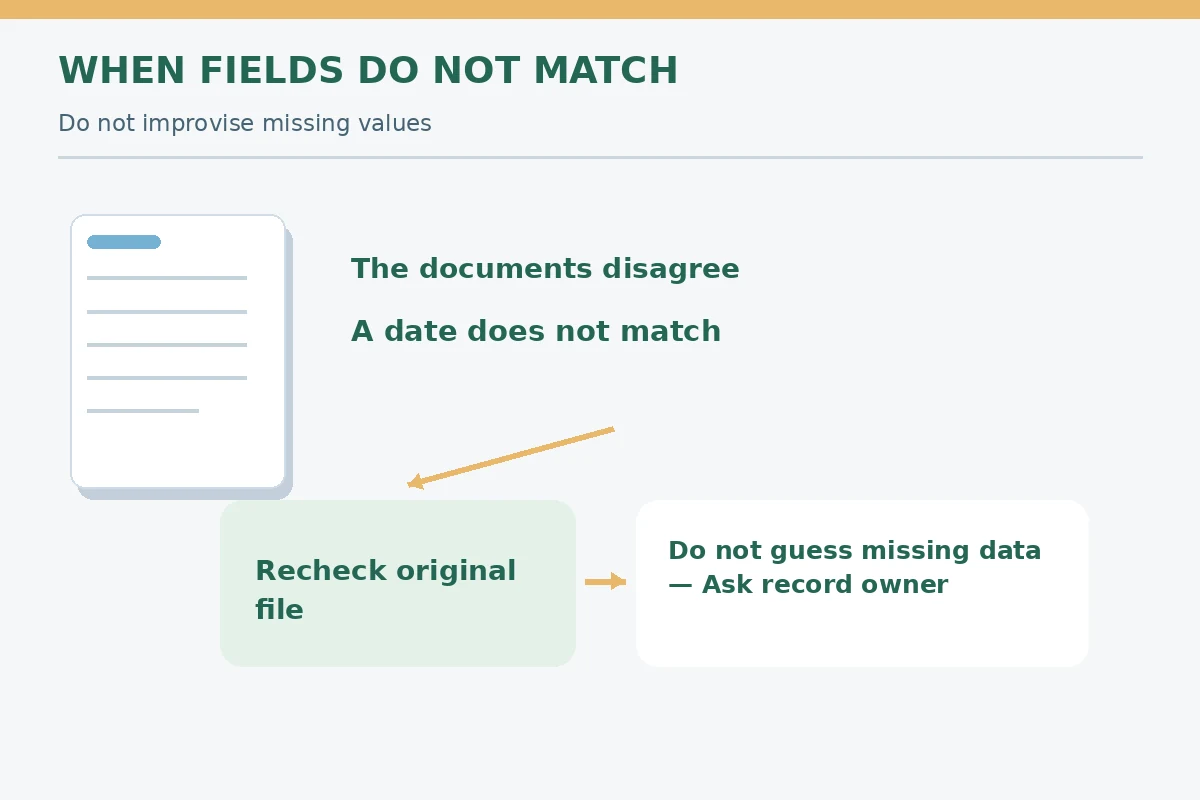
What do you do when two documents conflict?
Suppose an order record contains one delivery date while an email contains another. Do not silently choose the later date or overwrite the original. Explain that you would identify the controlling source under workplace rules, record the discrepancy, and request clarification from the record owner or supervisor. If the correct source is not specified, ask the interviewer how exceptions are handled in their system.
Use exact language such as “I would preserve the original and document which two fields disagree.” Avoid “I always correct the database immediately” because the correct action may depend on access rules and audit history. This is a test of judgment as well as accuracy.
How do you protect confidential source information?
Discuss minimum access, approved devices, secure sharing routes, and privacy rules supplied by the employer. A good candidate does not copy sensitive records to personal email, public cloud folders, or a sample portfolio. When someone requests data outside their role, the correct response is to follow the organization’s access approval process, not assume a familiar name is enough.
For interview examples, describe the control without showing real customer, patient, employee, or financial identifiers. Use fictional sample documents if the interviewer requests a demonstration and gives permission. Never mention a named real customer as proof that you handle private information responsibly.
How would you handle a handwritten or unreadable field?
An illegible number is not an invitation to fill the blank from memory or the most likely value. Describe checking authorized supporting documents, marking the field as uncertain, and routing a clarification request. If the system has a special code for unresolved entries, use it only according to the documented process. This protects downstream staff from relying on a fabricated value.
In a practice example, state “The amount was unclear, so I stopped that record, checked the permitted source, and contacted the appropriate reviewer.” The interviewer should hear that the task continued for other records without disguising the exception as complete.
How do you balance speed and verification?
The useful answer is to explain a consistent workflow that reduces rework. You might group similar forms, use approved keyboard shortcuts, save at checkpoints, and complete a final comparison before submission. If the employer uses productivity targets, ask what is measured and how quality is reviewed. Do not claim typing speed or accuracy rates without a current test that supports them.
A school lab log, club membership spreadsheet, or community inventory can provide legitimate examples. A candidate who checked 15 volunteer sign-up entries may describe that concrete task; a candidate who cannot verify the count should focus on the checking method rather than a number.
Describe how you would hand off an unresolved record
A helpful handoff identifies the record reference, affected field, supporting sources checked, the issue remaining, and the person who should decide. It should not reproduce unnecessary confidential fields. A simple note such as “invoice date conflicts with approved source; held for finance review” is more useful than “bad entry.” If sensitive information is involved, document it only in the organization’s authorized system.
The interviewer may probe what happens after escalation. Say that you would monitor the status if assigned, but you would not mark the record verified until the proper correction or approval is made. “Sent for review” and “approved” are two different states.
Use truthful evidence if you have not held the title
Data entry experience may come from school attendance records, fundraising lists, library inventory, or administrative projects. Explain the purpose, your permitted access, your checks, and where the finalized list went. If you were only preparing a draft for review, say so. Do not describe a classroom worksheet as a confidential enterprise database.
Hypothetical answer: “For a volunteer event I consolidated sign-up forms into one spreadsheet, checked duplicates against the originals, and sent unclear entries to the coordinator. I did not decide missing information myself.” This shows accurate work and a clear authority boundary without inventing a job title.
How We Research and Verify Interview Advice
We compare each question with occupation-specific duties described by the O*NET and the U.S. Office of Personnel Management structured-interview guidance. CareerOneStop recommends preparation with evidence from actual experience. We distinguish past-experience questions from hypothetical situations, check that examples do not imply permissions beyond the job, and avoid promising hiring results. Specific employer procedures may differ. See our affiliate disclosure; this informational article does not presume an affiliate arrangement.
More Interview Preparation Guides
Accurate handling of source information is central, along with recognizing and escalating errors. The specific software and record categories depend on the posting.
Yes, if you clearly describe it as coursework and specify the actual checks you performed. Do not present it as paid experience or an employer system.
Follow the organization’s correction and audit procedures. Explain that you would report or correct it within your permissions instead of hiding the change.
No. Use an anonymized explanation or fictional sample materials. Never expose private data in an interview or portfolio.
Speed alone does not demonstrate source comparison, handling incomplete records, or protecting restricted information. Prepare an example of accuracy and judgment as well.