
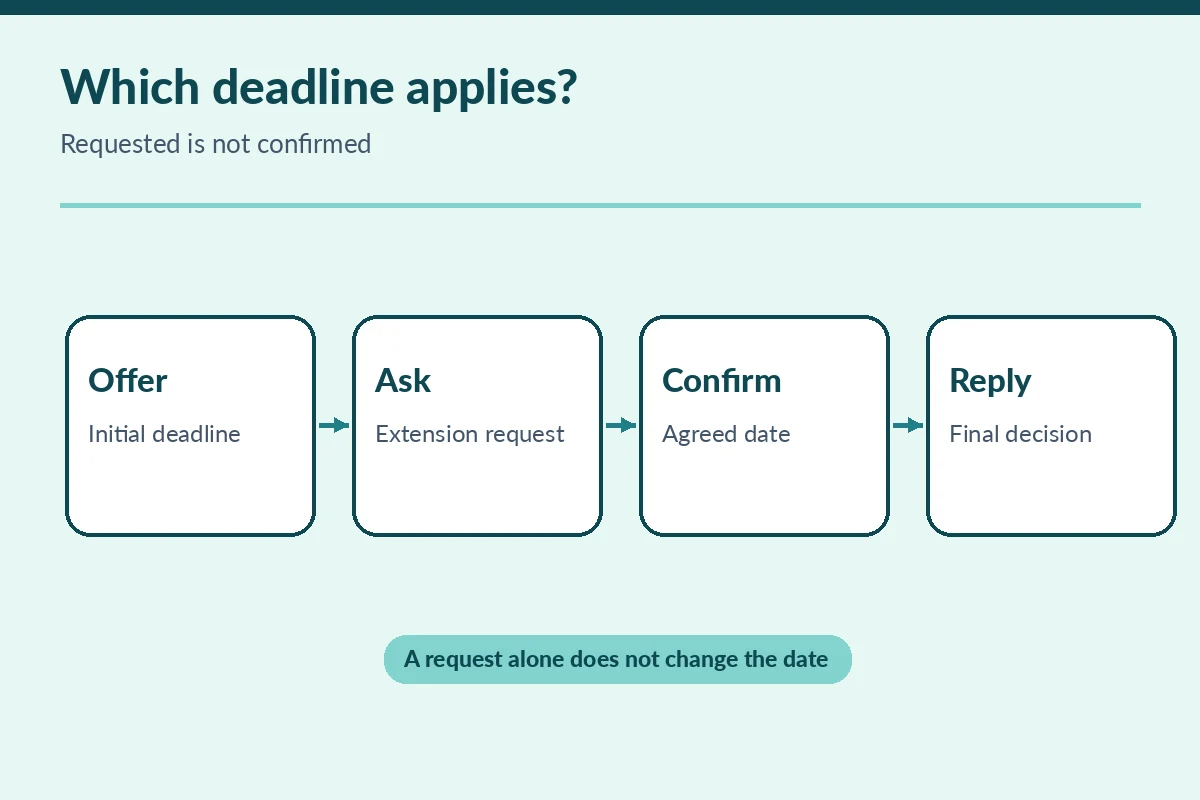
When an employer gives you extra time to decide on an offer and you eventually choose to decline, respond by the deadline the employer actually approved. Thank them for the added time, identify the role, and state that you will not accept. A request for an extension is not permission to move the deadline yourself. If no extension was confirmed, use the original deadline unless you receive a different instruction. The important distinction is between asking, receiving approval, and completing the decision.
Document the deadline you actually received
Create a miniature timeline with the initial offer date, the original deadline, when you asked for more time, the employer’s exact response and the final decision date. Record the local time and time zone if a deadline has a clock time. If the recruiter said ‘Monday’ without specifying a time, ask rather than assuming midnight in your own zone. Treat HR’s written confirmation as more reliable than a casual comment from someone who does not administer the offer.
For example, a request to answer on Friday instead of Tuesday does not move the deadline until the employer grants it. The employer may approve Thursday, decline the request, or propose a conversation. These are different results, and your notes should show them as such. Some campus recruiting guidelines recommend particular response periods, but those policies do not create a universal right to an extension from every employer.
Decide without turning the extension into silence
An extension buys decision time; it is not an obligation to continue negotiating or a reason to postpone a firm no. List what you needed to compare: responsibilities, location, start timing, schedule and written terms. Mark each as resolved, unresolved but nonessential, or material to the decision. If you know you will decline regardless of missing details, you can close the process before the revised deadline rather than forcing another meeting.
Do not accept simply because you feel guilty about having asked for more time. That creates a larger problem than a timely refusal. At the same time, avoid a last-minute decline justified by details that were never part of the offer. If you need professional advice on a contractual issue, get it before committing rather than claiming that a career-center template settles legal obligations.
Send to the owner of the offer decision
Use the official recruiter or HR representative who approved the extension, because that person can update the hiring system and notify the decision makers. A short thank-you to a hiring manager who invested significant time may be appropriate, but it should not contradict the formal decision. Do not send five separate versions with varying reasons. If the organization instructed you to reply through a portal, complete the portal action as well as any requested email.
A useful subject is ‘Decision on [Role] offer.’ In the body, refer to the extension once, not as an apology that dominates the message. You can say that the extra time helped you review the opportunity and make a final decision. Avoid phrases such as ‘for now I cannot accept’ unless you genuinely intend to ask about a later process; vague wording can leave the offer open in the recruiter’s records.

Use a concise deadline-extension decline example
Illustrative email: Hello [Name], thank you for allowing me additional time to consider the [Role] offer and for answering my questions. After reviewing the opportunity, I have decided to decline. I appreciate your flexibility and the time the team invested in meeting with me. I wish you the best as you continue the search. Best, [Your Name]. This is a complete decision even if the employer approved several extra days.
If there is a real fact that needs closing, such as an orientation slot tentatively held for you, you may add one neutral sentence: ‘Please release the tentative meeting time on your calendar.’ Do not add a fabricated scheduling conflict or mention another employer to make the decision sound more compelling. The example is a model, not evidence of any outcome or promised response.
If the extended deadline approaches or passes
If the decision is final, send it immediately through the established channel. If the revised deadline is today and you are uncertain about a time zone, use a timely email rather than assuming another calendar day is available. If a bounce occurs, retry the verified alternate address or official recruiting channel and preserve the error. Do not treat an unacknowledged request for yet another extension as automatically accepted.
If you have already missed the deadline, acknowledge that briefly without inventing an excuse: ‘I apologize for the delayed response. I have decided not to accept the offer.’ The employer may already have moved forward, and you should not demand that they keep a place open. Your aim is to resolve the communication cleanly, not to change the history of when you replied.

Keep the relationship professional afterward
An employer who accommodated your review may still welcome future applications, but no particular relationship is guaranteed. Thank the person for the process and then stop contacting them unless they ask a specific follow-up. Avoid broadcasting your decision in a public post or forwarding internal offer terms to others. The extended deadline was part of a private hiring conversation, not a promise that your preferred date will always be granted.
A final check before sending: have you confirmed the new deadline, made one unambiguous decision, used the appropriate contact and included the role? If yes, there is no need to add a long explanation. Career centers consistently emphasize prompt, clear and respectful offer correspondence; that is the transferable lesson, not a universal number of days every candidate must receive.
How We Research Job Offer Decisions
We review primary university career-service materials about offer communications, deadlines and decision factors. We compare those sources with the specific scenario here and flag where employer documents or individualized advice—not general templates—are needed. Every sample message is fictional and meant to be adapted to the actual hiring process; it is not a real offer, employer reply, legal determination, or guaranteed outcome.
Sources checked November 11, 2026: career.ucsb.edu — UC Santa Barbara Career Services recommends reviewing written offer terms and asking for a clear decision deadline.; careerservices.fas.harvard.edu — Harvard career services recommends clarifying written offer terms, questions, and the response deadline before deciding.; tips.career.vt.edu — Virginia Tech provides distinct correspondence models for requesting an extension and declining an offer.; careers.wisc.edu — UW–Madison advises communicating a decision promptly, clearly, and respectfully without excessive explanation.. Please also read the JobAsk affiliate disclosure before using any external service linked by this site.
Related Workplace Guides
No. Asking for an extension does not itself accept an offer. Give a clear answer within the deadline the employer actually approved.
Do not assume it was granted. Work from the original deadline or ask the official contact for immediate confirmation.
A simple thank-you for the additional review period is usually better. If you missed an agreed deadline, acknowledge that delay accurately.
No. State your decision and a brief truthful reason only if it adds useful context. You do not have to identify another employer.
Yes, if the employer specifies a withdrawal or response action there. Keep the portal result and the email consistent.