
You may decide to decline a job offer because the benefits package does not meet your needs even when the salary looks acceptable. Before you reply, compare only what the employer actually documented: eligibility, effective dates, available coverage information, time off and any benefits that matter to your decision. Ask HR about missing terms rather than guessing. If the full package still does not fit, a brief decline is enough; you do not owe the employer your health history or household finances.
List benefits separately from base salary
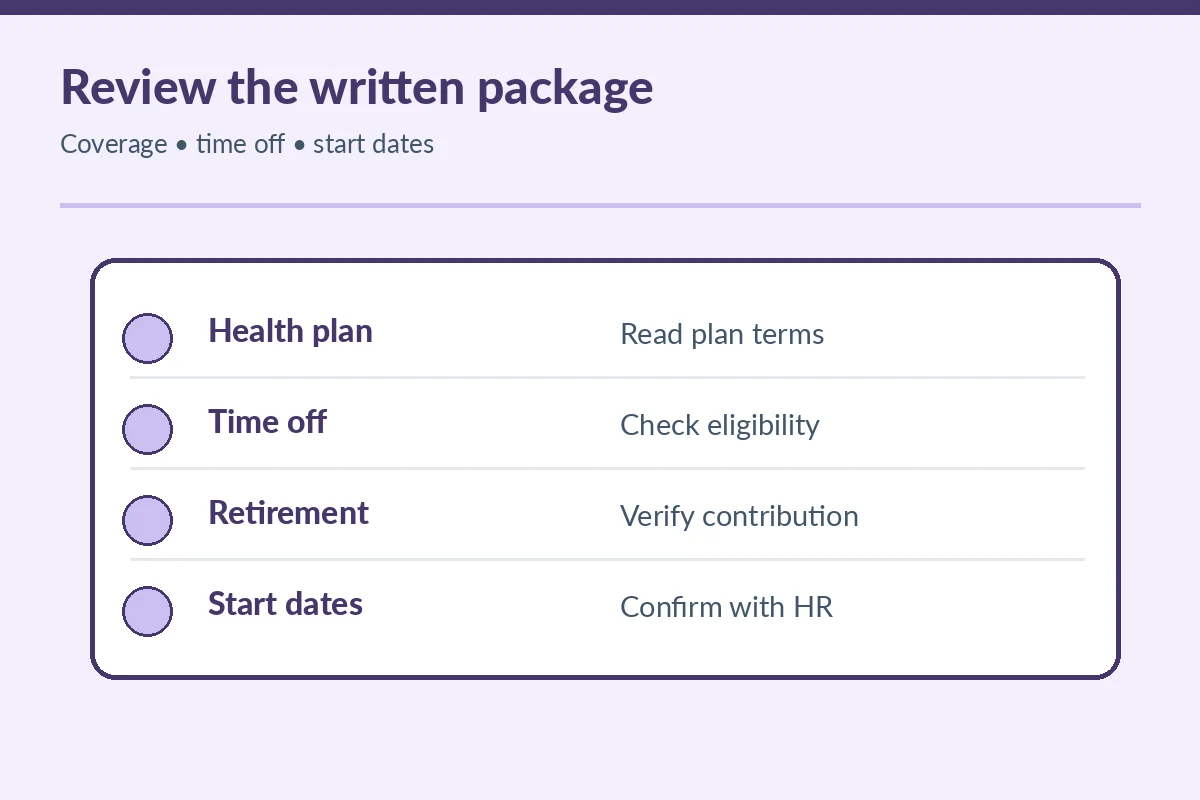
Create a two-column comparison that includes compensation and the other parts of the written offer without treating them as interchangeable. Benefits may involve health insurance, paid time off, employer retirement contributions or other programs, but the actual package is employer-specific. Write ‘provided in materials’ only when you have the document. A job posting’s broad phrase ‘competitive benefits’ is not proof of eligibility, coverage or start date for an individual candidate.
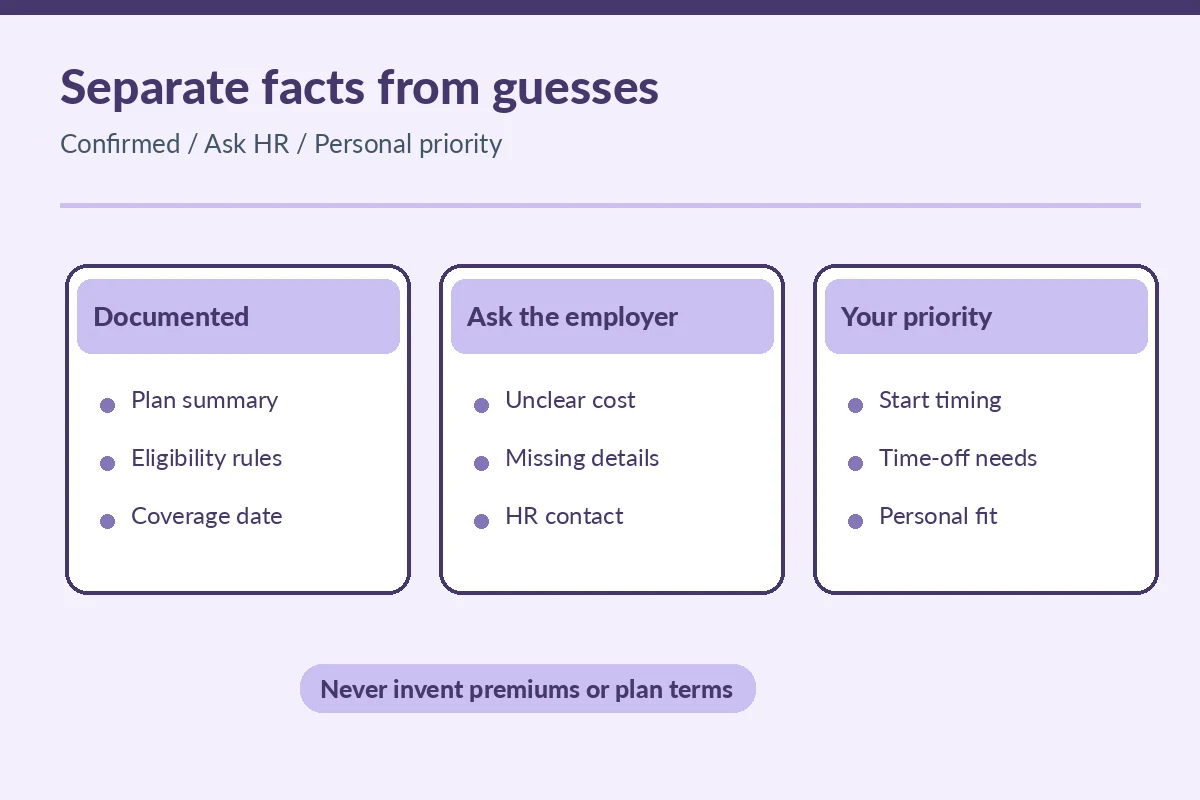
Your personal decision may turn on when coverage begins or whether a schedule is compatible with existing commitments. Avoid using invented costs, premium estimates or generic percentages to justify your choice. Instead, note which features are confirmed, which you need HR to explain and which are preference factors. Michigan Technological University’s offer guidance recommends evaluating benefits among the other parts of a package; it does not promise that every employer has the same options.
Request missing information before deciding
If the offer summary lacks a benefits guide, ask the authorized HR contact where candidates can review the current plan summary, eligibility rules and relevant effective dates. Do not ask a hiring manager to interpret insurance coverage they may not administer. A useful question is ‘Could you point me to the plan details and the date coverage would begin for this position?’ You can also ask which terms are confirmed in writing and which are still estimates.
Do not send medical records, family details or bank information as a condition of asking about benefits. A legitimate employer can explain its plan and hiring process through established channels. If a message directs you to pay upfront for employment, verify the organization independently; FTC guidance identifies pay-to-get-a-job schemes as a warning sign. The goal here is an informed hiring decision, not medical, insurance or financial advice.
Use a decision matrix without invented totals
For every benefit that matters, mark one of three statuses: confirmed and acceptable, confirmed and not suitable, or not yet confirmed. A gap such as unknown insurance eligibility should prompt a question, not an assumption. A confirmed mismatch can support a decision to decline even when the recruiter has described the role positively. Decide what information is material to you rather than copying another applicant’s list of must-have benefits.
Imagine a fictional candidate who values a particular coverage start date. The offer materials show a later date than the candidate can accommodate; HR confirms that the date is not flexible. It is accurate for that candidate to decline on overall-package fit, without announcing a claim about all jobs in that industry. A different candidate with different circumstances might accept the same terms. There is no objective benefits score or guaranteed employer response.
Separate a clarification request from a decline
If you would accept an improved package and are still reviewing, ask a clear question or discuss whether terms are flexible; do not write a refusal disguised as negotiation. If you have already decided no, communicate it without implying that HR must reopen the offer. This distinction protects both sides: ‘Can you confirm eligibility?’ asks for information, whereas ‘I have decided to decline’ ends the decision. Keep the record of what terms the employer actually supplied.
Benefits details can change with plan documents or employment status. Do not promise that a particular plan would cover a service or that a tax treatment applies. For individualized questions about benefits rights or coverage, consult the employer’s official plan materials or a qualified specialist. Your refusal email need not become a dispute over technical plan language if the position is no longer a fit.
Send an offer decline that respects privacy
Illustrative email: Hello [Name], thank you for offering me the [Role] position and sharing the information about the overall package. After careful consideration, I have decided to decline because the terms do not align with my needs at this time. I appreciate the chance to learn about the team and the work. Thank you for your time and understanding. Best, [Your Name]. This states a decision without discussing private coverage needs.
If you want to be even less specific, write ‘I have decided not to accept the offer after reviewing the full package.’ That is usually sufficient. Avoid criticizing a plan using inaccurate numbers, suggesting the recruiter hid information without evidence, or comparing the employer publicly with confidential offer details. If a revised package is offered unexpectedly, request the change in writing before considering whether it warrants a new decision.

Make a final record and move forward
Record the title, version of the offered terms, the date you declined, and the recipient. Avoid preserving sensitive personal details in shared job-search spreadsheets. If a portal also asks you to indicate that you are withdrawing, follow the official instructions. Once HR acknowledges the decision, you usually do not need to send further explanatory messages unless paperwork or access is still pending.
Review what you learned for future applications: ask earlier about the parts of a package that affect your decision, but do not demand personal benefit advice from someone who cannot provide it. The practical lesson is to compare documented terms with your own requirements and make a timely, truthful choice. This article does not evaluate the fairness, legality or adequacy of any particular insurance or retirement plan.
How We Research Job Offer Decisions
We review primary university career-service materials about offer communications, deadlines and decision factors. We compare those sources with the specific scenario here and flag where employer documents or individualized advice—not general templates—are needed. Every sample message is fictional and meant to be adapted to the actual hiring process; it is not a real offer, employer reply, legal determination, or guaranteed outcome.
Sources checked November 11, 2026: www-cf.mtu.edu — Michigan Tech lists benefits, training and advancement among factors to review when evaluating an offer.; career.ucsb.edu — UC Santa Barbara Career Services recommends reviewing written offer terms and asking for a clear decision deadline.; www.smc.edu — Santa Monica College describes reviewing the written offer and considering benefits, lifestyle, and responsibilities.; career.uconn.edu — UConn career guidance calls for thanking the employer, stating a decline clearly, and keeping reasons brief.. Please also read the JobAsk affiliate disclosure before using any external service linked by this site.
Related Workplace Guides
No. You may simply say the overall package does not meet your needs. Private health or family information is not required for a polite decline.
Ask the official HR contact for current written materials and eligibility information before drawing conclusions. An advertising phrase is not a plan document.
If you remain interested, you can ask whether specific terms are flexible. Do not suggest a change has been approved until it is confirmed in writing.
Usually not. Discuss your own requirements or overall fit; comparing confidential packages is unnecessary for a final no.
No. Benefit eligibility, coverage and taxation depend on actual documents and circumstances; consult the relevant plan administrator or qualified professional.