
For a posted research assistant opening, an effective application email identifies the project and role, names one or two methods you genuinely used, and states what you did under supervision. It is not a miniature research proposal or a claim that you can run a lab independently. First check whether the posting asks for email, a campus portal, or both. Then write a short message that lets the reader understand your fit and locate the requested materials.
Separate a posted research job from a general inquiry
A listed research assistant vacancy has an owner, requirements, and often a posting number. Use that specific position in the subject line and opening. A message asking whether a professor might have an opening is different: it should seek information rather than imply you are applying to an advertised job. Princeton’s career email examples illustrate a research inquiry; use that approach only when there is no posting or the lab expressly invites inquiries.
Read whether the project involves human-participant interviewing, wet-lab preparation, literature review, data cleaning, transcription, or records work. These are not interchangeable. A student who managed citations in a course project should not claim participant recruitment experience; a student who observed sample processing should not claim independent instrument operation. Write down the job’s actual requirements beside tasks you can explain in an interview.
Inventory evidence before claiming research skills
Build a two-column ledger. On the left, copy the posting’s tasks: for example, maintain a spreadsheet, schedule study sessions, summarize articles, or check data quality. On the right, list the exact setting where you performed each task, who reviewed it, and what artifact remains. If the evidence is only a class exercise, call it a class exercise; if it involved restricted research information, do not attach the original files.
Distinguish ‘I prepared a codebook for a seminar project’ from ‘I developed the lab’s official coding protocol.’ The first can be genuine and valuable even when it was graded rather than implemented. Say ‘assisted with’ only when you genuinely helped someone do the work. Research teams must follow their own approvals, training, and data-access rules; a recruitment email should not promise that you already have approvals you have not received.

Write a concise email with one method and one match
A useful example, with entirely fictional details: Subject: Research Assistant Application — Behavioral Data Project — Applicant Name. Dear Hiring Team, I am applying for the advertised research assistant role. In an undergraduate course project, I cleaned coded survey responses in a spreadsheet and documented inconsistent entries for my instructor’s review. I am particularly interested in your stated work on data-quality checks. My resume is attached as requested; I would welcome a conversation about the role’s training and supervision. Sincerely, Applicant Name.
The example does not invent a professor’s name, publish sample results, or imply the applicant handled clinical records. Replace ‘course project’ with ‘paid assistantship’ only if that accurately describes your experience. If you know the specific supervisor’s title and preferred form of address, use it; otherwise ‘Dear Hiring Team’ is safer than guessing a name or an academic credential.
Choose supporting material without releasing study data
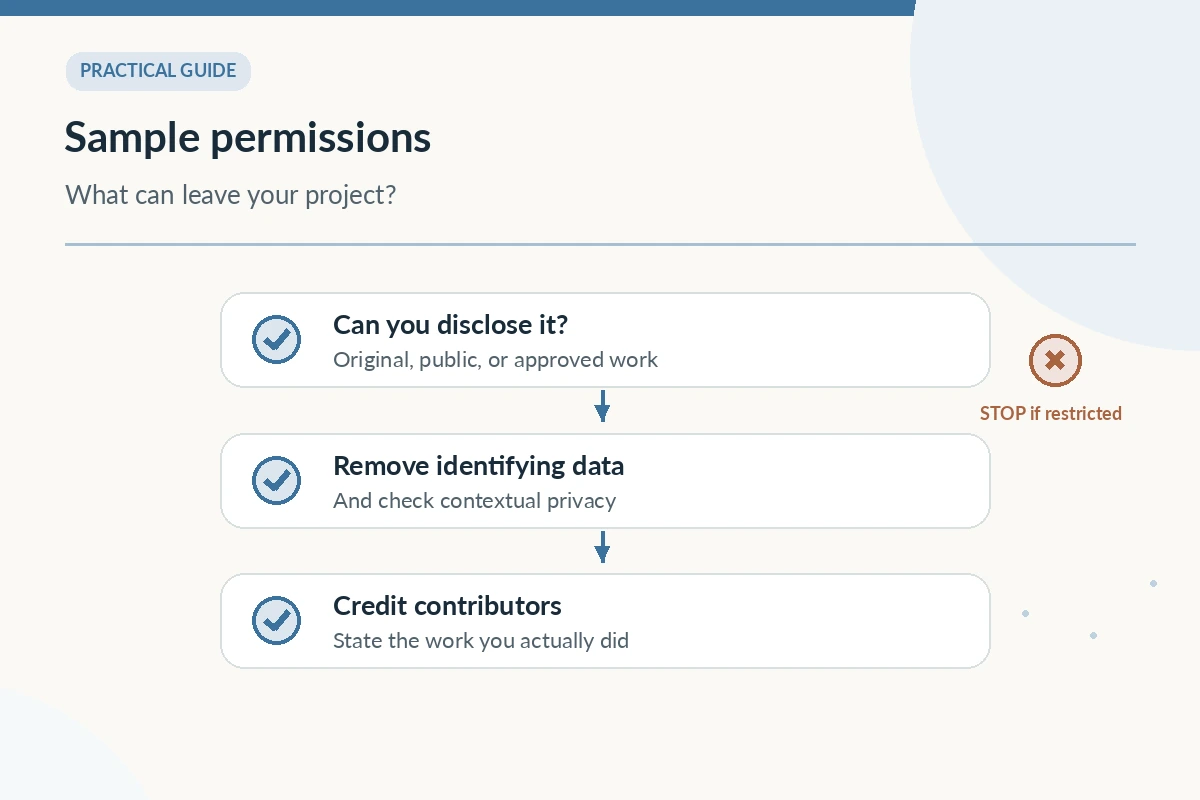
Some teams ask for a CV, a short statement, a transcript, references, or a writing sample. Send only the files or links specified. If a writing sample is allowed, choose an original or approved piece showing synthesis, citation, or methodology; remove private participant information. UMBC’s writing-sample advice emphasizes editing and protecting confidential details, a better rule than simply attaching the most technically impressive document.
For group-authored work, identify the piece you actually wrote and obtain any necessary permission before circulating it. A lab protocol, participant roster, employer data table, or unpublished manuscript can be restricted even if it lives in your own laptop folder. If the role requests an attachment you cannot lawfully share, respond through the official contact channel and ask whether an anonymized or original sample would meet the requirement.

Check the subject line and delivery route
Before sending, compare recipient address, required subject, closing date, attachments, and file types against the announcement. Do not guess a professor’s personal email from a search result when the lab specifies a hiring inbox. If the posting is on a university portal, a supplementary email is not automatically a substitute for the portal submission. Save the posting reference and the version of the resume you used.
Use a straightforward filename such as ApplicantName_ResearchResume.pdf if PDF is accepted. Open the file to confirm it is readable, and make sure its contents match the email. The University of San Francisco’s career advice makes clear that delivery may involve attachments, an email body, or an online form: the employer’s exact instructions decide which path to use.
Prepare for the follow-up without overstating results
After submitting, log the date and communication channel, but do not treat a sent message as confirmation it was received or that you are eligible. If the lab publishes an application timeline, respect it; otherwise use a brief inquiry after a reasonable interval rather than multiple reminders. In an interview you may be asked to reproduce the process behind your example, so keep an accurate list of what you did and what your supervisor did.
If the role includes participant contact, health information, hazardous materials, or specialized equipment, ask about training and oversight rather than promising unsupervised use. A credible research email emphasizes curiosity, care with records, and openness to established protocols, not a fictional record of discoveries.
How We Research Job Application Emails
Our guidance prioritizes the advertised application channel, accurate claims about an applicant’s experience, and careful handling of documents. We reviewed primary university career-center resources and official technical or consumer-protection guidance relevant to this specific scenario. The email examples are fictional teaching illustrations, not actual employer requirements, employment offers, or claims of successful delivery.
Sources checked November 11, 2026: www.kent.edu — University guidance on writing a concise, specific email for a posted student research role.; careerdevelopment.princeton.edu — Princeton examples distinguish an inquiry about research opportunities from a response to an actual opening.; myusf.usfca.edu — Employer instructions govern email subject lines, submission channels, and attachments.; careers.umbc.edu — Writing samples should be edited and protect confidential information.. Before using any tools or offers mentioned on this website, read our affiliate disclosure.
Related Job Search Guides
Apply through the listed route first. A separate inquiry may be appropriate only if the posting permits it or the investigator invites contact; it does not replace an HR submission.
Yes, label it clearly as coursework, describe your own tasks and review process, and avoid claiming it was a paid or approved laboratory study.
Do not forward identifying or restricted material. Use your own authorized sample, remove confidential information, or request a permitted alternative.
Usually one accurate method with a direct link to the advertised work is enough; technical depth belongs in the attached materials or interview.
Only state authority you actually hold. Many research tasks require project training, approvals, review, or access controls determined by the team.