
A part-time job posting that says “flexible schedule” does not automatically tell you how many hours are available, who sets the shifts, or whether weekend coverage is required. Before emailing a recruiter, read the entire posting and isolate the one unanswered scheduling fact that matters for your application. Ask about the employer’s normal shift pattern or expected weekly range without sending an overspecified personal timetable. Then compare the reply with your real availability before applying.
Part-time job searches often fail at the details: a role may be part-time but include rotating nights, seasonal peaks, mandatory training, or hours that vary by business demand. These are possibilities to verify with the actual employer, not universal rules. The University of Minnesota Duluth career center identifies information-seeking correspondence as a legitimate type of job email; DePaul emphasizes a clear subject and simple, direct purpose. Your message should clarify fit, not bargain about terms that have not been offered.
Read the Posting for a Real Schedule Signal
Locate the job title, worksite, posting date, and any stated weekly hours, days, or shift rotation. A schedule description may say “up to” a number of hours without guaranteeing that number. Some employers require training on days different from recurring shifts. Write down each known term, then identify one missing detail that affects whether you can accept an interview or eventual offer. Do not infer paid training, shift choice, or guaranteed hours from a friendly marketing phrase.
Use a small decision record with three columns: confirmed in the posting, not specified, and question for recruiter. If the listing already says weekend availability is essential and you cannot work weekends, asking the recruiter to remove that requirement may not be productive. A better option may be another opening with a compatible published schedule. If the listing is inconsistent, refer to the exact wording you are trying to clarify.
| Situation | Good next action | Boundary to observe |
|---|---|---|
| Fixed shifts | Which days and start times? | Compare against firm availability |
| Rotating shifts | How are shifts announced? | Ask about required coverage |
| Hours not specified | Is there an expected range? | Do not assume guaranteed income |
Ask One Precise Question Instead of Sending a Full Negotiation
A useful question focuses on the distinction that determines fit: “Does the 20-hour part-time schedule normally use fixed weekday shifts, or do assigned hours rotate?” Do not introduce salary demands, time-off exceptions, training reimbursement, and schedule changes in the same first message. Your goal is to learn whether applying makes sense. If no individual recruiter is listed, use the employer’s official applicant question channel rather than guessing private contact information.
Choose neutral language. “I am available for weekday evening shifts and want to confirm whether that meets the posted coverage needs” explains your constraint without sounding like a demand. Avoid “I can work anytime” if you have limited availability, and avoid telling a recruiter that you can meet mandatory shifts when you know you cannot. A precise constraint helps both parties evaluate the real role.
Use an Email Template That Names the Exact Opening
Hypothetical example: “Subject: Part-Time Service Assistant — schedule question. Hello [recruiter], I saw the Service Assistant position on your careers page. The posting mentions part-time shifts but does not specify whether the schedule rotates. Are the usual shifts fixed by day or assigned week to week? I am available weekday evenings and can confirm additional dates if useful. Thank you, [name].” The role, title and availability must be replaced with your actual details.
Avoid attaching a resume merely to ask a schedule question unless the official process requires it. If the answer is that weekend coverage is required, you can thank the recruiter and decide whether to apply without debating policy. If the recruiter can only give broad guidance, the final terms may still depend on a hiring manager or offer document. A pre-application reply is helpful information, not a binding schedule agreement.
Compare Fixed, Rotating, and On-Call Patterns
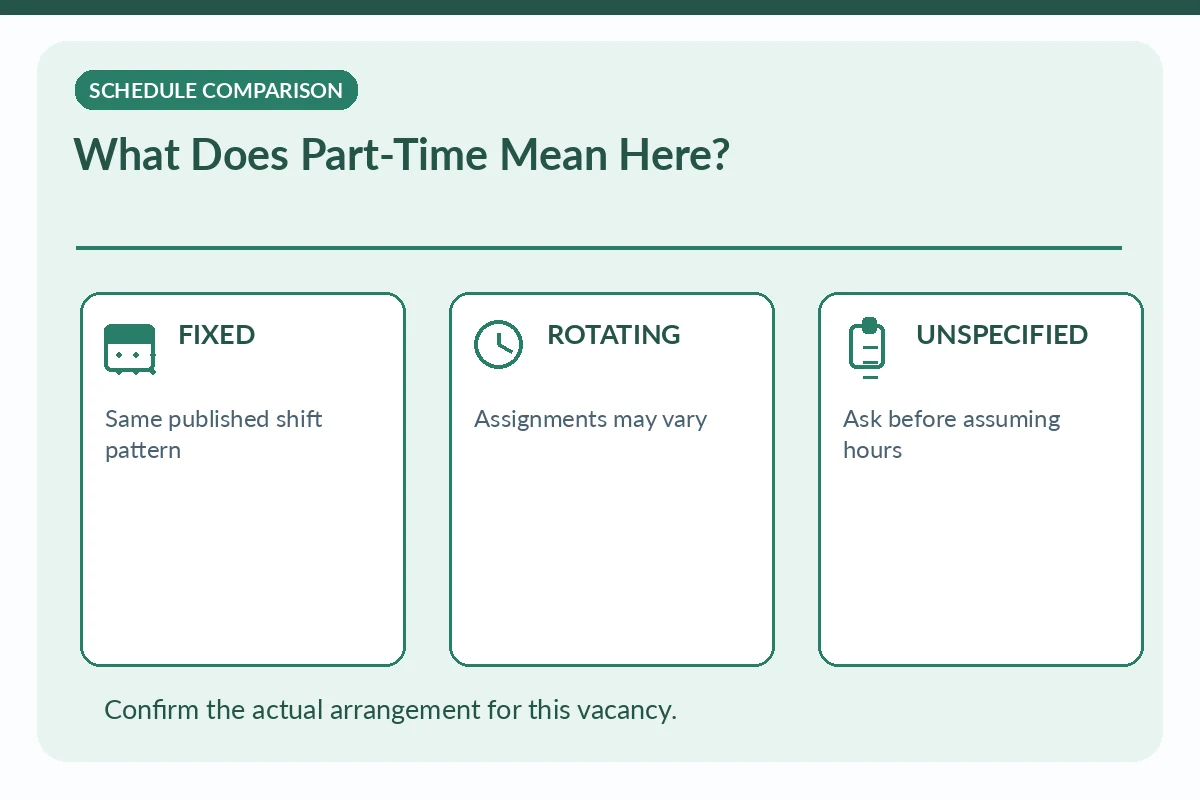
A fixed pattern can be compared with your reliable hours, but confirm whether peak periods or training use exceptions. A rotating pattern needs information about how far in advance shifts are posted and whether minimum availability is required. An on-call or variable-hours arrangement may have no dependable weekly amount; do not assume income or guaranteed hours without written confirmation. Each pattern can be suitable for a different candidate, but the label “part-time” is not enough to choose.
In your private worksheet, identify nonnegotiable availability, times that are sometimes possible, and dates requiring advance notice. You do not have to disclose the reason for each conflict. A recruiter usually needs a usable availability answer, not information about your medical history, family care, school grades, or another employer’s confidential schedule. Offer only the information needed to assess the posted requirement.

Check Work Location and Training Before Committing
Part-time positions may involve training at a different location, occasional travel between nearby sites, or a remote schedule tied to another time zone. Treat these as questions to verify, not as facts about the position. Ask how onboarding shifts relate to the ongoing schedule and whether the advertised worksite covers all assigned days. Do not promise independent driving, access to a licensed activity, or coverage for a location you cannot reach.
If a recruiter says “we are flexible,” ask what the term means operationally: employee choice among published shifts, employer-assigned rotation, or occasional swaps requiring approval. Record the answer in the same words the recruiter used. If the hiring manager later provides a different schedule, clarify the conflict before relying on either description. Written terms and employer policy ultimately matter more than a casual statement made early in recruiting.
Make a Good Decision When the Recruiter Cannot Confirm Hours
Sometimes a recruiting coordinator may not know the precise shift plan until the department reviews candidates. In that case, you can ask whether the hours are confirmed before an interview or if the hiring manager will cover them during screening. Do not treat uncertainty as proof of deception, but do not make commitments that depend on information you do not have. A clear record can save wasted travel and repetitive messages.
After receiving an answer, update a simple outcome: compatible, requires clarification, or incompatible. If you apply, use the official route and be consistent about your availability across the resume, application form, and later scheduling messages. If the role is incompatible, decline politely without criticizing the recruiter. That discipline makes the inquiry useful even when it does not lead to an application.

Worked Example: What the Recruiter Really Needs to Know
Hypothetical: A posting says “part-time, flexible schedule” and you can work Tuesdays and Thursdays after 4 p.m. Instead of claiming weekend availability to get an interview, ask whether evening coverage matches the role. If the recruiter says weekends are essential, do not send a second email asking them to waive it. Choose a compatible opportunity or wait for a position with different published hours.
Do Not Turn the Message Into a Second Application
A recruiter note should make the next decision easier, not reproduce every section of a cover letter. Identify the specific vacancy if one exists, state one relevant fact about your work, and ask one answerable question. Keep a local record of the role, verified contact, date, version of materials, and response. Follow the stated application channel; a message is not a substitute for a required portal application. If the posting forbids outreach, respect that instruction and work through the formal process.
Protect Your Information Before You Press Send
Check the employer or recruiting firm through its official site or a separately verified channel. The FTC warns that impersonators may use polished job descriptions and false offers to request money, banking details, or identification. A legitimate-looking name, social profile, forwarded introduction, or employer logo does not itself prove a contact is authorized. Never purchase equipment, share financial credentials, or upload identity documents merely to gain a recruiter conversation. When the role cannot be verified, stop and ask the employer directly.
How We Research Recruiter Outreach Advice
Sources checked on 2026-11-15: career.d.umn.edu (An information-seeking email can ask about an organization or position when information is not available elsewhere.); resources.depaul.edu (Job-search emails need specific subject lines and a concise core question.); consumer.ftc.gov (Verify the employer before sharing sensitive information in a job inquiry.). Job-search examples are hypothetical and do not represent a recruiter response or employer policy. University guidance describes general professional communication; verify any actual vacancy, application instruction, recruiter identity, and sharing permission independently. We do not claim an affiliate partnership. See the affiliate disclosure.
Related Job Search Guides
Yes, if hours are missing and the answer materially affects fit. Ask one focused question through a verified official channel.
No. Fixed, rotating and variable schedules all exist; confirm the arrangement for the actual opening.
Usually you can state availability without disclosing private reasons; follow relevant application instructions.
Do not treat an informal estimate as guaranteed terms. Confirm the eventual written schedule arrangement with the employer.
Ask whether the hiring manager can clarify it during screening, and decide how much uncertainty you can accept before proceeding.