
Part-time job boards are useful for discovery, but the filter labeled ‘part time’ does not reveal exactly which days or hours you must work. The U.S. Department of Labor explains that the Fair Labor Standards Act does not define a universal full-time or part-time threshold. Employers generally determine that label, while applicable wage rules still matter. Start by writing down your available windows, the earliest and latest shift you can realistically accept, travel limits, and whether your availability changes during school or caregiving periods. Then verify each opening on the employer’s own website before treating its schedule as a match.
Write the schedule you can actually keep before searching
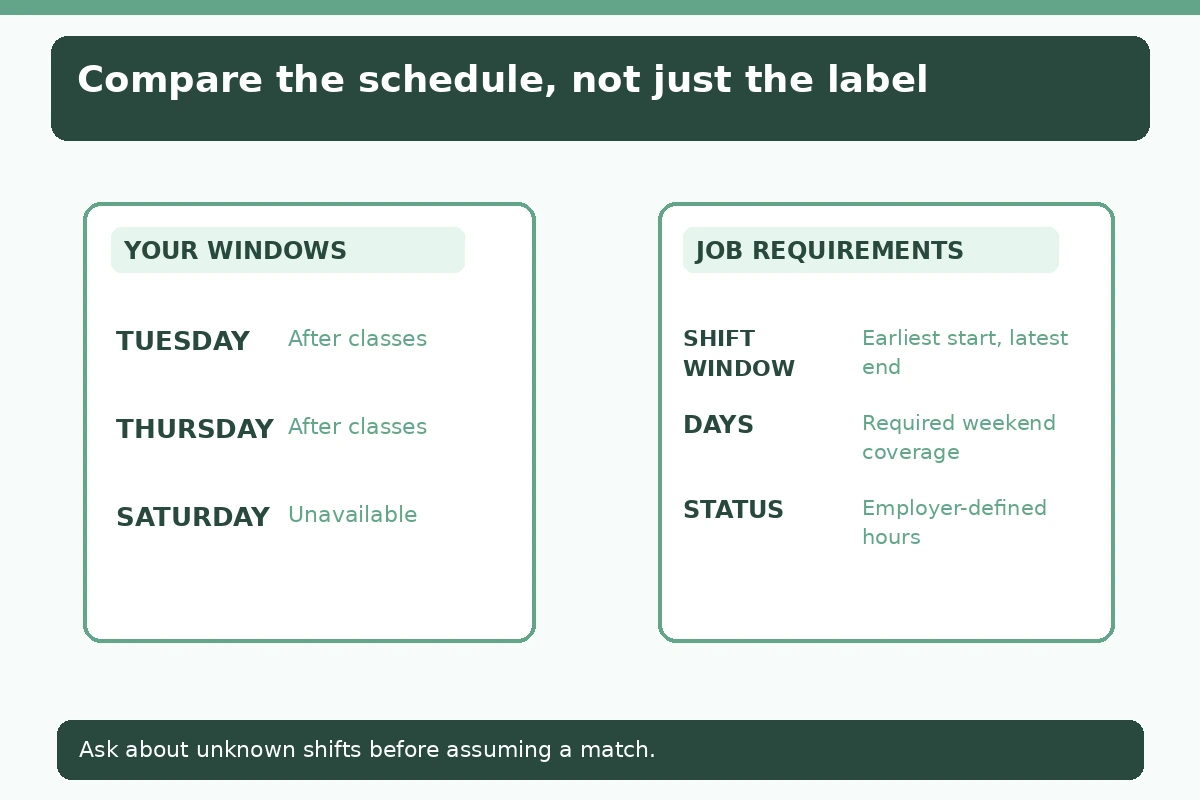
Choose an availability grid with weekdays, weekends, start and end times, commute buffer, and any dates when you will be unavailable. ‘Afternoons’ may mean something very different to a restaurant manager, clinic office, or warehouse. If you can work Tuesday and Thursday after class, write that rather than checking ‘fully flexible’ in a form. Include a private note about transportation and the time needed to reach work, but avoid posting personal circumstances publicly. This gives every part-time board search a clear pass/fail test, preventing applications to jobs whose shifts could never work.
Understand why part-time labels differ between employers
DOL’s FLSA guidance says federal law does not define full-time versus part-time employment. A board may display ‘part time’ while the actual listing uses a broad weekly range, rotating demand, or a temporary schedule. Do not infer benefits eligibility, exact paid hours, or fixed shifts solely from the filter. Read the employer’s policy and official job posting, and ask how hours are assigned in practice. Some companies use multiple categories for seasonal, variable-hour, and regular part-time staff. Record the employer’s exact label and the written hour range, leaving unknown information marked ‘not stated.’
Use role-specific filters in addition to the hour filter
Search for the kind of work you can perform: front-desk support, stocking, classroom aide, recreation attendant, payroll assistant, or another realistic role. Add location, on-site or remote, workdays, required experience and credential filters. A broad part-time search often mixes hourly employees with independent contractors and commission-only arrangements; separate those forms of work. If a listing says ‘flexible schedule,’ investigate whether the employer offers mutually agreed shifts or expects open availability. Filter results by your concrete constraints and read the full description, not just the platform’s headline badge.

Check shift patterns, weekend requirements, and changes
Translate a posting into an example week without inventing hours. Identify whether the workplace uses fixed days, rotating shifts, split shifts, weekend peaks, on-call coverage, or variable demand. A posting that requests ‘weekend availability’ might mean alternating Saturdays or every weekend; neither is safe to assume. Ask how much notice workers normally receive, whether shifts can change, and who approves swaps. Compare these answers with obligations you already have. The safest choice is a schedule whose expected range you understand and can sustain, not the one with the most attractive short description on the board.
Compare worksite location and actual travel time
Part-time roles can become impractical when a short shift requires a long or unreliable trip. Check the true worksite rather than assuming the company’s headquarters address. Some employers rotate staff between branches or assign event venues only shortly beforehand. If the board lists a city but not a location, ask for the possible sites and normal reporting instructions. Use your own travel estimate, not a fabricated figure from the article. If a remote role claims to be nationwide, verify time-zone constraints and state residency restrictions with the employer. Remote is a location arrangement, not a guarantee of flexible hours.
| What to compare | What the listing should tell you | Safe next action |
|---|---|---|
| Hours | Expected weekly range and shift length | Do not infer a fixed paycheck |
| Availability | Weekdays, weekends, rotations and training | Confirm actual required windows |
| Location | Specific site or remote state/time-zone rule | Verify official employer posting |
Ask about pay methods, hours records, and employment status
For an employee role, confirm the quoted rate or pay method, scheduled hours, and when hours are recorded. DOL says FLSA protections do not vanish simply because the employer calls someone part time. Rules vary by role and jurisdiction, so avoid blanket claims about overtime, paid leave, or benefits. If the listing is for freelance or contract work, clarify deliverables, payment terms and whether it is actually a different relationship. Keep compensation questions polite and specific. Do not calculate a guaranteed paycheck from a range of possible shifts, or assume the job will always give the same number of hours.
Verify the source before submitting a sensitive application
A job-board application can be convenient, but use an independently found company careers page to check that the position exists. Compare employer name, address, requisition, role type and shift description. The FTC warns that scam listings can offer effortless remote work or request money and financial information. Avoid any supposed recruiting process that requires an application fee paid to a stranger, depositing a check and sending part back, or completing paid click tasks. Submit identity and payroll details only through an authenticated employer process when genuinely needed. Save the verified link and a dated record of what you submitted.
Use a simple three-column shortlist
For each promising role, record ‘confirmed fit,’ ‘question for employer,’ and ‘not compatible.’ A hypothetical evening receptionist opening may list a part-time label but no ending time: that belongs under ‘question,’ not ‘confirmed.’ A role requiring every Saturday when you cannot work Saturdays belongs under ‘not compatible’ even if everything else sounds appealing. Add the official listing URL and date checked. This short sorting exercise reduces wasted applications and avoids treating an algorithm’s relevance score as an employment commitment. You can revisit uncertain listings if the employer clarifies the schedule.

Follow up about availability before accepting an offer
At the interview, explain the working windows you can truly honor and ask how schedules are published. If the employer offers the job, read the written terms for ordinary hours, expected weekend coverage, training shifts, worksite and reporting manager. A starting schedule may differ from long-term assignments, so ask which details are fixed and which can change. Keep the written explanation rather than relying on a verbal promise from a third-party board. Your goal is a job whose actual duties and schedule you can do reliably, not simply one marked ‘part time’ in a search filter.
How We Research Job Search Websites
JobAsk checked these public primary sources on November 16, 2026: DOL clarifies that FLSA does not define full-time or part-time and discusses wage and scheduling questions. DOL explains that the FLSA does not separately address part-time employment. FTC describes job scams and precautions for job boards. We compared this search intent with the user-provided inventory of WordPress posts and the preceding JobAsk packages. Public search and a local inventory cannot confirm private WordPress slug availability. Job listings and platform interfaces can change; examples here are hypothetical, not current job offers. We do not guarantee hiring results, compensation, endorsements or employer approvals. Read our affiliate disclosure.
Related Job Search Guides
The FLSA does not set a universal definition. Employers generally determine their part-time designation; check the actual schedule and applicable employment rules.
Not necessarily. Some labels are broad or employer-supplied. Ask about expected weekly range, training shifts and scheduling method.
No. A part-time role can have fixed, rotating or weekend shifts. Confirm the employer’s required availability.
Relevant wage rules may still apply. DOL notes that an employer’s full-time or part-time label does not change FLSA applicability.
Pause and verify. The FTC identifies upfront fees, fake checks and payment demands as warning signs of job scams.