
An entry-level copywriter job is a plausible first step when you can show clear writing for a defined audience and medium. Search for junior copywriter, marketing copy assistant, or content assistant openings, then read the duties instead of assuming the titles mean the same work. A useful first application includes a small, labeled portfolio: the assignment, the copy you wrote, and what you changed after feedback. It does not require imaginary clients, fictional sales figures, or a claim that a classroom exercise ran as a paid advertisement.
Read the assignment before trusting the title
A junior copywriter may draft a short product description, email subject line, paid-ad headline, or landing-page paragraph. A content assistant may research and organize longer articles; a social media assistant may schedule posts and adapt tone. These tasks overlap, but the intended audience, approval chain, and measures of success differ. Search several titles and record the actual deliverables. A title alone cannot tell you whether the employer expects independent campaign ownership.
Highlight verbs in an opening: draft, revise, proofread, research, upload, approve, and report. Drafting or revising under an editor suggests a more realistic first assignment than owning strategy and budgets across many channels without supervision. A listing labeled junior may still ask for previous agency work. Treat that as a fit question, not a reason to assume the employer will waive its requirements. Apply when you can meet essential duties honestly and explain any remaining gap.

Create one sample from a tightly written brief
Make a hypothetical brief for an ordinary, nonregulated product: a refillable notebook intended for students who want fewer loose pages. Specify the reader, the desired action, the channel, a word limit, and the facts you can safely say. Your deliverable could be a subject line, a two-sentence body, and a call to action. Label it ‘Self-directed spec sample, not commissioned or published.’ The label is part of honest evidence, not a weakness.
Show the brief alongside the sample. A recruiter can then judge whether your writing actually answers a task rather than merely sounding clever. Do not invent a discount, environmental certification, customer quote, or measurable conversion rate. If you choose a real brand for a speculative exercise, make the nonaffiliation unmistakable and avoid copying its protected material. Use ordinary original practice products when that is easier to explain.
Make revision visible rather than polishing away the process
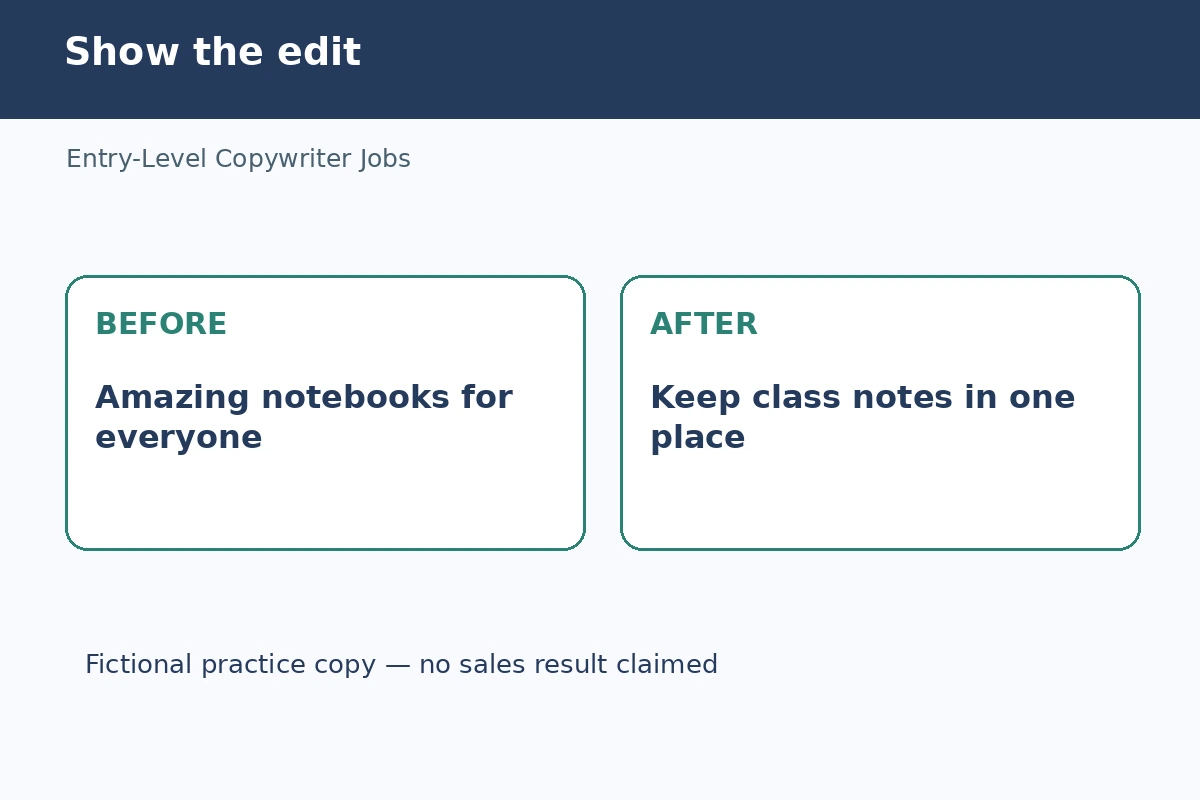
One strong sample can include a before-and-after pair. A vague draft such as ‘Amazing notebooks for everyone’ gives the reader little reason to act. A more concrete hypothetical version could be ‘Keep class notes together in one refillable notebook.’ Explain that you changed the copy to describe an actual use instead of making a broad claim. The result is a judgment example, not proof that one version converted better.
If you received real critique from a teacher or volunteer editor, say who reviewed the work only with permission and summarize the specific revision. If you revised alone, call it self-editing. Do not manufacture a client comment or a manager’s approval. Clear edit history can be more instructive than a decorative screenshot because it shows how you interpret a brief, test wording against the facts, and respond to limits.
Choose portfolio pieces for the actual channel
An employer asking for email copy should not have to search through ten unrelated opinion essays. Send a small relevant set: one brief-backed email, one product description, and perhaps a rewritten paragraph in a different tone. Mark the audience, intended medium, approximate length, and your role on each page. If the application asks for a single PDF or a specific file type, obey that direction instead of substituting a public portfolio site.
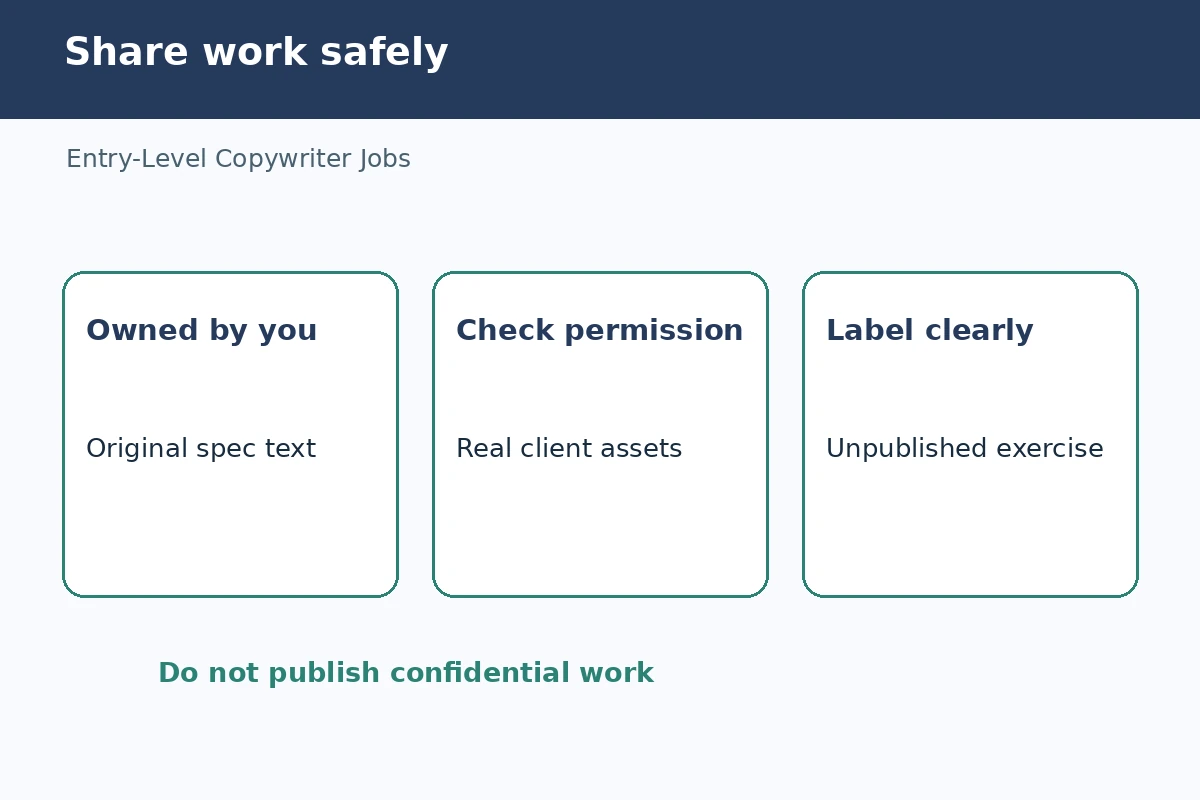
Keep portfolio access predictable. Public links should open without a login or expired sharing permission. For previous employers, honor copyright, confidentiality, and internal approval rules; a private campaign draft may be unsuitable for sharing even if you wrote it. When rights are uncertain, recreate the skill with fictional content and label the replacement clearly. Never publish customer lists, unreleased pricing, performance dashboards, or internal notes as portfolio evidence.
Use a two-column posting comparison
Before applying, split an opening into ‘Can demonstrate now’ and ‘Need to learn.’ Writing concise headlines, editing to a style guide, and creating drafts in a document tool may belong on the first side if you have examples. Managing an ad spend, securing legal approval, or reporting verified campaign returns may belong on the second side. Do not promote tasks you merely watched someone else perform into first-person ownership.
Look for indications of mentorship: a named editor, a review process, and concrete first-month assignments. Be cautious when ‘entry level’ appears next to sole ownership of every brand message and no approval pathway. That combination may be a poor fit, even if the company will accept your application. Your goal is to find work you can perform safely and improve at, not to collect titles with the word junior.
Write a focused application paragraph
A fictional applicant could write: ‘I created a short email and product-copy portfolio from self-directed briefs, with the audience, constraints, and revision notes included. I am comfortable revising copy for clarity and following a documented style guide. I would welcome the chance to support your editor on the product and email tasks described in the posting.’ This states available evidence and desired supervised work without claiming campaign results.
Adjust the paragraph to the job. If the employer writes for technical buyers, show your research and accuracy process. If it produces short promotional messages, place the clearest short sample first. Avoid sending a generic letter that repeats your résumé. A writing role makes basic mistakes in spelling, named products, or file permissions particularly costly; review the final submission in the same view the recipient will open.
Evaluate writing tests and feedback requests
A prospective employer may request a writing exercise or edit sample. Ask for the scope, deadline, intended use, and whether existing samples can demonstrate the same skill. Keep a record of the instructions and avoid sharing confidential work. If the task is unusually long or appears to request a finished live campaign, consider whether it reasonably assesses the role rather than supplying unpaid production content.
For feedback, ask one useful question such as ‘Was the sample missing a required audience detail or a more relevant channel?’ Do not demand an employer’s internal scoring notes. You can use any feedback you actually receive to improve the next sample. A rejection does not prove that your writing is weak, and a compliment does not establish that your copy will deliver a particular business result.
Use a repeatable application review
Save the posting, the exact samples you sent, the application date, and the role title in a simple tracker. When the next copywriting opening appears, compare its audience and deliverables rather than reusing the same portfolio blindly. Keep two or three strong samples current by improving the explanations, not by adding claims. This makes your work more relevant with every application.
A good final check answers four questions: Is this truly writing work? Can I show a real or clearly labeled practice example? Are all claims about clients and results accurate? Can the reviewer see the file without access problems? If yes, apply with concise evidence. If no, fix the weakest part before submitting another application that says more than your samples can support.
How We Research Entry-Level Roles
We compared task descriptions and preparation expectations in U.S. Bureau of Labor Statistics; Penn Career Services; BLS occupational research. The sources describe broad occupational activities, not a promise that a specific employer will hire a beginner. We distinguished supervised support tasks from experienced decision-making and avoided claims about vacancies, compensation, placement rates or employer outcomes. All example names, records, products, and exercises in this guide are illustrative. Check the current employer posting and keep your application truthful. This guide is not legal, financial, or safety certification advice. See our affiliate disclosure for information about recommendations and relationships.
Related Job Search Guides
Yes, where the requirements permit it. Label original practice or school work as such and show how it answers a brief.
Not necessarily. Match your sample to the employer’s channel, audience, length, and requested action.
No. A fictional or unpublished sample cannot establish a real campaign result.
Only when you have permission and it does not disclose confidential material; otherwise create a labeled alternative.
The brief, your actual copy, and one defensible revision explain your decision-making most clearly.