
Entry-level dispatcher jobs are not one single occupation. Non-emergency dispatch can mean coordinating a repair crew, relaying freight service messages, scheduling rides, or recording customer requests. It differs from public-safety emergency dispatch, which has its own training and procedures. Start by comparing the communication and record duties in the job posting. For a beginner, an accurate fictional intake log can demonstrate careful listening, verification, and escalation without claiming authority to direct vehicles or respond to emergencies.
Identify the kind of dispatch desk
Search for service dispatcher trainee, transportation dispatch assistant, scheduling coordinator, or dispatch support clerk. The title alone does not tell you whether the employer schedules field technicians, coordinates passenger trips, or manages freight communications. Read the exact equipment, shift, customer contact, and training requirements. Some roles may require prior logistics experience or specialized systems, so do not assume all dispatching is beginner-friendly.
O*NET describes non-emergency dispatch as coordinating workers, service vehicles, or information through calls and records. It is not interchangeable with police, fire, or ambulance communications. If a posting involves emergency response, evaluate that occupation on its own terms instead of treating it as the same work with a different phone line. In an application, identify the actual setting you can support.

Practice a factual request-intake log
Create a fictional service request with fields for caller channel, requested service, location as supplied, time received, contact reference, priority as assigned, and person notified. Do not include a real home address, driver phone number, or customer detail. The exercise should show what you heard, what you confirmed, and what remained uncertain. Use generic locations such as ‘Depot A’ and ‘Site B’ to avoid sharing personal information.
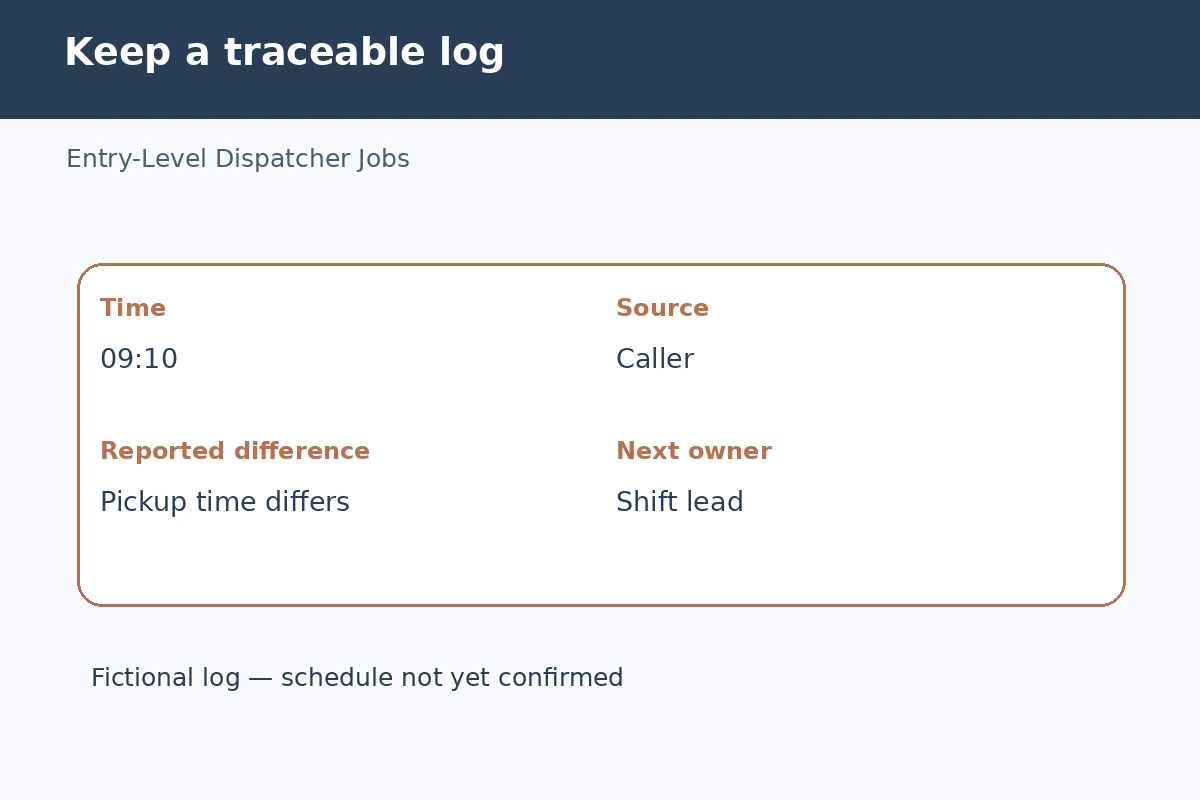
For example, a caller may report that a pickup time in the booking differs from the confirmation email. A junior staff member can record the mismatch and relay it to the designated dispatcher, rather than promising an arrival time. Distinguish the customer’s statement from independently verified facts. A line like ‘Caller reports 10:00; schedule confirmation pending’ is stronger than a confident but unsupported correction.
Follow the relay chain without taking control
The workflow may be receive, confirm, log, relay, and update after authorized feedback. Verify the callback channel and the person responsible. If details change, record the new information with the source and time; do not erase the earlier message without a trace. A documented chain reduces the risk of an unclear handoff. The right workflow depends on the employer’s communication system and rules.
A trainee should not independently reroute drivers, disregard rest requirements, or instruct staff to ignore a hazardous condition. Those decisions can require trained dispatchers, supervisors, or other specialized roles. This article is about job fit and communication practice, not operational dispatch instructions. In a sample portfolio, mark decisions as ‘supervisor confirmation required’ wherever approval or safety judgment belongs to someone else.
Recognize what must be escalated
Practice classifying messages by category without inventing an emergency protocol: missing details, changed appointment, repeated communication failure, or a reported safety concern. Your responsibility in a beginner exercise is to document the concern and contact the designated trained person immediately according to workplace instructions. Never turn an uncertain report into a verified fact. Do not promise a new schedule, resolution, or safe route before the responsible team confirms it.
If a caller describes an immediate danger, follow the employer’s emergency procedure and direct urgent matters to the appropriate emergency response channel as instructed. Do not improvise a dispatch decision based on a blog illustration. Different services operate under different rules and can have specialized legal or safety responsibilities. The relevant skill for a first-role candidate is knowing when the situation exceeds their assignment.
Compare shift work and information demands
Dispatch work can involve multiple inbound messages, fast handoffs, and schedules that change. Review whether a role is daytime scheduling support, evening operations coverage, or an on-call desk. Ask if the new hire receives written procedures and shadowing before handling messages alone. A flexible schedule is not automatically a good fit if you cannot reliably meet its hours and communication expectations.
Look at the stated tools as well. A job may use dispatch software, a spreadsheet, radio, or company messaging platform. A self-made log can demonstrate accurate records, but it cannot establish proficiency in a proprietary dispatch system you have never used. Call your exercise a process demonstration and explain which tools you actually know.
Turn customer service into an application strength
If you have answered phones, taken appointment requests, or documented customer issues, those habits may transfer to dispatch support. Describe what you really did. ‘Recorded service messages and forwarded unresolved requests to the shift lead’ is more credible than claiming to manage field crews if that never happened. If your experience is limited to school projects, show the fictional message log and explain the verification steps.
A hypothetical application line might read: ‘I practiced creating structured service-request notes with clear fields for source, time, unresolved details, and supervisor handoff.’ Do not call it paid dispatch experience. Show your attention to times and handoffs without claiming that you set priorities or authorized route changes. Interviewers can then ask meaningful questions about your accuracy and willingness to follow procedures.
Check the employer and the training path
Read the company’s official role description and verify the application route. Ask which tasks a trainee owns immediately, which require senior signoff, and how safety concerns are escalated. An employer that clearly documents communications and supervision offers more useful information than a posting that simply demands ‘work well under pressure.’ Consider whether you can meet the actual schedule and any role-specific credential requirements.
Avoid paying an unknown recruiter for access to a supposed dispatch opening or sharing unnecessary identification before confirming the employer’s legitimate process. Keep sensitive documents out of a public portfolio. If an application asks for a realistic example, supply fictional, nonidentifying data and label it. This protects the people whose information a real dispatch desk might handle.

Rehearse a clear handoff answer
An interviewer might ask how you would handle conflicting information. A good first-role response begins with what you can verify: repeat key details, note the discrepancy, log the source and time, and contact the assigned supervisor rather than making an unauthorized decision. Avoid telling a story in which you solved an emergency using procedures you do not know. The point is reliable communication under supervision.
Before applying, prepare one accurate sample record and a short explanation of the limits. Check that your résumé distinguishes customer service from actual dispatch work and that your availability fits the role. If an opening expects extensive unsupervised routing decisions, seek a clearer trainee or scheduling-support role. An ethical entry-level application shows disciplined records and safe escalation, not imagined control over operations.
How We Research Entry-Level Roles
We compared task descriptions and preparation expectations in O*NET OnLine; O*NET OnLine; BLS occupational research. The sources describe broad occupational activities, not a promise that a specific employer will hire a beginner. We distinguished supervised support tasks from experienced decision-making and avoided claims about vacancies, compensation, placement rates or employer outcomes. All example names, records, products, and exercises in this guide are illustrative. Check the current employer posting and keep your application truthful. This guide is not legal, financial, or safety certification advice. See our affiliate disclosure for information about recommendations and relationships.
Related Job Search Guides
No. Emergency public-safety communication is a separate setting with its own training and procedures.
Some support positions provide training; follow each employer’s essential requirements honestly.
A fictional intake log with the source, time, unresolved detail, and authorized handoff.
No. Keep routing and safety decisions assigned to qualified, authorized staff.
Follow the employer’s emergency procedures and escalate promptly to the appropriate trained people or services.