
Work-from-home copywriter jobs involve writing persuasive content for a defined audience and purpose, often from a client or marketing brief. The work may cover email campaigns, landing pages, product descriptions or advertisements. It is different from general reporting, proofreading and random “typing jobs.” Before applying, ask who provides the facts, who approves claims, how revisions are handled, and what rights the employer expects in the final material. This guide helps you evaluate actual assignments and build suitable samples without making up campaign results, clients or publication permissions.
Tell copywriting apart from content writing and editing
Copywriters commonly create messages designed for a specific action, such as registering, requesting information or comparing a service. Other writers produce informational articles, reports or scripts. A proofreader checks an existing text, while a copywriter may need to develop the message from the brief. The BLS includes advertising copy and client review among writers’ work, but no universal title guarantees a particular format. Some roles combine website copy, social captions and simple editing. Read the listed deliverables and channels before assuming the job matches your portfolio. A home-based writer still needs context, feedback and a documented approval process.
Use the creative brief as the first screening tool
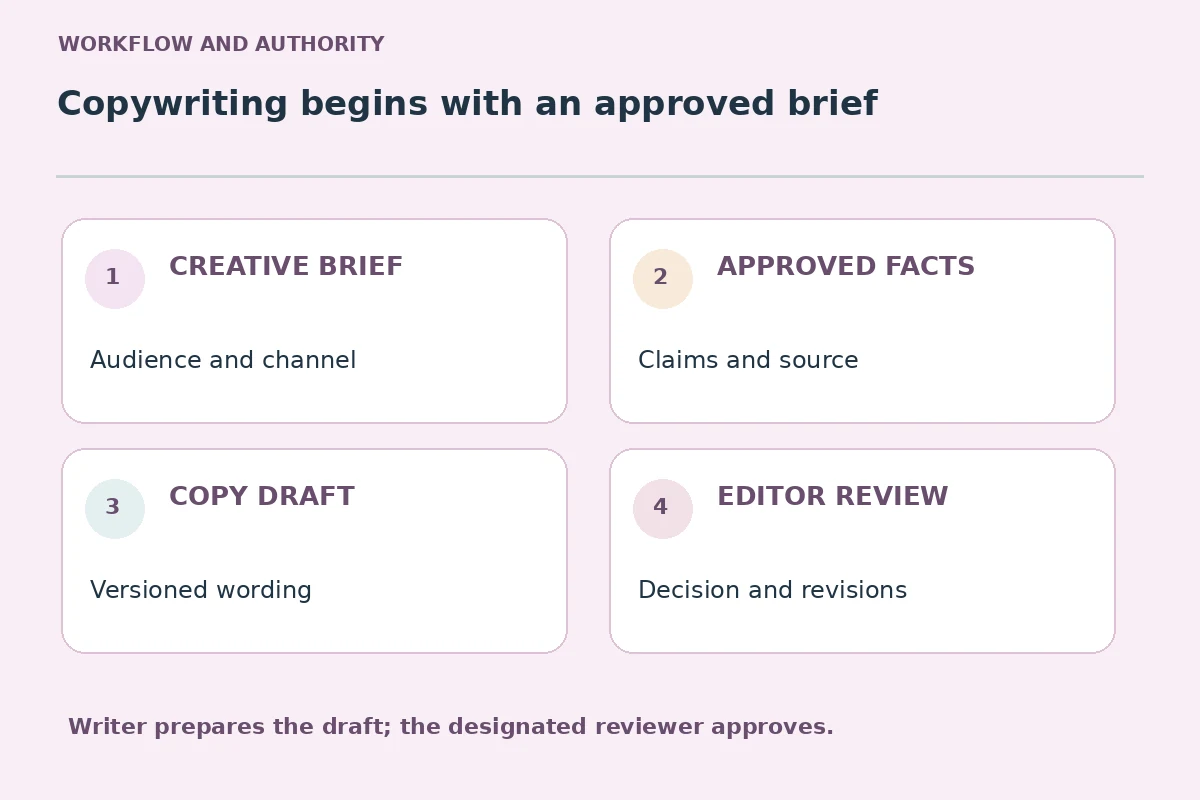
A plausible assignment identifies the intended reader, channel, message, relevant facts, brand voice, length constraints and desired action. Ask what supporting material is approved and what cannot be claimed. For a product email, for example, it matters whether the employer supplies verified features and a price or expects the writer to invent persuasive details. If an advertiser promises that you can produce effortless copy without a brief, find out how accuracy and review will work. You can demonstrate professional judgment in an application by explaining how you extract requirements, collect approved evidence and deliver clean drafts. Do not invent customer testimonials or independent product testing.
Compare remote employment with freelance projects
A staff role may assign ongoing writing tasks, collaborative review and scheduled hours; a freelance project may define discrete deliverables, payment terms, rounds of revision and usage rights. The word “remote” describes location, not employment classification. Ask who decides the schedule, supplies tools and approves the final text. A gig advertised as “pay per word” should still specify what counts as a finished deliverable and whether research or editing time is covered. Keep the role description, agreement and requested sample. A single freelance sample should not be represented as proof of running a long-term brand campaign or holding a managerial position.
Build a small portfolio around honest scenarios
A portfolio could contain a welcome email, a short landing-page section and an alternate headline set from a single fictional product brief. Label the product, company and results as illustrative. Explain the target audience, the approved facts and one specific reason you chose each message. That tells reviewers how you think, not just how you write. If you have real published work, check permission to share it and identify your contribution when designers, editors or strategists were involved. Do not remove confidential information merely by changing a brand name while retaining proprietary campaign details. Clean, bounded samples are more valuable than fabricated conversion rates.
Understand review cycles and who can approve claims
A copywriter may draft wording, fact-check supplied details and revise in response to editorial feedback. The final publication decision can belong to marketing, compliance, legal or a client. Ask whether “approval” means copyediting a draft or having authority to sign off an advertising claim. If a product description says an item is guaranteed to work, request authorized supporting language instead of amplifying the promise. During interviews, describe a revision process: record feedback, identify changed requirements, update the draft and return the correct version for approval. Do not promise that an ATS, advertising platform or audience will reward a certain phrase.

Read the rights and portfolio clauses before you accept
Ownership is not automatically the same for an employee, contractor and self-published author. The U.S. Copyright Office explains that rights can be transferred, but the relevant work arrangement and written terms matter. Ask which material the employer can reuse, whether you may display approved excerpts, and whether the agreement restricts use of drafts or client names. Do not make confident legal claims based only on a casual recruiter message. If a work-for-hire or assignment clause is unclear, consider qualified legal guidance before signing. For your own samples, use assets you created or have permission to use, and keep a record of image and text provenance.
| Checkpoint | Evidence to request |
|---|---|
| Creative brief | Audience, channel and goal |
| Source claims | Approved facts and limitations |
| Review workflow | Editor, legal or client approval |
| Rights and scope | Revisions and permitted use |
Clarify revision rounds, turnaround and communication
A home-based writing role may involve an asynchronous editorial queue or scheduled client calls. Clarify what happens if the brief changes after the first accepted draft. A reasonable process distinguishes factual corrections from completely new deliverables. Ask whether revisions are included in a quoted project price and who combines contradictory feedback. If two reviewers request opposite approaches, document the conflict rather than guessing which instruction controls. For an employment role, discuss realistic volume and deadlines rather than promising to produce unlimited polished copy in a few minutes. Show a sample version history or an annotated change summary if permitted. Consistent handoff is an actual skill, not a buzzword.

Verify listings, test tasks and payment conditions
Search for remote copywriter positions on the employer’s own hiring site and through reputable professional channels; verify the recruiter independently. Be careful with ads promising extraordinary income for simple typing or demanding a large unpaid writing assignment. A small, clearly scoped test may be legitimate, but ask how submitted material will be used and whether it is paid. The FTC warns against work-from-home job offers that request up-front fees or send checks for equipment purchases. Do not supply sensitive identity data through a casual direct message. Prioritize postings that explain the type of copy, review owner, work schedule and compensation structure over vague invitations to “earn from words.”
How We Research Remote Job Roles
We reviewed these primary U.S. government and occupational sources on November 17, 2026: BLS identifies advertising copy, research, client feedback and revisions as writer and copywriter work. U.S. Copyright Office explains that rights may be transferred and written agreements govern many ownership questions. FTC cautions that fake work-from-home offers seek money or identity data, and warns against advance fees and fake equipment checks. The role duties described above reflect typical tasks and professional boundaries, not an assertion that a particular company is hiring now. All illustrated cases, resumes, examples and names are hypothetical. Actual job requirements, employee classifications, geographic eligibility, equipment rules, permissions and work schedules differ by employer. Check any specific vacancy on the employer’s own site and confirm disputed claims with the responsible department. We do not guarantee employment, earnings, employer responses or interview outcomes. For commercial relationships and referral disclosures, see our affiliate disclosure.
Related Job Search Guides
Not always. Copywriting often aims to prompt a defined action and follows a marketing brief; blogs may be informational or editorial. Read the assignment.
Yes when the employer accepts spec work. Label it as a hypothetical sample and avoid claiming it generated commercial results.
The answer depends on the employment relationship and written terms. Ask about ownership, licenses, confidentiality, and portfolio permission before accepting.
Some involve live reviews and deadlines even if drafting is asynchronous. Confirm collaboration hours and feedback expectations.
Unverified recruiters, requests for payment, unreasonably large unpaid samples and vague ownership or compensation terms deserve further scrutiny.