
Entry-level environmental science jobs include different kinds of technical and field work. Rather than applying to every opening with “environmental” in the title, compare environmental science technician, field sampling assistant and laboratory support duties. A technician pathway can involve collecting samples, recording conditions and preparing data under supervision; it is not the same as being an independent environmental scientist.
This guide explains entry-level environmental roles and how to show your readiness, not which agencies are hiring now. Sample messages are hypothetical, so check every requirement against the real field or lab posting.
Choose the Entry-Level Job Type Before Applying
Field technicians may travel to sample sites and label water, air or soil samples. Laboratory support work can focus on preparation, instrument logs or basic testing tasks. Environmental compliance positions may involve different responsibilities, regulations and formal qualifications. Do not assume a first job authorizes you to handle hazardous substances, enter restricted sites or sign compliance reports.
Start with the daily work: field sampling, lab analysis, or data entry, not the job title. Compare two listings: the field or lab tasks, which decisions stay with scientists, what coursework they ask for, and the travel or seasonal pattern. A “technician” title can still expect a specific degree or field season experience.
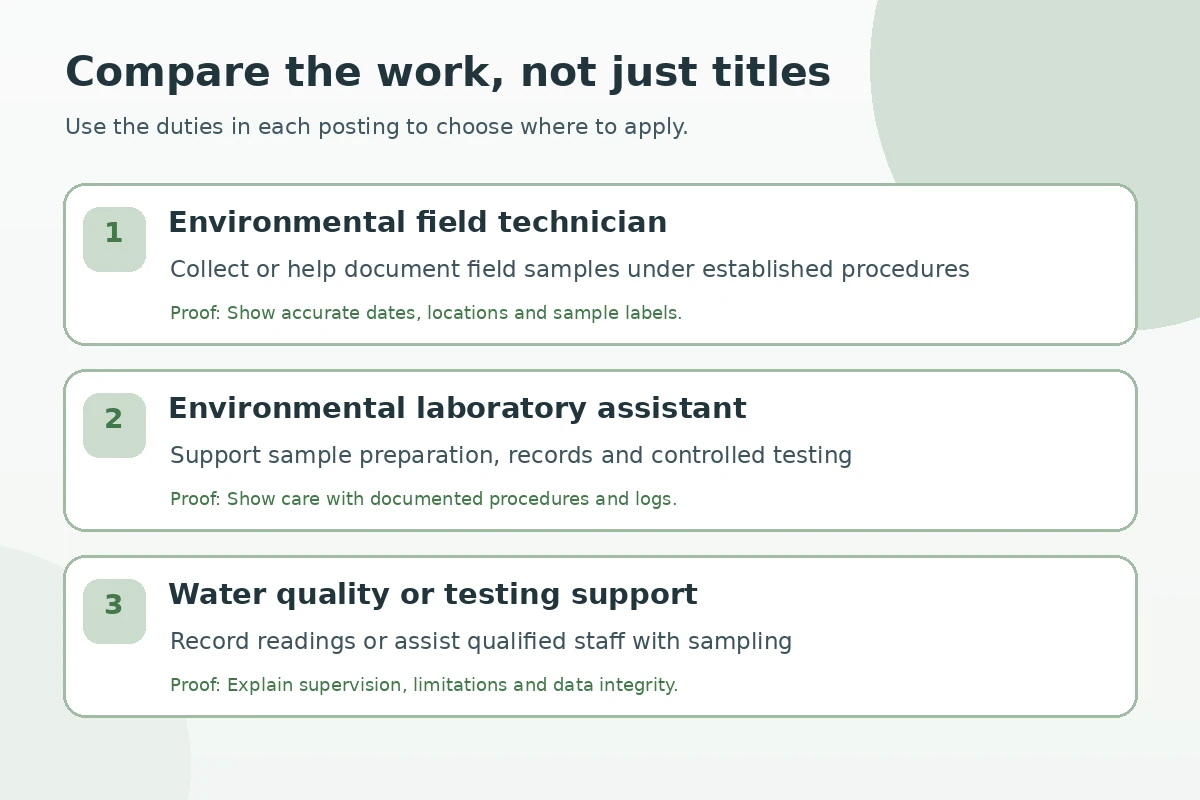
| Searchable role | What the work may involve | A truthful first proof |
|---|---|---|
| Environmental field technician | Collect or help document field samples under established procedures | Show accurate dates, locations and sample labels. |
| Environmental laboratory assistant | Support sample preparation, records and controlled testing | Show care with documented procedures and logs. |
| Water quality or testing support | Record readings or assist qualified staff with sampling | Explain supervision, limitations and data integrity. |
Check Education and Experience Requirements Carefully
BLS says environmental science and protection technicians typically need an associate’s degree; educational expectations can range from a high school diploma to a bachelor’s degree depending on the position. Science coursework and careful laboratory practice may matter. That is why “entry level” should not be read as “no relevant training needed.”
Sort the requirements into must-haves, field or lab skills you can show, and preferences you do not meet yet. Missing a preference such as GIS experience is normal; claiming it is not. If a role requires a driver’s license, safety training, or site access, confirm those details with the employer.
Build One Piece of Evidence From Your Real Experience
Technical credibility comes from describing the method and limits of what you performed. Name the units you actually recorded, the supervisor who reviewed work if relevant, and the checks you used to avoid mixing labels or samples. Never claim lab certifications, site access, statutory sign-off or chemical-handling qualifications from a personal exercise.
Practical project option: Prepare a fictional water-quality field log with sample IDs, dates, units, missing-value flags and a note that no real environmental conclusion is claimed. Label a practice exercise as coursework or self-initiated, and do not invent sample results or site data.
| Posting asks for | Evidence to consider | Clarify at interview |
|---|---|---|
| Sample traceability | A permitted school-lab log with anonymous or invented identifiers | What sampling training is required? |
| Data quality | A coursework chart that correctly describes the method and units | Who reviews the readings? |
| Field readiness | A truthful account of a supervised field or lab assignment | What travel and safety requirements apply? |
Compare a Hypothetical Example With Your Own Record
Hypothetical: A class team collects practice observations during a supervised field activity. A student records the site label, timestamp, sample identifier and measurement units; when one reading is missing, they mark it missing instead of inventing a value. The example illustrates careful documentation, not professional environmental clearance or laboratory accreditation.
Hypothetical resume line: “Maintained a supervised coursework sampling log with timestamps, labels, units and missing-data notes.” Use your actual course details only; never turn a class example into paid industry experience.
Before you copy a sample phrase, ask: did I actually do this field or lab task? Was it a paid job, a class lab, volunteering, or a personal project? Did you see the results, or did you only collect the samples? An invented sample count or agency name weakens a science application, however polished it looks.
Search for the Right Job Titles and Variations
Try “environmental technician,” “field sampling assistant,” “environmental lab assistant” and “water quality technician.” Compare field travel, outdoor work, lab practices, specimen handling, scientific coursework and supervised responsibilities. An “environmental scientist” listing may require additional degrees or independent analytical expertise. To go further, our guide “Entry-Level Environmental Jobs” shows how to compare field and lab technician paths.
Search under several titles, such as field technician, lab assistant, or environmental aide, and compare the duties. Track the employer, posting link, date checked, minimum requirements, status, and one question about field travel. The CareerOneStop job-search plan supports organizing your search rather than relying on repeated speculative applications.
Read One Posting Like a Decision Sheet
Copy the field and lab duties into a private checklist and mark the ones that appear more than once. Next to each duty, add a real example, a coursework example, or “not yet.” Look up unfamiliar terms like “chain of custody” before you use them. If a listing mixes field work with project management or permit decisions, ask what the job actually covers.
For each application, pick one requirement you meet, one field or lab story you can tell, and one gap to explain honestly. Open with a sentence that links your coursework or field experience to the task the employer needs. Do not send one vague cover letter to a lab, a consulting firm, and a parks agency.
Prepare for an Interview With Clear Boundaries
For a technical scenario, explain the procedure you would verify, the training and protective practices supplied by the employer, the supervisor to notify about anomalies and the records that need correction. Avoid prescribing unsafe testing or hazardous-material procedures from a career article.
Hypothetical practice case: A sampling sheet has two containers with similar labels, and one entry lacks a timestamp. First response: Do not assume their identities; pause the record, preserve the original information, and notify the responsible trained supervisor. Safe next step: Document the uncertainty and follow the approved correction and sampling procedure; never fabricate measurements.
Prepare one real field or lab example, one answer about a safety or sampling problem, and two questions about training and fieldwork. Make clear which steps you did yourself and which a supervisor or scientist approved. For an unfamiliar method or regulation, say you would learn it rather than guessing how it works.
Screen Job Listings and Protect Your Information
A listing on a large job board is not proof that the field job is real. Check the employer’s official site and be careful if a recruiter asks for personal details before an interview. The Federal Trade Commission’s job-scam guidance warns about fake-check schemes and demands to pay for the promise of a job. Never pay for equipment or training to secure a field job offer.
A personal practice log is not a field-safety manual, a regulatory sample record or proof of certification. Hazardous work requires employer-approved procedures, training and supervision.
Follow a Focused Five-Step Application Checklist
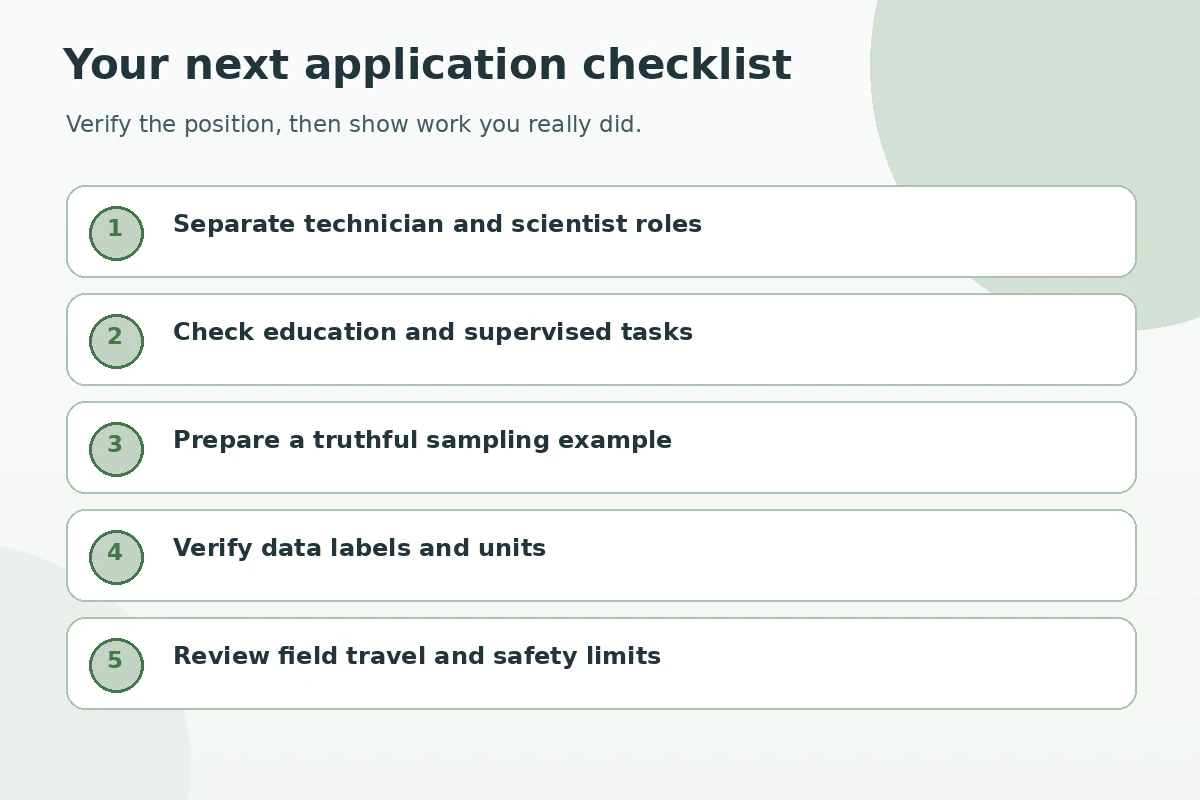
| Check | Do this before submitting |
|---|---|
| 1 | Choose technician or lab-support duties instead of an unrelated scientist title |
| 2 | Check degree, coursework, driving and site requirements |
| 3 | Prepare a truthful, permission-safe sample or lab evidence note |
| 4 | Explain units, traceability and missing-data handling |
| 5 | Confirm who supervises field work and handles safety training |
After you apply, note the date and status in your tracker. If you have a real contact, send one short follow-up and mention your field availability. If you do not hear back, keep your notes on which field skills came up most and which credentials you still need.
How We Research Entry-Level Career Paths
Occupational task claims are grounded in O*NET’s occupation profile and the U.S. Bureau of Labor Statistics. Practical search organization is based on CareerOneStop; caution about scams is supported by the FTC.
We checked the linked sources on October 20, 2026.
This guide contains no affiliate links. Read the affiliate disclosure for site-level information.
Related Job Search Guides
- Entry-Level Administrative Assistant Jobs: Build Credible First Proof
- Entry-Level Graphic Design Jobs: Match Your Portfolio to Real Work
- Entry-Level Warehouse Jobs: Read Tasks, Shifts, and Training Needs
- Entry-Level Automotive Technician Jobs: Trainee Routes and Skills
- Entry-Level GIS Jobs: Mapping Technician Routes and Project Proof
Some specific technician roles may accept a high school diploma, but BLS says an associate’s degree is typical and requirements vary. Check each listing carefully.
No. Technician work often supports sampling and analysis under supervision, while scientist positions may involve different educational and decision-making responsibilities.
Yes, if it is described as coursework and accurately reports your contribution without claiming professional certification or workplace experience.
No. Describe the practical methods and safety training you actually completed. Do not improvise hazardous procedures.
Match the specific field or lab duties, document relevant coursework or supervised evidence, and be precise about data accuracy and training limits.