
An entry-level warehouse job may involve moving stock, packing orders, receiving products, checking labels or recording what was shipped. Compare the physical tasks, working schedule and equipment training before applying. “Warehouse associate” can describe several work settings, and an advertisement may combine duties that require different instruction and authorization.
This guide explains entry-level warehouse roles and how to show your readiness, not which sites are hiring now. Sample messages are hypothetical, so check every requirement against the real warehouse posting.
Choose the Entry-Level Job Type Before Applying
Order pickers locate the requested goods; packers protect and label shipments; receivers verify delivered items; stockers replenish and track locations. Some jobs require lifting, repetitive movement, standing or variable shifts. A forklift or powered equipment assignment is not the same as a general hand-material-moving position; ask how training and authorization are handled.
Start with the daily work: picking, packing, receiving, or loading, not the job title. Compare two listings: the floor tasks, which equipment needs certification, what experience they ask for, and the shift pattern. A “general labor” title can still expect forklift or scanner experience.
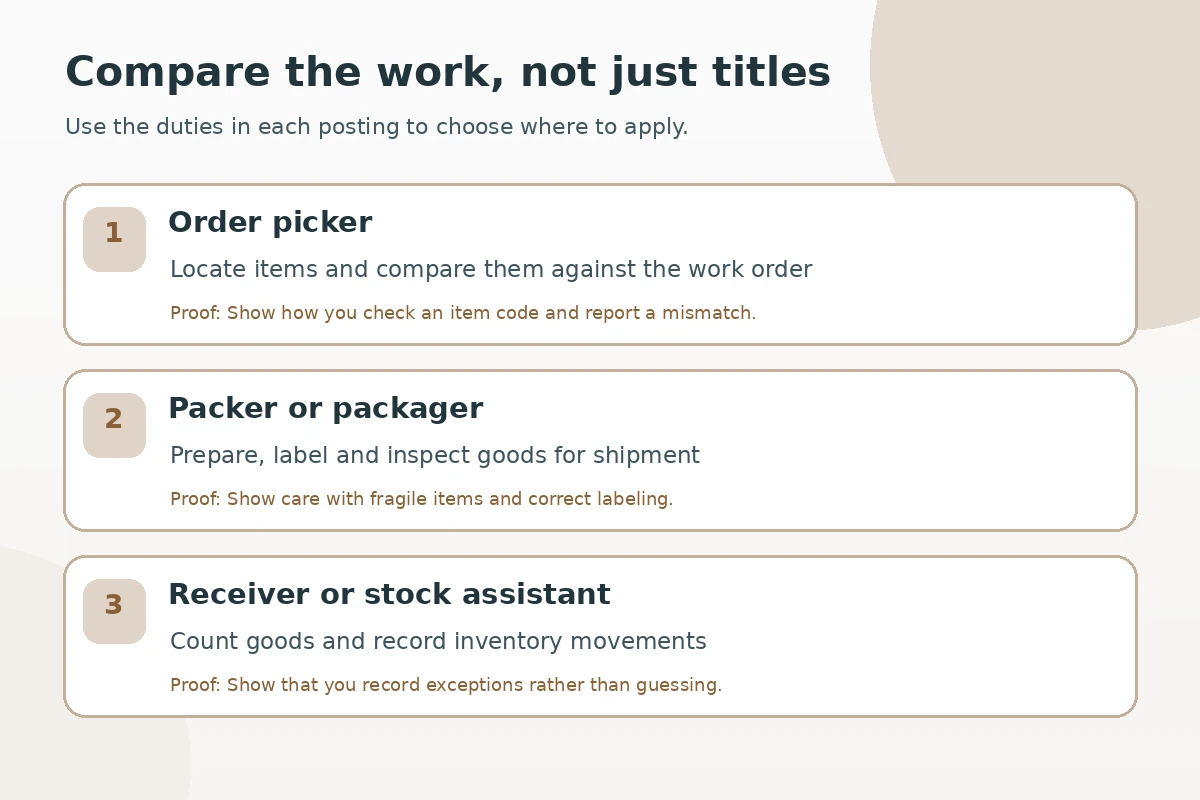
| Searchable role | What the work may involve | A truthful first proof |
|---|---|---|
| Order picker | Locate items and compare them against the work order | Show how you check an item code and report a mismatch. |
| Packer or packager | Prepare, label and inspect goods for shipment | Show care with fragile items and correct labeling. |
| Receiver or stock assistant | Count goods and record inventory movements | Show that you record exceptions rather than guessing. |
Check Education and Experience Requirements Carefully
BLS says hand laborers and material movers typically have no formal educational credential and often train on the job, but some roles need specific licensing or safe equipment instruction. These are occupation-wide patterns, not permission to operate any machine without employer training and authorization.
Sort the requirements into must-haves, floor skills you can show, and preferences you do not meet yet. Missing a preference such as equipment certification is normal; claiming it is not. If a role requires forklift certification or safety training, confirm those details with the employer and official sources.
Build One Piece of Evidence From Your Real Experience
A useful entry-level application focuses on reliability, accuracy and willingness to follow safety procedures, not invented productivity rankings. Explain how you followed a list, caught an error or asked for clarification. You should not claim forklift certification, machine access or a safe lifting capacity that you cannot verify. To go further, our guide “Entry-Level Environmental Science Jobs” shows how to find the technician path.
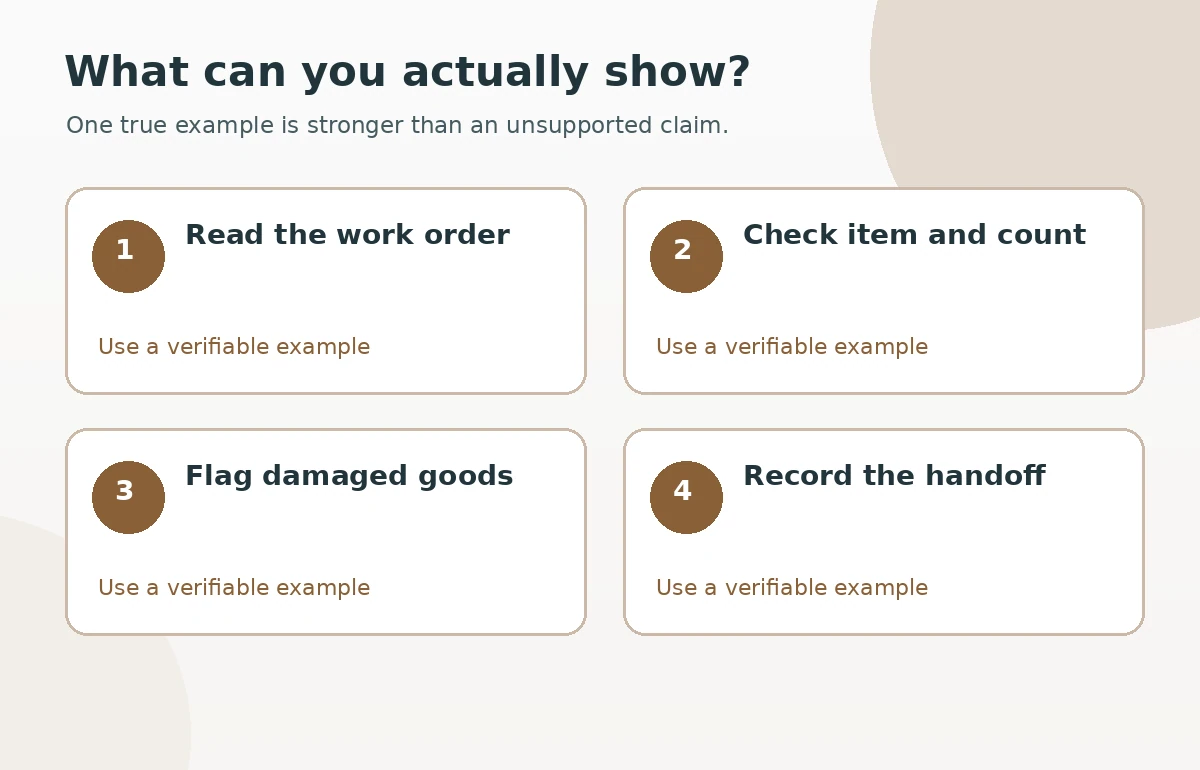
Practical project option: Prepare a simple mock pick-list with fictitious item codes, a checked quantity, a damaged-item flag and a documented handoff. Label a practice exercise as self-initiated, and do not invent pick rates or accuracy figures.
| Posting asks for | Evidence to consider | Clarify at interview |
|---|---|---|
| Order accuracy | A truthful example of checking a list or inventory record | How are errors corrected? |
| Physical and shift expectations | A realistic statement about tasks and availability | What safety training is provided? |
| Team handoff | A packing, delivery or volunteer organizing example | Who signs off on damaged goods? |
Compare a Hypothetical Example With Your Own Record
Hypothetical: A community donation team sorts sealed supply boxes. One volunteer compares label codes to the packing list, notices a mismatch and flags the box for the coordinator before it is delivered. This example can show checking and escalation but must not be presented as professional warehouse employment.
Hypothetical resume line: “Checked donated supply labels against a distribution list and flagged mismatched cartons to the coordinator before packing.” Only use it if you truly performed that activity.
Before you copy a sample phrase, ask: did I actually do this floor task? Was it a paid job, a school event, volunteering, or other physical work? Did you check the count, or did you only move the boxes? An invented pick rate or employer name weakens a warehouse application, however polished it looks.
Search for the Right Job Titles and Variations
Try “warehouse associate,” “material handler,” “order picker,” “packer,” “stock associate” and “receiving assistant.” Search for responsibilities as well as titles. Always read the location, shift pattern, lifting or physical demands and equipment expectations; a broad title cannot answer those questions.
Search under several titles, such as warehouse associate, picker, or material handler, and compare the duties. Track the employer, posting link, date checked, minimum requirements, status, and one question about shifts. The CareerOneStop job-search plan supports organizing your search rather than relying on repeated speculative applications.
Read One Posting Like a Decision Sheet
Copy the floor duties into a private checklist and mark the ones that appear more than once. Next to each duty, add a real example, a related job, or “not yet.” Look up unfamiliar terms like “cycle count” before you use them. If a listing mixes floor work with supervisor or inventory-control duties, ask what the job actually covers. Our guide “Entry-Level Customer Service Jobs” covers how to match the channel and the skills.
For each application, pick one requirement you meet, one reliability story you can tell, and one gap to explain honestly. Open with a sentence that links your physical or safety experience to the work the employer needs. Do not send one vague cover letter to a distribution center, a retail stockroom, and a factory.
Prepare for an Interview With Clear Boundaries
If asked what you would do after finding damaged or mislabeled stock, describe stopping the questionable handoff, reporting it through the workplace process, protecting other goods and documenting the exception. Do not improvise repair, disposal or machine operation instructions.
Hypothetical practice case: A picking list says four units, but a bin label appears to identify a different product. First response: Stop the pick, recheck the order identifier and item label, and ask the authorized team lead about the mismatch. Safe next step: Record the discrepancy and continue only when the correct product and quantity are confirmed.
Prepare one real reliability example, one answer about a safety situation, and two questions about training and shift changes. Make clear which tasks you did yourself and which a lead or supervisor approved. For an unfamiliar scanner or safety rule, say you would learn it rather than guessing how it works.
Screen Job Listings and Protect Your Information
A listing that promises immediate warehouse hiring is not proof that the offer is real. Check the company’s careers page and be careful if a recruiter asks for fees or bank details before you start. The Federal Trade Commission’s job-scam guidance warns about fake-check schemes and demands to pay for the promise of a job. Never pay a fee or send money to secure a warehouse shift.
Do not publish workplace identifiers, inventory sheets or delivery addresses. Never treat a hypothetical article as equipment-operation training or safety certification.
Follow a Focused Five-Step Application Checklist
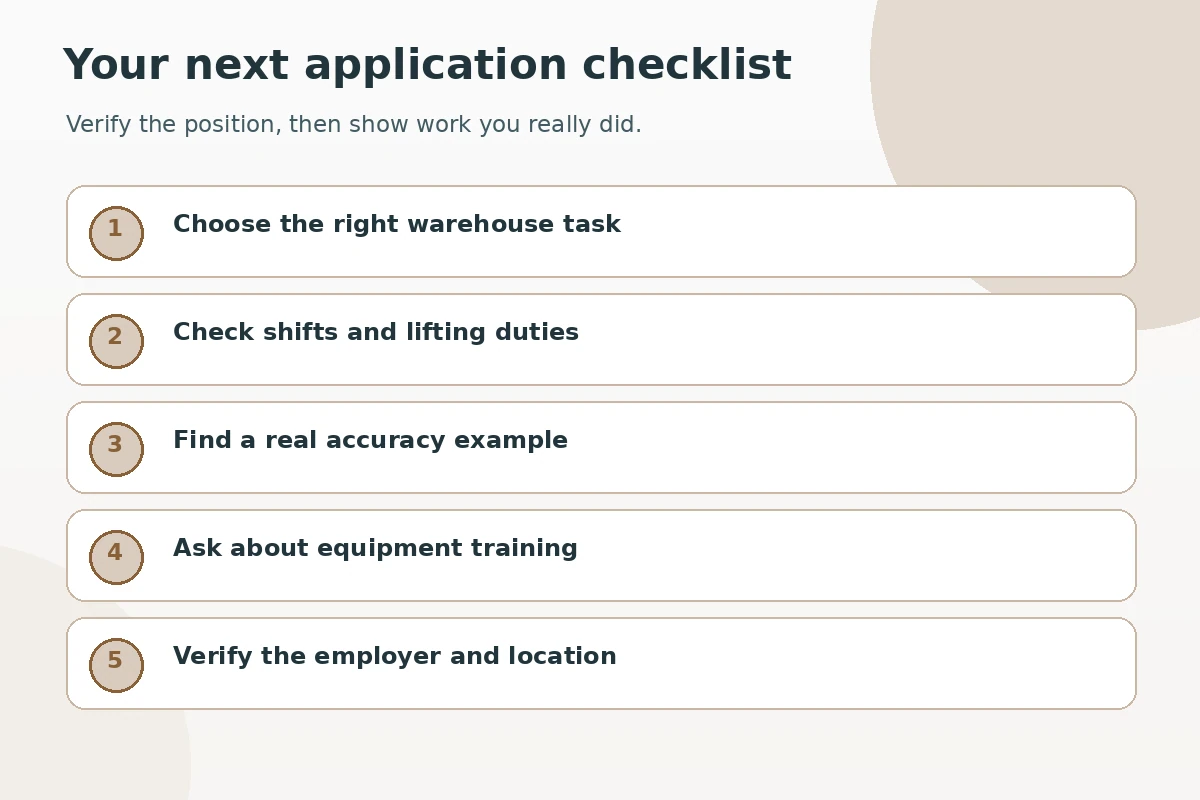
| Check | Do this before submitting |
|---|---|
| 1 | Compare picking, packing, receiving and general handling duties |
| 2 | Check shift times, site location and physical expectations |
| 3 | Read what training is provided for any equipment |
| 4 | Prepare one truthful accuracy or checklist example |
| 5 | Verify the hiring organization before sharing identifiers |
After applying, record the date, status, and the shift you applied for. If you have a real contact, send one short follow-up and confirm your shift availability. If you do not hear back, keep your notes on which floor tasks came up most and which certifications you still need. Our guide “Entry-Level Graphic Design Jobs” covers how to match your portfolio to real work.
How We Research Entry-Level Career Paths
Occupational task claims are grounded in O*NET’s occupation profile and the U.S. Bureau of Labor Statistics. Practical search organization is based on CareerOneStop; caution about scams is supported by the FTC.
We checked the linked sources on October 20, 2026.
This guide contains no affiliate links. Read the affiliate disclosure for site-level information.
Related Job Search Guides
- Warehouse Job Application Online: Check Shifts, Handling, and Training
- Part-Time Warehouse Jobs: Compare Shifts, Physical Tasks, and Entry Requirements
- Entry-Level Manufacturing Jobs: Compare Assembly Work and Training Needs
- Part-Time Warehouse Jobs: Compare Picking, Packing, and Shift Demands
- Entry-Level Data Center Jobs: Hardware Tasks, Shifts, and Safe Entry Paths
Some material-moving positions have no formal educational credential requirement according to BLS, but individual advertisements and specialist equipment roles may differ.
No. Work schedules can include days, nights or weekends, and they vary by employer and location. Read the specific listing.
Only if you can accurately describe the training and authorization you hold. Do not imply a beginner is automatically qualified to use powered equipment.
It can be useful related evidence when you accurately identify it as volunteer work and explain exactly what you did.
Ask about common tasks, shift schedule, physical demands, onboarding, equipment training and how errors or safety concerns are reported.