
For entry-level graphic design jobs, an attractive gallery alone may not tell an employer how you solved a communication problem. Match two or three relevant portfolio pieces to the deliverables in the posting and explain the brief, your layout decisions, revisions and final files. Do not treat every “creative” job title as the same role.
This guide explains entry-level design roles and how to show your readiness, not which studios are hiring now. Sample messages are hypothetical, so check every requirement against the real design posting.
Choose the Entry-Level Job Type Before Applying
A production artist may concentrate on preparing accurate files to existing specifications. A junior visual designer may develop layouts for digital assets. A marketing design assistant may adapt creative work across channels. Some jobs mix motion graphics, coding or product design; those can require skills outside a basic graphic design portfolio. Our guide “Entry-Level Customer Service Jobs” covers how to match the channel and the skills.
Start with the daily work: production files, social graphics, or layouts, not the job title. Compare two listings: the design tasks, who approves final files, what portfolio pieces they ask for, and whether the role is in-house or agency. A “junior designer” title can still expect several years of client work.
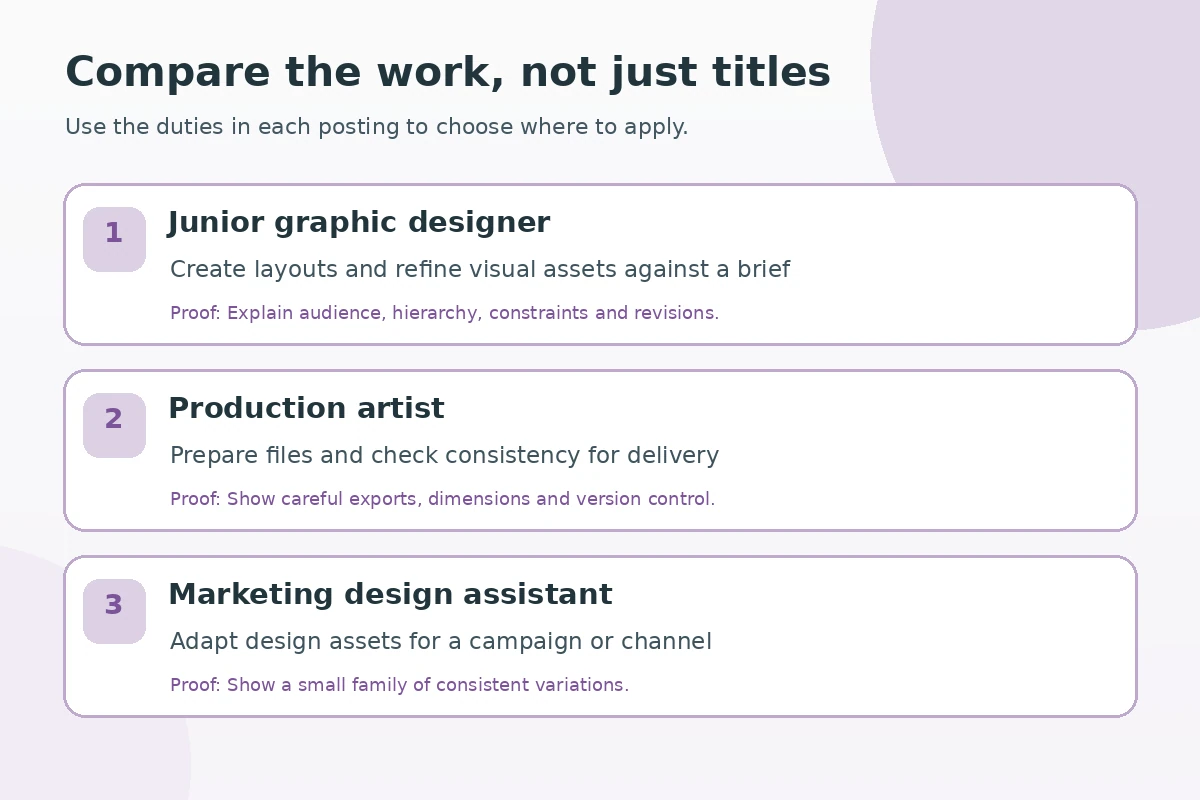
| Searchable role | What the work may involve | A truthful first proof |
|---|---|---|
| Junior graphic designer | Create layouts and refine visual assets against a brief | Explain audience, hierarchy, constraints and revisions. |
| Production artist | Prepare files and check consistency for delivery | Show careful exports, dimensions and version control. |
| Marketing design assistant | Adapt design assets for a campaign or channel | Show a small family of consistent variations. |
Check Education and Experience Requirements Carefully
BLS describes a bachelor’s degree in graphic design or a related field as the typical entry-level education and emphasizes portfolios for candidates. That does not prove every specific employer demands the same credential, nor that a short course guarantees eligibility. Compare required qualifications with what you can substantiate. If that is your next decision, our guide “Entry-Level Administrative Assistant Jobs” explains how to build credible first proof.
Sort the requirements into must-haves, design skills you can show, and preferences you do not meet yet. Missing a preference such as motion-graphics experience is normal; claiming it is not. If a role requires specific software or a portfolio review, confirm those details with the employer.
Build One Piece of Evidence From Your Real Experience
Employers evaluating design work can ask why you chose a layout, how you responded to feedback, and what specifications you used. Make one case study answer those questions. File names, licensed assets and collaborative credits also matter; accurately identify which parts you produced and which were provided to you.
Practical project option: Prepare a fictional event flyer, a matching social graphic and a short annotated note explaining typography, contrast and revision decisions. Label a practice piece as self-initiated, and do not use logos, client names, or images without permission.
| Posting asks for | Evidence to consider | Clarify at interview |
|---|---|---|
| Layout and hierarchy | Before-and-after examples you genuinely created | Who approves a final design? |
| Production accuracy | A sample print or screen export checklist | What formats and specifications matter? |
| Feedback and revision | An annotated improvement between two drafts | What are the review stages? |
Compare a Hypothetical Example With Your Own Record
Hypothetical: A student creates a poster for a fictional community workshop. An early draft makes the date difficult to read, so the student adjusts hierarchy, spacing and contrast, then exports a corrected digital version. This is a useful self-initiated case study when plainly labeled as fictional work, not a claim that an organization hired the designer.
Hypothetical portfolio caption: “Self-initiated event-poster concept; revised heading hierarchy for clearer time and location scanning; prepared one print and one digital layout.” Replace it with real project facts before submitting.
Before you copy a sample phrase, ask: did I actually design this piece? Was it a client job, a class brief, volunteering, or a personal project? Did the piece get used, or was it only a draft? An invented client name or engagement figure weakens a design application, however polished it looks.

Search for the Right Job Titles and Variations
Try “junior graphic designer,” “production artist,” “design assistant” and “marketing design assistant.” Read the deliverables: brand assets, print production, simple social creatives and product interfaces are not interchangeable. A listing requiring advanced 3D, animation and UI research may not be a beginner graphic-design fit.
Search under several titles, such as junior designer, production artist, or design assistant, and compare the duties. Track the employer, posting link, date checked, minimum requirements, status, and one question about the portfolio review. The CareerOneStop job-search plan supports organizing your search rather than relying on repeated speculative applications.
Read One Posting Like a Decision Sheet
Copy the design duties into a private checklist and mark the ones that appear more than once. Next to each duty, add a real example, a class project, or “not yet.” Look up unfamiliar terms like “print-ready files” before you use them. If a listing mixes design with marketing strategy or development work, ask what the job actually covers.
For each application, pick one requirement you meet, one portfolio piece to discuss, and one gap to explain honestly. Open with a sentence that links one portfolio piece to the work the employer needs. Do not send one vague cover letter to an agency, an in-house team, and a print shop.
Prepare for an Interview With Clear Boundaries
For a portfolio review, choose one project and walk through the purpose, audience, first draft, feedback, changes and deliverable. Avoid saying a design increased clicks or sales unless you actually have verified measurement and permission to share it.
Hypothetical practice case: A hiring manager asks how you would adapt a print flyer to a narrow mobile graphic. First response: Check the audience, size, priority message, image rights and required output formats before redesigning. Safe next step: Create an appropriate hierarchy and export a correctly labeled sample while keeping the same essential information.
Prepare one portfolio walkthrough, one answer about handling feedback, and two questions about how work is reviewed. Make clear which design choices were yours and which an art director decided. For an unfamiliar tool or brand rule, say you would learn it rather than guessing how it works.
Screen Job Listings and Protect Your Information
A freelance or remote design listing is not proof that the offer is real. Check the studio’s own site and be careful if someone asks you to buy software or pay for a test. The Federal Trade Commission’s job-scam guidance warns about fake-check schemes and demands to pay for the promise of a job. Never pay for a “starter kit” or software license to secure a design job.
Use only artwork you own, have permission to publish or can properly license. Credit teammates and disclose mock briefs rather than implying a fictional campaign ran for a real client.
Follow a Focused Five-Step Application Checklist
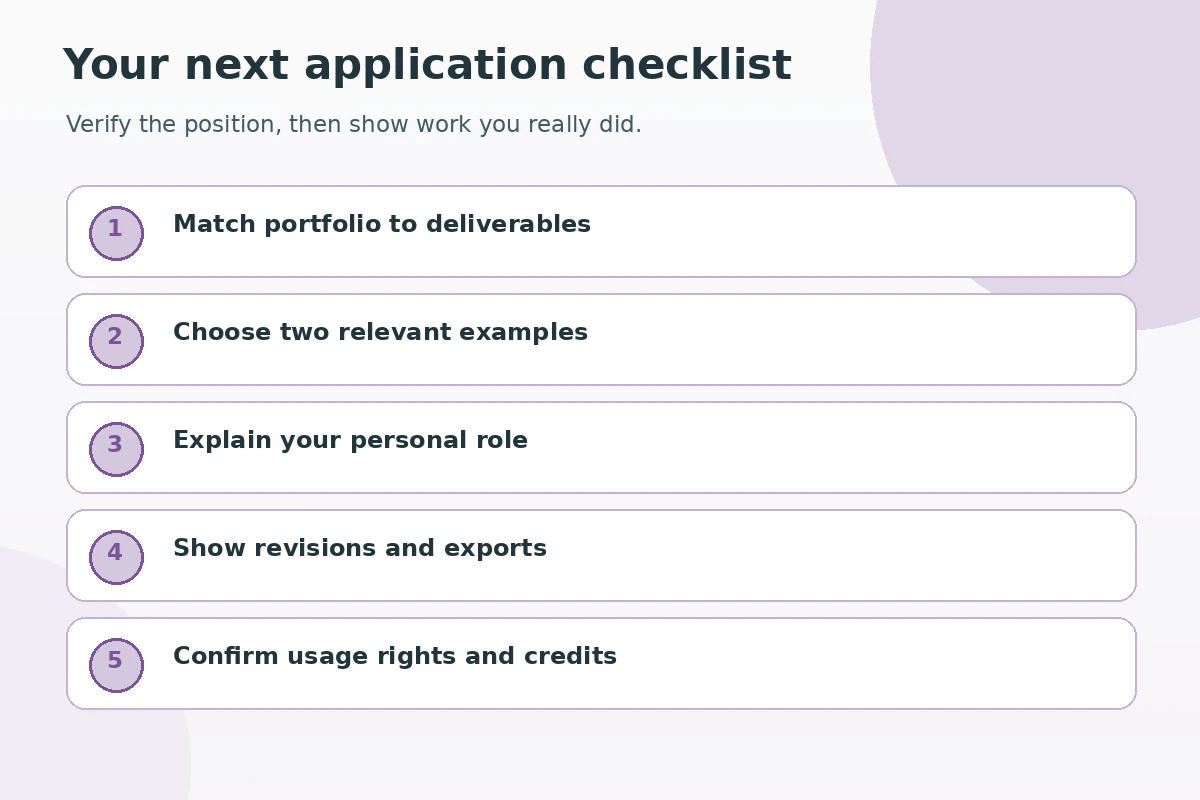
| Check | Do this before submitting |
|---|---|
| 1 | Identify print, digital, branding or production deliverables |
| 2 | Select two relevant portfolio examples, not everything |
| 3 | Explain the brief, changes and quality checks |
| 4 | Confirm file-format and design-tool requirements |
| 5 | Check credit, image rights and claimed results before sharing |
Once you submit, log the date, status, and which portfolio pieces you sent. If you have a real contact, send one short follow-up with a link to your portfolio. If you do not hear back, keep your notes on which portfolio pieces fit best and which skills employers asked for.
How We Research Entry-Level Career Paths
Occupational task claims are grounded in O*NET’s occupation profile and the U.S. Bureau of Labor Statistics. Practical search organization is based on CareerOneStop; caution about scams is supported by the FTC.
We checked the linked sources on October 20, 2026.
This guide contains no affiliate links. Read the affiliate disclosure for site-level information.
Related Guides
- Remote Content Writer Jobs: Match Your Portfolio to Briefs and Editing Workflows
- Questions to Ask in a Graphic Design Interview About Briefs and Feedback
- Entry-Level Graphic Design Jobs: Choose Junior Roles and Portfolio Proof
- Graphic Design Interview Questions for Portfolio and Feedback Reviews
- Graphic Designer Cover Letter: Explain Portfolio Choices and Feedback
Portfolios are commonly important, and BLS highlights them. Include accurate examples of your work, even if self-directed, and explain the context clearly.
Yes, when transparently labeled as personal or hypothetical concepts. Do not imply you were paid or endorsed by the organization.
Not necessarily. Lead with work relevant to the exact job’s deliverables and show how you reasoned through constraints and revisions.
BLS identifies a bachelor’s degree as the typical qualification, but individual employers differ. Check the listing rather than assuming a portfolio always substitutes for formal education.
Only if you understand the licensing, permission and disclosure requirements of the assets and employer. Identify your actual contribution instead of presenting others’ work as original.