
A part-time medical receptionist position is an administrative job in a healthcare setting, not a clinical license. Common advertised tasks may include checking in patients, answering calls, scheduling visits, directing people to the correct team, and keeping records accurate. The exact scope depends on the practice and employer. Choose openings by desk workflow and shift requirements, not by assuming every “medical front desk” role includes the same responsibilities.
The BLS receptionist profile identifies visitor communication, calendars, calls, records, and varied office settings. O*NET also lists Medical Receptionist among related job titles. These sources describe occupation patterns; they do not establish the hiring standards or working hours of any particular clinic. Your first screening job is to separate administrative responsibilities from clinical judgments, patient-specific advice, and tasks requiring additional training.
Read the Front-Desk Workflow in Order
Look for a description of how visitors arrive, confirm appointments, complete the employer’s check-in steps, and move to the appropriate waiting area or staff member. Some front desks primarily receive calls; others involve scheduling, forms, payments, or records maintenance. Ask whether the role covers one provider, multiple departments, or a shared call queue. These distinctions change the pace and skills needed, especially on a shorter shift with limited handoff time.
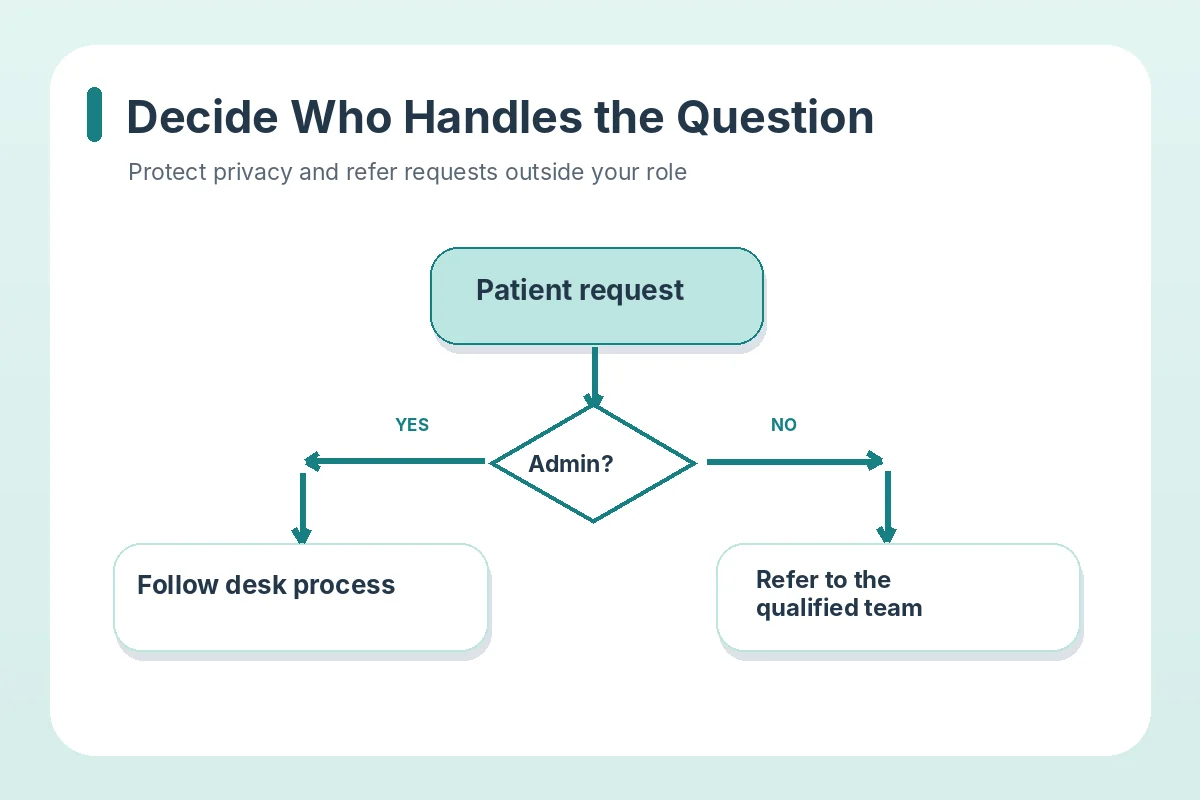
Use a simple workflow map: arrival or call, identification of the request, authorized administrative action, documented handoff, and follow-up. If a person asks for a diagnosis, medication recommendation, or interpretation of results, that is not a routine receptionist decision. The safe skill to demonstrate is identifying whom to contact and passing the request along through the organization’s approved process.

Inspect the Shift Pattern and Coverage
Part-time can mean a fixed morning block, several afternoons, weekend reception, or cover for another staff member. Some healthcare reception settings operate outside regular business hours; the BLS work environment guidance notes evenings and weekends in settings such as hospitals and nursing homes. That does not mean a particular clinic will offer those shifts. Ask about arrival time, closing paperwork, breaks, training hours, and occasional schedule adjustments.
For a hypothetical applicant available Monday, Wednesday, and Friday until 2 p.m., a role requiring daily late-clinic closing would be unsuitable. The applicant should confirm the schedule before an interview rather than promise to be flexible. Also ask who covers the desk while the receptionist is at lunch or away from a call. Reliable coverage affects how well patient requests can be handed off.
Translate Administrative Experience Honestly
Useful examples can come from school offices, community organizations, a customer counter, or a scheduling volunteer role. Describe how you handled incoming requests, kept a calendar accurate, conveyed information, or maintained documents. If you have never used a medical scheduling system, do not label ordinary calendar use as electronic health record expertise. Software named in a posting may require employer-specific training and supervised access.
A hypothetical bullet might read: “Scheduled volunteer appointments and confirmed changes through the organization’s shared calendar.” This shows coordination without inventing clinical knowledge. If you have handled confidential information under an actual policy, describe the practice at a high level without revealing any private records. If not, state that you understand the need to follow the employer’s privacy and authorization procedures rather than claim specialized compliance credentials.
Clarify Questions You Should Escalate
Medical reception sometimes combines administrative and payment activities, but the responsibility line must be clear. An unclear insurance explanation, appointment eligibility question, or patient complaint may require referral to trained office personnel. Ask who handles clinical questions, record access, documentation corrections, and payment discrepancies. A strong candidate is not someone who personally resolves every question; it is someone who knows when accurate routing protects the visitor and the organization.
At a hypothetical check-in, a visitor reports that the date on the appointment reminder differs from the calendar. The receptionist should verify the available scheduling record according to office policy and ask a designated staff member to resolve discrepancies. Do not promise a clinician’s availability, disclose another patient’s details, or change records without appropriate permission. These examples are training scenarios, not accounts of a real practice.
Check Training and Credential Wording
Many advertisements list a combination of education, customer-service experience, typing, familiarity with scheduling software, and familiarity with healthcare terminology. Read “required” separately from “preferred.” A front-desk receptionist role is not automatically the same as medical assistant, coder, or technician work. If the posting includes clinical procedures, verify the exact job classification and any state or employer requirements rather than assume front-desk experience qualifies you.
During screening, ask how the organization teaches check-in procedures and who supervises new staff using patient-facing systems. Find out whether orientation can be completed within your proposed part-time schedule. Keep a clear list of systems you have used and systems you are willing to learn. A truthful skill inventory is more useful than copying every software name from the advertisement.

Apply With a Precise Desk-Fit Summary
Write a short application summary naming the requested duties and one relevant example: scheduling accuracy, polite phone communication, document organization, or a careful handoff. Add your real weekly availability and earliest possible start date if requested. Review the site location carefully; clinics belonging to one health group can have different schedules and vacancies. Submit through the practice or health system’s authenticated application page.
Use an application log without storing patient data or other sensitive records. Record the role, location, schedule, posting URL, and next step. If a recruiter reaches you unexpectedly, independently verify the role and contact details. The FTC advice on job scams applies to healthcare administration jobs too: a professional-looking message alone does not prove that an offer is legitimate.
How We Research These Job Options
This guide uses U.S. occupation descriptions as background evidence and adds an applicant-side decision framework. It does not represent a live vacancy list, guarantee work, or assume a particular employer’s schedule. Examples marked hypothetical illustrate a method only; candidates must replace them with their own verified details. Sources consulted on 2026-10-23: BLS occupational profile, O*NET task profile, FTC consumer guidance. Affiliate relationships are not asserted; see the affiliate disclosure.
Related Guides
- Entry-Level Medical Receptionist Jobs: Front-Desk Skills and Role Limits
- Medical Receptionist Interview Questions: Scheduling and Privacy
- Medical Receptionist Cover Letter With No Experience: Scheduling and Privacy
- Part-Time Medical Assistant Jobs: Check Scope, Credentials, and Clinic Hours
- Medical Receptionist Resume Objective: Show Scheduling and Privacy-Aware Skills
It is generally an administrative front-desk role. Review any clinical duties separately and verify their training or credential requirements.
Some employers use part-time or varied scheduling, but actual opening hours and coverage needs determine fit.
It depends on the advertisement. Do not claim experience with systems you have never used; ask about training.
Follow the employer’s process to direct clinical questions to appropriately qualified staff, rather than giving medical advice.
Clarify desk coverage, shift end time, orientation, administrative scope, privacy procedures, and who receives escalations.