
For entry-level journalism jobs, search for reporting assistant, local news reporter, newsroom production assistant, audience/news assistant, and multimedia reporting roles, then check the actual editorial duties. The BLS describes a bachelor’s degree as typical for reporters and notes that internships and school media can help. A credible first portfolio shows work you truly reported: what happened, which facts were checked, whose perspectives were sought, and what the editor changed. A personal opinion essay or promotional article may demonstrate writing skill, but it should not be presented as independently verified reporting.
Distinguish original reporting from other writing jobs
An advertisement for ‘staff writer’ might mean reporting a city meeting, producing evergreen lifestyle content, or writing sponsored marketing material. Ask who assigns stories, what verification standards apply, whether interviews are expected, and whether the publication separates editorial content from advertising. O*NET describes research, interviews, fact checks, writing, and revision as newsroom activities. Those tasks—not a glamorous label—tell you whether the role will grow reporting competence.
Newsroom production and audience roles can be legitimate entry points, but they are not the same as receiving a reporting assignment. A production assistant may prepare approved material for publication; a reporter may gather facts in the field; a copy editor may verify style and clarity. Build a job-search table of the daily output and decision authority for each posting. If your current portfolio contains only a class newsletter, do not claim you managed a newsroom investigation. Show the parts you actually performed.
| Role to investigate | Evidence to bring | Editor question |
|---|---|---|
| Reporting assistant | Interview notes and verified draft | Who checks facts before release? |
| Newsroom production | Accurate handoffs and approved updates | Who can approve publishing? |
| Multimedia reporter | Reported writing with permitted media | What capture and editing support exists? |
Create a reported clip with a defensible source trail
Choose an accessible local event, public record, campus development, or community issue and ask a narrow question. Before you write, list the claims that require independent checking: dates, names, numbers, quotes, positions, and attributed opinions. Distinguish firsthand observation from information supplied by a source. The SPJ ethics code encourages accuracy and verification; it is a professional ethics resource rather than a legal guarantee for every reporting situation.
For a hypothetical community meeting brief, you could rely on an official agenda, your own attendance notes, and on-the-record interviews, clearly distinguishing decisions made from proposals discussed. Never invent quotes, imply you interviewed someone you did not, or add a second perspective that is actually your own paraphrase. If a relevant person does not respond, say only what happened and follow the assignment’s editorial policy. Retain your notes securely and respect any source confidentiality commitments you actually made.

Check what your clip proves before you share it
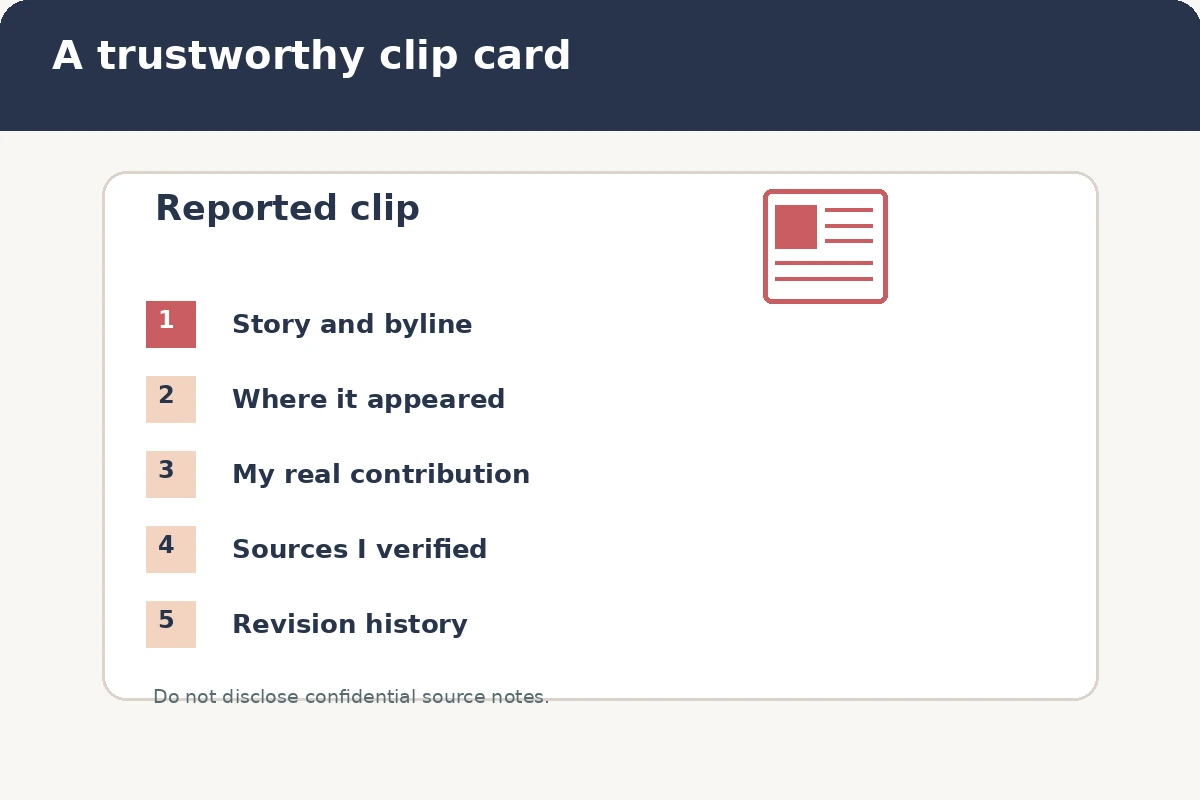
A portfolio link should lead to a published article you have permission to display, or a clearly labeled unpublished sample. Include the publication, date, and your precise contribution. If several students collaborated, identify who reported, photographed, edited, and fact-checked. A polished article with an unclear byline can be less useful than a simple honest sample with a short reporting memo explaining the sourcing.
For each clip, record an evidence trail without exposing confidential notes: original assignment, publicly shareable primary record, who reviewed the text, and whether a correction was made. Do not list private phone numbers, unpublished addresses, or restricted source material in a public portfolio. If an employer asks to see your approach, you can describe your verification method and any limitations while protecting commitments to sources and prior publications.
Learn a clean correction and revision process
Journalism is iterative. O*NET lists revising work to meet editorial approval and correcting factual, grammar, and style errors among journalism tasks. An entry-level candidate should understand the distinction between a stylistic edit and a correction of a material fact. If a date is wrong, confirm the primary record, inform the editor, and follow the publication’s correction policy; changing a draft silently after a published error can erase accountability.
For interview questions, prepare a real example of feedback. State what the editor asked you to check, which source resolved the issue, and how the draft changed. If you have never worked with an editor, request a faculty or peer review of a clearly identified class sample and describe the review honestly. Do not claim ‘no corrections ever’ as proof of quality; it can sound like you have not learned how to check your own work.

Show the right mix of reporting and multimedia skills
Newsrooms may ask for a short article, photo captions, audio clips, video, or verified social updates. Pick a format supported by your work and the vacancy. A reporting clip needs clear attribution and usable context; a visual component should have permission and an accurate caption. Do not use images from someone else’s feed without evaluating their rights. Avoid claiming you can broadcast live or handle hazardous field assignments merely because you have used a phone camera.
A useful miniature portfolio may contain one original text report, one documented update or correction, and one multimedia element with permissions. Quality matters more than the total number of links. Include a sentence about your verification approach: checking an official document, cross-confirming a date, or identifying the distinction between allegation and established fact. News content can change quickly, so note when your sample was last updated rather than presenting an outdated version as current.
Search editorial employers and read the work conditions
Look beyond a generic ‘journalism’ search: local newspaper reporter, community news assistant, newsroom digital producer, audio reporting assistant, and reporting internship are useful seeds. Check the publication’s careers page and distinguish paid roles from unpaid exposure pitches. Review shifts, field assignments, deadlines, editorial supervision, and the expectation to work nights or weekends. BLS notes that reporters’ schedules can change around breaking news; this may matter as much as the starting title.
Before applying, inspect the organization’s recent reporting and identify its audience and editorial formats. For each vacancy, note whether the job requires a degree, a driving assignment, production skills, or samples from a specific beat. A media platform’s name alone does not establish the role’s credibility; confirm who employs you and who can authorize assignments. Do not send unpublished sensitive source information to an unverified email address or an informal recruiter.
Apply with a source-conscious reporting pitch
A short application note might say: ‘My sample covers a publicly documented local meeting. I confirmed the agenda and vote in the official record, interviewed participants on the record, and revised the story after review.’ Only use such language if those steps actually occurred; the wording is hypothetical. Pair each claim with a portfolio example and be prepared to explain which facts remain unresolved rather than promising an impossibly complete narrative.
Ask hiring editors what a successful first assignment looks like, who reviews sensitive facts and legal concerns, and how corrections are handled. If you receive a reporting test, verify the deadline, editorial standards, permitted sources, and ownership of the result. A sustainable first job teaches disciplined gathering, writing, and feedback, not only rapid posting volume.
How We Research This Job Search Guide
This page is based on the following primary and occupational sources: BLS describes reporter responsibilities, degree expectations, internships and story samples.; O*NET outlines gathering information, checking facts, interviewing, editing and collaborating with editors.; The Society of Professional Journalists provides a voluntary ethics framework for accuracy, source care and corrections.. Sources were checked on November 16, 2026. We also compared the proposed intent against the supplied JobAsk WordPress title inventory, including drafts and published posts; this does not confirm an unpublished URL is available. Role examples are hypothetical and must be checked against an individual employer’s actual posting. We do not verify live jobs, salaries, licenses, training access, or offers for a particular applicant. This page contains no affiliate product recommendations; see our affiliate disclosure.
Related Job Search Guides
Some support or training roles may allow it, but original, clearly labeled reporting samples help demonstrate skills. Check the posting’s qualification requirements.
It can show writing ability, but do not present it as independently verified reported news unless it actually contains original reporting and attribution.
Use a small relevant selection that shows verifiable work and your real contribution; follow any exact number specified by the employer.
Update or correct it according to the publication or assignment process and be clear about the date and changes made.
No universal rule applies, but BLS says internships or school-media experience can help. Actual hiring requirements vary by vacancy.