
Entry-level market research jobs usually require you to separate three kinds of work: collecting responses, checking data quality, and interpreting what a sample may mean. Search for research assistant, survey operations assistant, research coordinator, and junior analyst, then read their duties instead of assuming each title is interchangeable. The BLS says market research analysts typically need a bachelor’s degree and research skills, so a candidate without that background may find a supporting data-collection or coordination role a better match. A trustworthy portfolio sample labels its source, method, and limits rather than claiming to have discovered a universal consumer truth.
Match the vacancy to a research workflow stage
Job titles are not standardized across employers. One ‘research assistant’ helps schedule interviews and maintain approved participant records; another cleans survey responses or prepares a chart. A ‘marketing analyst’ may own deeper statistics and recommend actions. O*NET describes collecting consumer information, designing research methods, producing graphical reports, and measuring campaign results, but that occupational description is not proof that every junior vacancy involves all of those tasks. Separate the job into recruitment, collection, cleaning, analysis, and reporting before deciding whether you qualify.
For each vacancy, underline the outputs a new hire must deliver. Are they expected to send approved survey invitations, maintain a fieldwork schedule, reconcile variable names, write a methods note, or independently recommend business decisions? The farther the work moves toward research design or inference, the more important statistical training and judgment become. Use a role matrix to decide whether to apply now, build a practice sample, or seek a structured training path. Do not substitute a generic digital-marketing portfolio for actual research evidence.
| Role family | Typical evidence to look for | Scope question |
|---|---|---|
| Survey operations | Scheduling, consent process, response tracking | Who approves participant contact? |
| Research data support | Source tables, cleaning log, quality checks | Who signs off on recodes? |
| Junior insights | Charts, methods, limitations, write-up | Who reviews interpretations? |
Check how research participants and data are handled
Market research frequently uses personal or behavioral information. Never assume that public visibility of a data point gives permission to use it for every commercial purpose. Ask whether the employer uses consent language, approved contact methods, access controls, and retention rules. A beginner should be able to follow a documented workflow and flag a data-handling concern without independently deciding that privacy obligations do not apply.
Interviewers and fieldwork coordinators may be asked to recruit or contact participants. Check whether scripts, incentives, participant instructions, and escalation procedures are supplied. Do not pitch yourself as able to scrape private customer profiles, bypass paywalls, or send unsolicited messages. If a public dataset is used for a sample, read its documentation and any usage limits. The priority is a valid, reproducible, respectful data process, not the largest possible number of records.

Build a compact public-data practice brief
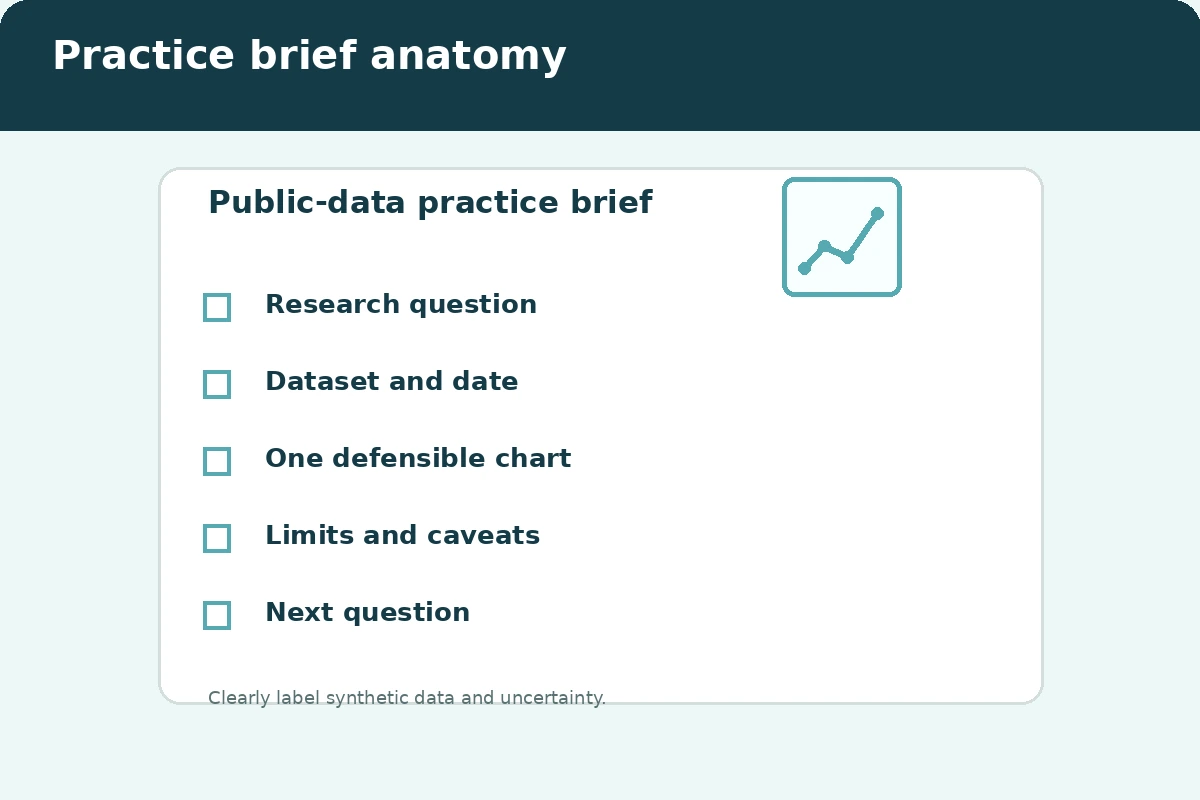
A practice project can demonstrate your approach even if you have never held a research job. Choose an openly accessible dataset with documentation—such as a relevant Census Bureau table—and ask one narrow, answerable question. Record when you accessed the data, the population and geography covered, variable definitions, filters, and missing values. Include one chart that is directly connected to the question and a short explanation of what the data cannot prove. Do not present invented survey responses as real people or imply that public population data measures consumer preference when it does not.
For example, a hypothetical candidate could compare a publicly available demographic measure across two locations, explicitly state that this is context rather than an estimate of product demand, and show a reproducible calculation. A second example could be a clearly labeled synthetic survey worksheet used solely to demonstrate validation rules; it must not be described as collected research. Strong evidence is often a clean source log plus honest caveats, not an impressive-looking dashboard with unknown provenance.
Show how you detect rather than hide messy data
A junior research hire may receive duplicate records, mismatched dates, out-of-range values, or unlabeled fields. The right response is to log the anomaly and follow the project method. Do not quietly discard records, replace blanks with zero, or redesign the sample because a chart looks unappealing. Document each change: original issue, decision rule, reviewer approval when required, and whether the final interpretation changes. An employer can evaluate an applicant’s reasoning when the transformation is visible.
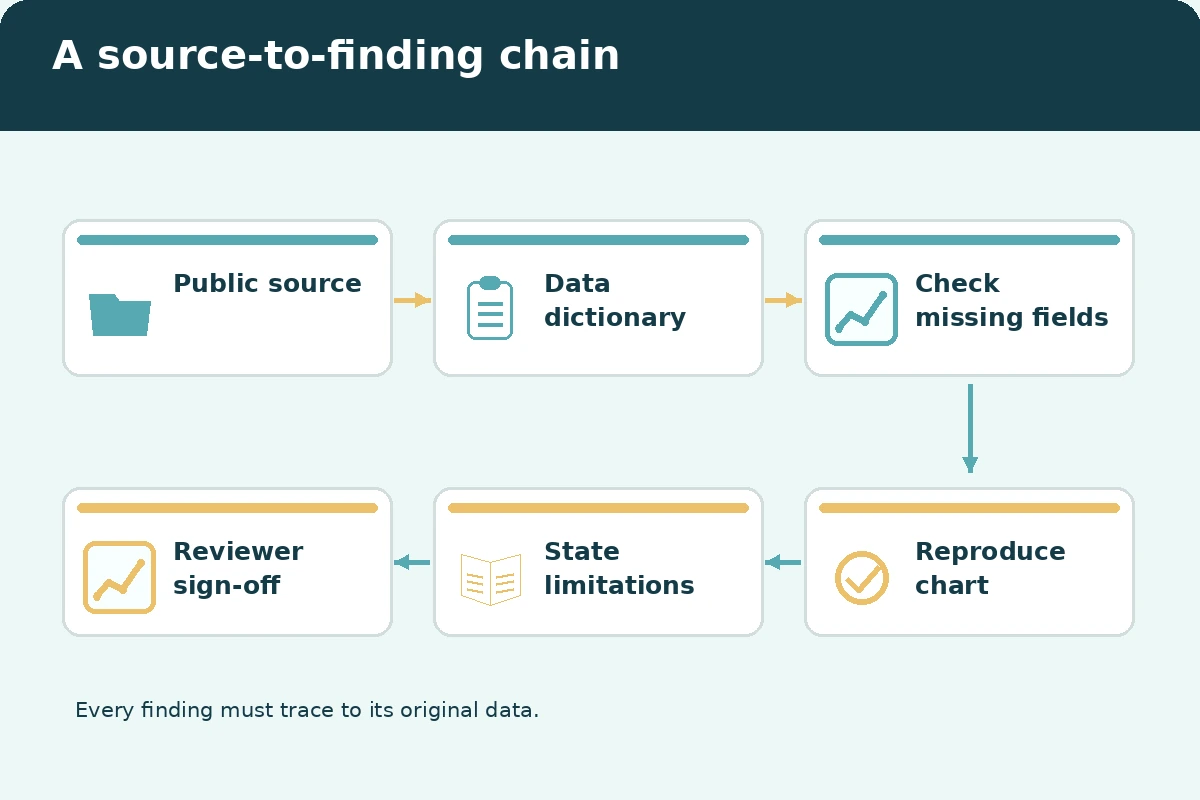
In a sample brief, add a one-page data dictionary and a change log. Show a count of checked records only if you actually calculated it from the example dataset. If you use formulas, explain them without calling an Excel workbook ‘advanced machine learning.’ Identify what you would ask a senior researcher before presenting a finding. This evidence fits a research-support position better than a resume full of unsupported claims such as ‘expert in all analytics platforms.’
Read qualifications and test assignments carefully
BLS notes that research analysts typically study statistics, research methods, and related topics. A job requiring survey sampling, statistical inference, or independent market forecasts may therefore be a less realistic first target than data-support work if your training is limited. Some employers also expect a bachelor’s degree; screen that explicitly instead of interpreting ‘entry level’ as ‘no education required.’ Coursework or prior administrative work can help, but it does not erase essential stated qualifications.
If the employer sends a practical assessment, confirm the scope, deadline, permitted data, and how the assignment will be used. Do not provide confidential records from a previous job or submit another person’s analysis as your own. A defensible response distinguishes observations, possible explanations, and recommendations that need further testing. It also labels any constructed example as hypothetical. Keep a copy of the instructions and your submitted work for future discussion only where permitted.
Search outside the single analyst job title
Try related titles such as survey research assistant, fieldwork coordinator, research operations assistant, consumer insights coordinator, and junior market analyst. These search terms are paths to investigate, not proof of current openings. Visit employer sites, research agencies, and organizational career pages to verify the official vacancy. Be cautious when a listing promises unusually rapid advancement but provides no actual research duties, supervisor, or data-protection process.
Use a tracker with the dataset or methodology mentioned in each ad, required software, degree requirement, expected output, and evidence you can supply. Apply to roles where your previous work maps to actual tasks—for example, record reconciliation, customer service call summaries with permission, or class research methodology. Keep the language accurate: a business presentation is not by itself a validated research study, and marketing campaign administration is not equivalent to independent statistical analysis.
Use a narrow and credible application pitch
The strongest beginner pitch explains one complete, modest research step. A hypothetical statement might read: ‘For a documented public-data class project, I checked source definitions, flagged missing fields, and prepared a chart with written limitations.’ If your actual work was a survey operations assignment, emphasize approved scripts, reliable tracking, and accurate handoffs instead. Avoid fake sample sizes, fabricated client names, or commercial claims about outcomes you never measured.
Before interviewing, prepare to walk through the origin of one figure and one judgment you deferred to a reviewer. Ask how the research team approves survey instruments, handles participant data, and distinguishes descriptive findings from causal conclusions. A useful first role exposes you to sound methods and feedback, even if it does not yet include ownership of the final recommendation.
How We Research This Job Search Guide
This page is based on the following primary and occupational sources: BLS reports that market research analysts typically need a bachelor’s degree and research methods.; O*NET describes research data, survey methods, analysis, and reporting tasks.; The Census Bureau provides public materials for understanding and using source data.. Sources were checked on November 16, 2026. We also compared the proposed intent against the supplied JobAsk WordPress title inventory, including drafts and published posts; this does not confirm an unpublished URL is available. Role examples are hypothetical and must be checked against an individual employer’s actual posting. We do not verify live jobs, salaries, licenses, training access, or offers for a particular applicant. This page contains no affiliate product recommendations; see our affiliate disclosure.
Related Job Search Guides
Many analyst postings do, and BLS describes a bachelor’s degree as typical. Support positions may differ; read the specific posting.
Often, if you follow its terms and cite the source accurately. Label population, methods, timing, and limitations.
No. Accurate collection and cleaning can support research, but analysis includes a separate process of interpretation and judgment.
You can use openly labeled synthetic data to demonstrate a technique, but must not describe it as responses from actual participants.
Search by deliverable as well as title: survey operations, research assistant, data quality support, or junior insights, then screen requirements.