
If you need to decline a job offer in person, thank the employer, name the position, and say directly that you will not accept it. Keep your reason optional and short; do not leave the conversation sounding like a negotiation if your decision is final. If the offer was formally made or the employer asks for a record, follow up with a concise email that repeats the decision. An unexpected offer on the spot is different: you can ask for time to review it rather than accepting or rejecting under pressure.
Tell the difference between a surprise offer and a final decision
A hiring manager may announce an offer at the end of a workplace visit, during a scheduled meeting, or while showing you around the team. The first task is to identify whether you actually have an offer, a preliminary expression of interest, or a request for a future conversation. Do not assume that a friendly statement such as ‘we would love to have you’ includes final terms. If you have not received the title, work arrangement, decision deadline, and a written summary, it is reasonable to ask for these details before deciding.
If you have already reviewed the offer and made a decision, you do not need to invent an objection to justify it. State the decision plainly and courteously. If you are still considering the terms, do not use the language of refusal merely to buy time. Say that you appreciate the offer and need to review the details, and agree on a realistic reply time. This prevents a spoken exchange from creating conflicting expectations. The separate JobAsk guides about offer deadlines and questions cover undecided situations in more depth.
Use a spoken script with a decision, gratitude, and a stop
A useful face-to-face response has three moves: appreciate the offer, make the decision unambiguous, and end on a professional note. For example, a hypothetical applicant might say: ‘Thank you for offering me the Operations Associate position and for taking the time to meet with me. I have decided not to accept the offer. I appreciate the opportunity and wish the team well.’ This contains no invented competing offer, critique, or promise to reconsider.
Make eye contact if comfortable, use a normal conversational tone, and pause after the decision. Resist the urge to fill the silence with a long apology or details about your family, finances, or another employer. You can acknowledge a thoughtful recruitment process without claiming that you will definitely apply again. If speaking to several people, direct the decision to the person authorized to manage the offer, not to a colleague who happened to be nearby.
| When the manager says | A clear response |
|---|---|
| “Can we change your mind?” | “I appreciate that, but my decision is final.” |
| “What was the main concern?” | “I decided this is not the right fit for me at this time.” |
| “Can you confirm in writing?” | “Yes. I will send a short email confirming the decision.” |

When the offer arrives unexpectedly, avoid accidental acceptance
An offer made during a site visit or an interview may catch you without the documents needed to compare alternatives. You can respond: ‘Thank you for the offer. May I have the written details and the decision deadline before I respond?’ This is not a rejection or acceptance. If the employer suggests that you must decide immediately, clarify the deadline once and evaluate what you actually know. Do not make a commitment solely to avoid an uncomfortable pause.
If you discover a serious mismatch while standing in the workplace, you may decline immediately if you are sure. But think through whether the concern is an unanswered question or a genuine deal-breaker. Asking a question is not a promise to accept. Conversely, saying ‘yes, absolutely’ can sound like acceptance even if you intend to keep shopping. Use exact language that matches your intention. The employer’s own instructions and any signed documents matter more than generalized etiquette advice.
Follow the conversation with an unmistakable email
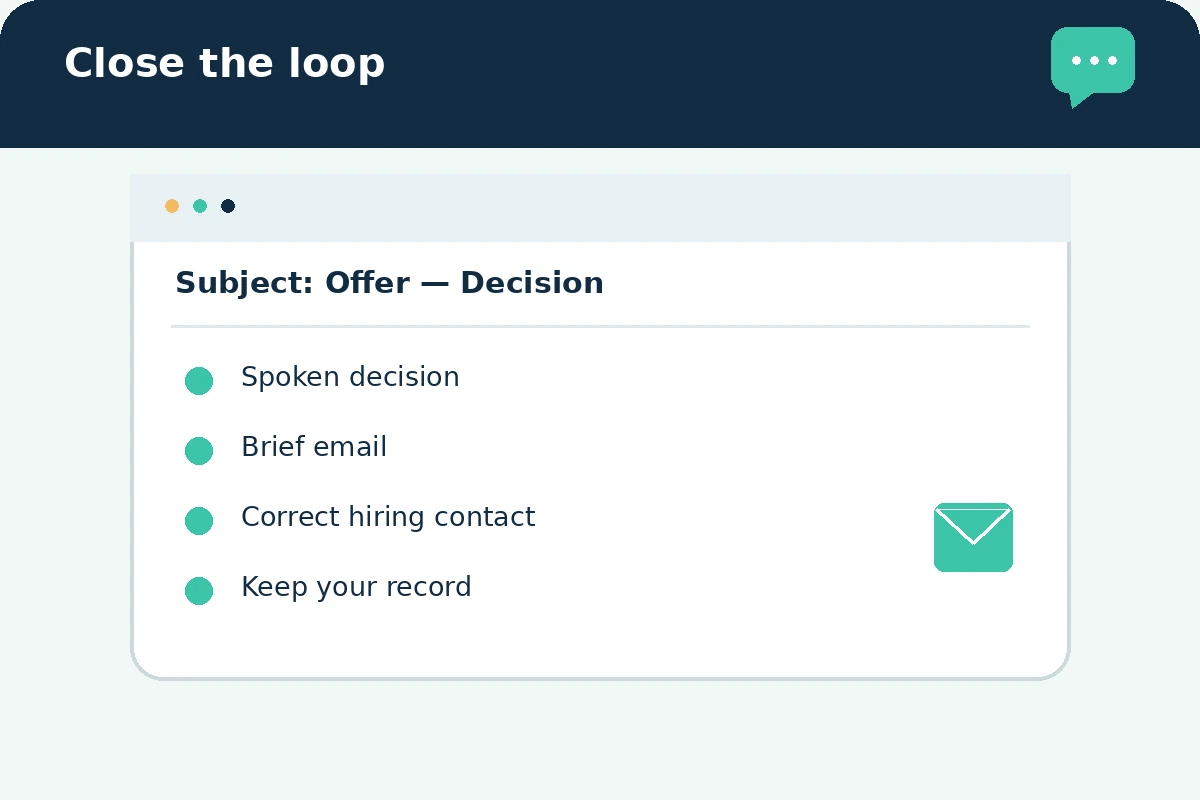
Send a written summary to the recruiter or hiring contact who formally extended the offer. An illustrative message is: ‘Subject: Operations Associate Offer — Decision. Thank you for meeting with me today and offering the Operations Associate role. As discussed, I am declining the offer. I appreciate your time and consideration. Best regards, [Your Name].’ Replace the bracketed signature and title with real details before sending. Do not include the word ‘accepted’ in a declined-offer subject line.
If the hiring team used an applicant portal, follow the verified employer directions for recording the decision there as well; an email may not automatically update a recruiting system. Save your sent note and any acknowledgment. Do not send a second, more elaborate explanation unless they request a factual clarification. UC Berkeley recommends a formal email notice and says that sharing a reason is optional. The goal is a shared, documented understanding, not a performance of regret.

Respond to pressure or a request for reasons without arguing
Sometimes a manager responds by offering a revised schedule, title, or work arrangement. If you genuinely want to reconsider, say that the decision is no longer final and request the updated terms in writing. If you do not want to continue, repeat the same clear answer without inventing conditions. Avoid negotiating against yourself by listing objections you hope the employer will not solve. A short ‘Thank you, but I am not proceeding’ is sufficient in many ordinary conversations.
If someone asks who hired you instead, do not disclose a different employer’s confidential offer details or imply one exists when it does not. You can share a general fit reason if you wish, but you are not obligated to provide medical, family, or financial history. If the atmosphere becomes confrontational, end politely and send the follow-up through the authorized contact. Offers connected to contracts, relocation repayment, or professional licenses may require review of actual documents beyond this communication guide.
Choose the right person and record the actual outcome
The person who welcomes you at reception may not be the person responsible for recruiting decisions. If a hiring manager made the offer but an HR representative sent the written terms, address the confirmation to the primary recruiting contact and copy others only when the employer’s process calls for it. Do not broadcast the refusal to the whole interview panel. Use the same job title or requisition reference appearing in the offer so recipients can match the decision to the correct opening.
After sending, check that the message reached the intended recipient, not a no-reply address, and that the portal status is consistent if a portal is used. One polite follow-up is reasonable when a time-sensitive request lacks acknowledgment; repeated reminders rarely add value. Keep the declined offer separate from active applications at the organization. An offer refusal is not the same as withdrawing every application, and the employer may treat separate requisitions independently.
Run a thirty-second language and follow-up check
Before you walk away or press Send, ask whether your words identify the role, contain a final yes-or-no answer, thank the right people, and avoid an accidental promise. Check that your email reflects the verbal conversation rather than reopening bargaining without intent. A concise message can be warmer than a long explanation, especially if it does not burden the hiring team with details they cannot act on.
If you wish to preserve a professional relationship, you can say that you appreciated meeting the team, but do not promise future availability or request a referral in the same note. Declining promptly gives the organization a chance to continue its own process. Your obligation is to communicate accurately and respectfully, not to predict whether the organization will invite you back. Keep the record for your own application tracker and move on to the next decision.
How We Research This Guide
This guide draws on these primary professional resources: Creighton University discusses declining by phone or email based on the existing communication channel.; UC Berkeley recommends formal email, clear decisions, appreciation, and optional reasons.; USC discusses when a phone conversation can be useful and how to avoid overexplaining.. We checked the linked resources on November 16, 2026 and compared the topic against the existing JobAsk collection to avoid duplicating a general job-offer refusal guide. The guidance is a decision and communication framework, not individualized legal, academic, or employment advice. Examples are hypothetical, and employer or program instructions may differ. No paid product, commercial link, or affiliate relationship is recommended. Our affiliate disclosure explains the site policy.
Related Workplace Guides
No. If you have not made a decision, ask for written terms and a mutually agreed reply deadline rather than responding under pressure.
No. A brief, truthful, general reason may help, but you can decline without sharing private details or criticizing the organization.
It is a good way to avoid ambiguity for a formal offer, especially when HR or a portal needs a written record.
Request the revised terms in writing if you want to reconsider; otherwise repeat that your decision is final.
Send the decision to the authorized recruiter or hiring contact with the actual position title; avoid sending it to unrelated colleagues.