
“Entry-Level Marketing Jobs” can describe different roles: marketing coordinator, content assistant, research assistant or reporting support. Those titles are not interchangeable. O*NET describes marketing and market-research work that includes investigating audiences, preparing reports and evaluating activities. The BLS notes that many market-research analyst roles have substantial education requirements; calling every analyst position beginner-friendly would mislead readers. This guide separates task families, shows how to prepare three openly hypothetical work samples and sets a truthfulness check for applications. It does not rank employers, list open positions or claim that an invented campaign improved sales.
Map the role before learning random marketing tools
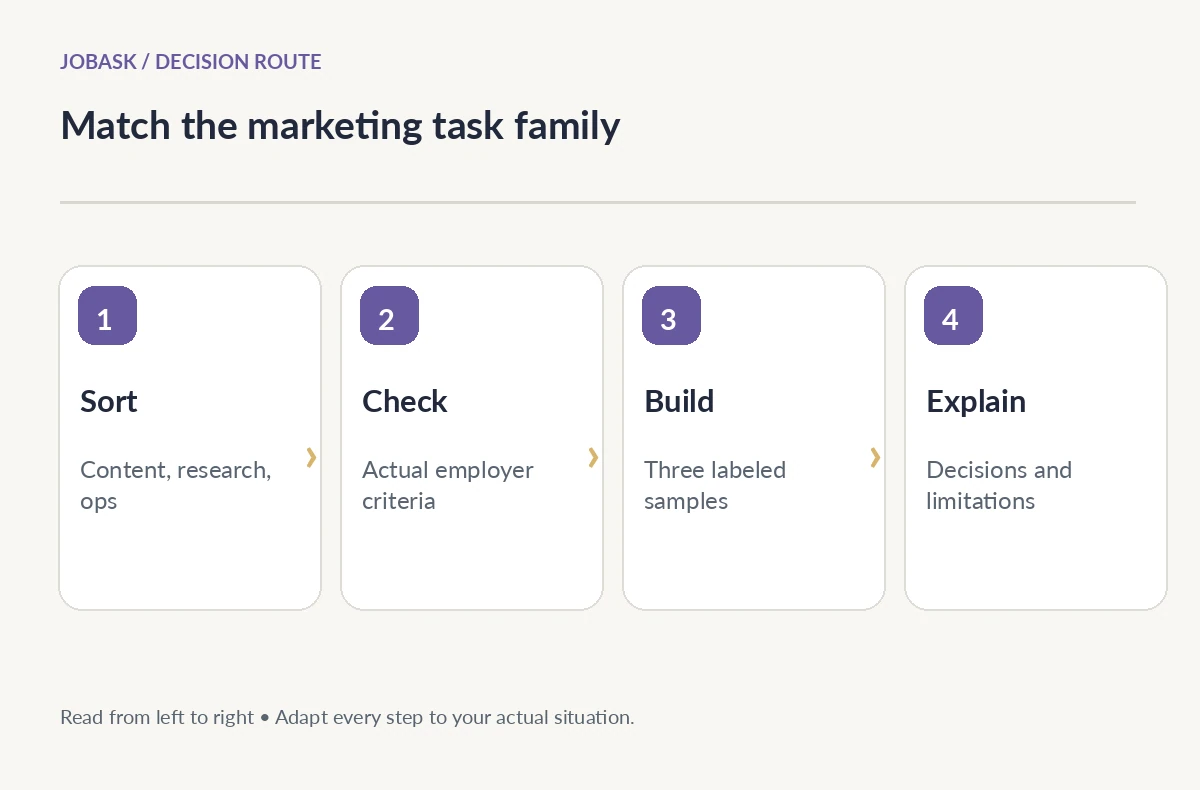
Start with the verbs in a real posting. Content coordination may involve calendars, briefs and proofreading. Marketing operations can emphasize organizing campaign assets, approvals and deadlines. Research-focused roles may require surveys, data interpretation and written findings. Reporting roles may emphasize spreadsheets, charts or dashboard tools. O*NET describes a broad occupation that includes analysis and recommendations, not a standardized description of every junior job. The BLS profile of market-research analysts is a useful reminder that some data-heavy analyst posts typically involve a degree and substantial preparation.
Make a task card for each opening: what is produced, who uses it, which tools appear and what formal education the employer requires. An imaginary “Junior Marketing Coordinator” might help maintain an editorial calendar and draft an event reminder; an imaginary research analyst role might demand statistical methods that the same applicant has not studied. These are teaching examples, not actual job postings. If most mandatory tasks exceed your evidence, do not relabel the job as entry-level merely because the title contains “junior.” Look for an appropriately scoped assistant or coordinator position within the same field.
Build a small practice portfolio with labeled artifacts
A beginner portfolio does not need imaginary brand growth. Choose a fictional community event or small bookstore and create three documents: a one-page audience brief, a two-week content calendar and a short results-measurement plan. Identify each as “self-directed practice project using invented business details.” The brief should state one real communication problem, a plausible target audience and the assumption you are testing. The calendar can include channel, message purpose, due date and reviewer, without pretending posts actually ran or customers responded.
The measurement plan is an opportunity to show restraint. Define what you would observe, such as link clicks or event registrations, but do not fill in outcome numbers unless you conducted a genuine, appropriately consented test. Explain that imagined targets are planning assumptions and not historical results. If you used publicly available information, cite it; if you invented the brand and audience, disclose that instead. A recruiter can then evaluate your organization and reasoning without being misled about clients or budgets. Remove any copyrighted logos you do not have permission to use, and never invent testimonials.
Demonstrate research without pretending a study happened
Market information can inform a marketing decision, but not every online observation is a scientific survey. Practice with an explicitly hypothetical product category and identify the public sources you reviewed. Distinguish a competitor’s published description from your interpretation of why it might appeal to someone. Prepare a short report with two findings, a limitation and an unanswered question. O*NET lists reports and information gathering among marketing-specialist activities; those facts justify practicing the method, not asserting that a student report qualifies you for a senior research position.
For example, an imaginary neighborhood arts workshop wants to inform students about a registration deadline. A research note might say, “Assumption: students may prefer a calendar reminder; evidence still needed.” This is a hypothesis, not a market result. A responsible next step would be to gather permission-based feedback, but you should not collect personal information for a portfolio without a real ethical plan. Describe which questions you would ask and how you would avoid leading answers. A good beginner demonstrates the boundary between evidence, assumption and recommendation, even if the final page has no impressive percentages.
Translate projects into useful resume bullets
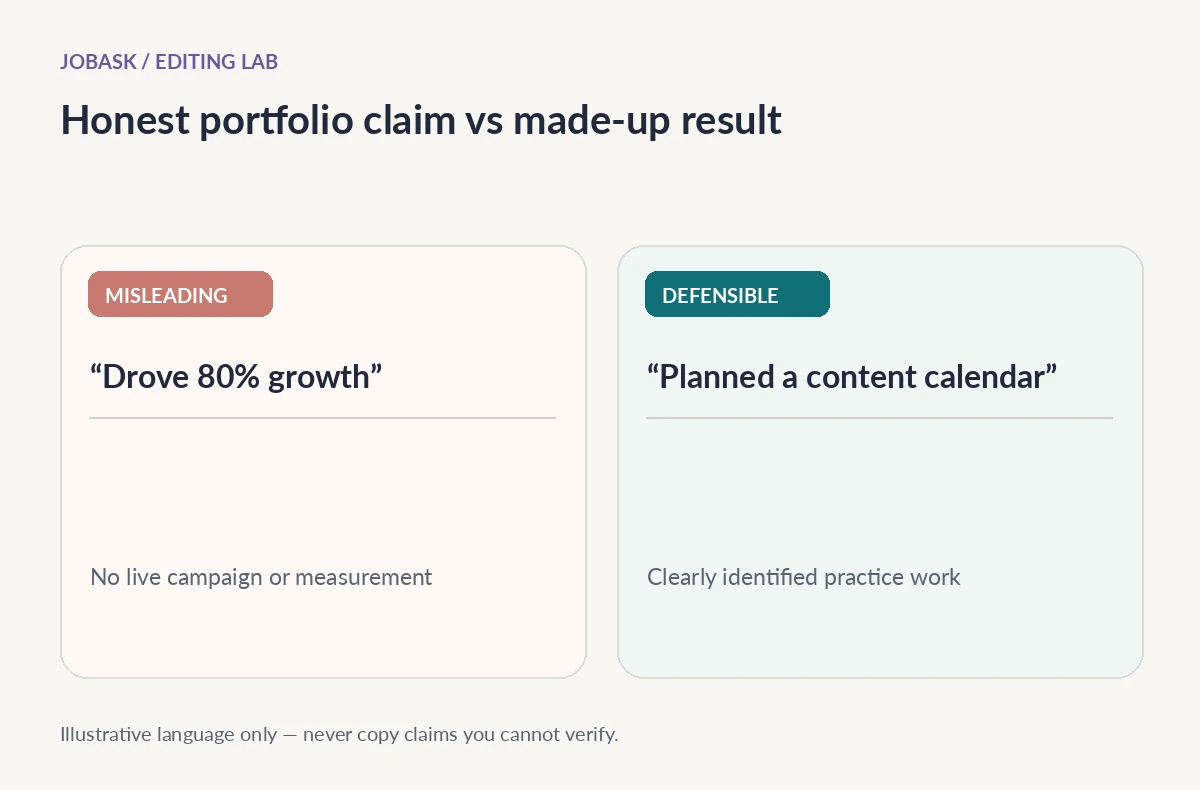
Each portfolio item should correspond to a task in a verified posting. If the role asks for scheduling, explain the calendar and version control. If it asks for writing, include a concise message written for a specified audience. If it asks for research, explain how you sourced and evaluated information. Avoid listing every marketing platform because it appears in job advertisements; a tool name is not evidence of proficiency. “Created a fictional content calendar with review checkpoints for a self-directed project” is an honest illustrative formulation, whereas “managed a national campaign with record conversions” is a fabricated outcome unless proven.
Add a small methods note to each work sample: purpose, inputs, choices, constraints and what you would test next. If using a spreadsheet, show a real formula or organization technique. If using design software, explain your layout decision without claiming client approval. Your application can link to a portfolio you control if the employer allows links; otherwise follow the upload instructions. Keep sample projects separate from employment history. The difference between completed practice and paid client work is material, and hiding it creates a problem even when the work itself looks polished.
Ask about the actual responsibilities and review process
During an interview, ask which tasks are the main part of the first month: content coordination, reporting, research support or channel execution. Ask who approves public-facing materials and how the team checks claims or measures work quality. Those questions protect you from accepting a position that uses the appealing word “marketing” but primarily demands activities you have no interest in or support for. Do not assume the employer offers training unless it says so. For specialized analyst tasks, clarify which degree, tools or quantitative methods are mandatory.
Prepare one concise presentation of your hypothetical sample. Start with the audience and goal, show two choices you made, explain an assumption you could not verify, and end with the feedback you would request. Do not narrate a nonexistent launch. If an interviewer asks about your “results,” say plainly that the exercise was a practice project and no live campaign metrics exist. You can still discuss what a responsible measurement plan would require. Employers may value different skills; this article does not claim every marketing manager uses the same scorecard.
Check the offer channel and skip suspicious opportunities
Verify the hiring organization’s identity and look for the actual opening on a legitimate company channel. Search for conflicting employer names, an absent role description or requests for upfront fees. The FTC cautions that scammers create fake postings and sometimes impersonate employers. Be skeptical of roles that demand you pay for “exclusive marketing onboarding” or transfer money before the start date. A portfolio invitation or friendly recruiter message is not proof that a job exists. Do not provide sensitive identifiers through an unverified application page.
Decide by task match rather than excitement about a title. Apply when the job requirements are explicit, you meet mandatory criteria and your sample work addresses real duties. Build a smaller proof artifact when a required skill is learnable but not yet demonstrated. Pass on a role when an essential credential is missing or employer information cannot be validated. Keep notes on whether an application was actually submitted, not whether a manager secretly approved it. A narrowly scoped, honest marketing sample is more useful than generic claims about creativity or analytics mastery.

| Situation | Practical next step | Important limit |
|---|---|---|
| Content calendar assistant | Show fictional practice schedule and revision rules | Do not claim it ran for a real client |
| Marketing research analyst requires degree | Check stated education before investing time | Assistant and analyst roles differ |
| Reporting task mentions dashboards | Show a small truthful data practice artifact | Practice metrics are not employer outcomes |
| Recruiter charges entry fee | Stop and verify via independent channels | FTC warns against pay-to-work requests |
How We Research and What Remains Unverified
We compared O*NET’s marketing-specialist tasks with the BLS description of the more analytically demanding market research occupation. The practice portfolio and four-role map are original instructional examples, not a hiring study, real campaign or sourced performance benchmark. FTC guidance supplies the independent employer-verification step. Public topical search results and the listed source pages were reviewed on October 19, 2026.
Sources reviewed October 19, 2026: O*NET describes marketing research and specialist activities including reporting, data analysis, campaigns and communication. BLS explains the education and analytical responsibilities typical of market research analysts, helping distinguish analyst posts from assistant work. FTC explains how to verify job opportunities and recognize payment and fake-check scams.
Affiliate disclosure for entry level marketing jobs: the resources linked in this guide are editorial sources, not verified paid endorsements or approved JobAsk partnerships. This guide contains no affiliate links. Read the JobAsk affiliate disclosure before considering a commercial service. Verify current conditions with the organization itself.
Related Job Search Guides
- Entry-Level Digital Marketing Jobs: Choose a Channel and Show Your Work
- Entry-Level Graphic Design Jobs: Choose Junior Roles and Portfolio Proof
- Entry-Level Laboratory Assistant Jobs: Match Samples to Training Limits
- Entry-Level Public Relations Jobs: Choose Writing and Media Support Roles
- Entry-Level Sales Jobs: Compare Positions and Build Proof
No. Openings may center on scheduling, research, reporting, writing or coordination.
Yes if clearly labeled as a self-directed practice example rather than paid client experience.
Requirements vary. BLS says market-research analysts typically need a bachelor’s degree, but other support roles may differ.
No. Only report measured outcomes from real work and explain methodology and limits.
Only the tools you can actually use and that relate to the employer’s stated tasks.