
In an executive assistant interview, a useful strength is not simply “being discreet” or “multitasking.” Show how you resolved a calendar conflict, prepared an accurate meeting brief, or identified who needed a decision without revealing confidential material. A realistic weakness may involve overloading a briefing with background information or waiting too long to raise a scheduling conflict. Explain how you now ask about priority, audience, and deadlines. Never pretend you have authority to disclose executive correspondence, approve travel spending, or decide priorities when those decisions belonged to someone else.
Match the strength to the job you actually seek
Executive assistants frequently work across calendars, documents, travel arrangements, visitors, and executive communication. The precise level of discretion and decision authority differs by organization. Turn the vacancy into an evidence map: which meetings were you allowed to move, what information could you share, and where did a decision need executive review? This helps you demonstrate judgment rather than merely speed.
Explain calendar prioritization through a concrete conflict
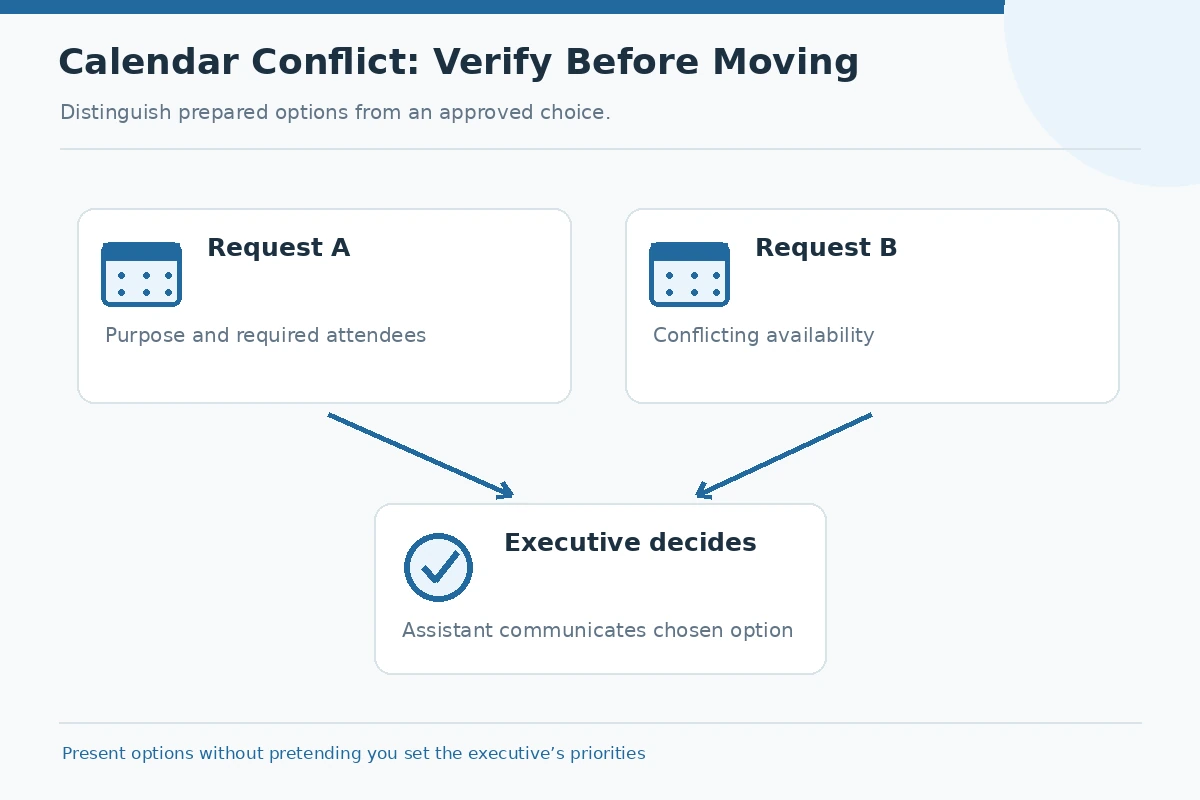
Pick a real moment when two legitimate requests competed for a meeting slot. Describe which facts you confirmed, what scheduling rules were already agreed, and how you presented alternatives to the authorized decision maker. Strong calendar management is transparent: the affected attendees know the final time and the meeting purpose remains intact. Do not say you rejected a stakeholder or committed the executive to an external meeting unless you had that authority. A clean confirmation is a defensible result even without a productivity number.
Prove you can prepare briefs without leaking private information
A meeting-preparation strength can include verifying an agenda, collecting approved background, checking names and dates, and clearly labeling unresolved items. In an interview, describe the process, not the private substance of board materials, personnel files, client contracts, or unreleased strategy. You could say that your brief distinguished confirmed facts from open questions and reached the right reviewer before distribution. This communicates reliability and sound information handling without exposing restricted details.
Choose an improvement area that reflects real work
One credible weakness is preparing too much detail when a concise decision brief is needed. The fix is not to withhold critical information: ask the meeting owner what decision is required, use a short summary followed by supporting material, and request feedback on what was missing. Another possible weakness is not clarifying which conflicting calendar request takes priority soon enough. Explain the escalation question you now ask earlier rather than claiming you have stopped making mistakes altogether.
| Interview focus | Verifiable evidence | Boundary to keep |
|---|---|---|
| Calendar triage | Confirmed priorities and communicated the decision | Executive still owns final priority |
| Meeting briefs | Verified facts and labeled open questions | No sharing of protected materials |
| Growth area | Shorter, purpose-led briefs | Keep essential context and approvals |

Distinguish anticipation from acting without approval
Employers may value an assistant who anticipates needs, but anticipation must not become unauthorized action. You can prepare draft options, reserve a tentative slot if policy permits, or flag a missing document. You should not sign a contract, promise an expense reimbursement, circulate restricted papers, or grant access just because you expected approval. Build one example where you prepared a choice and waited for the final decision. Interviewers can then see that you understand both initiative and limits.
Give a short improvement story with useful evidence
Suppose your weakness was sending meeting briefs too close to the meeting. Describe what made the timing difficult, how you changed the drafting checkpoint, and what review process you now follow. An honest result may be a documented earlier handoff or a clearer list of open agenda points. If you have no actual measure, say the procedure became easier to review rather than claiming attendance, cost savings, or faster decisions without evidence.

Prepare for confidentiality and stakeholder follow-ups
Expect an interviewer to ask how you handled a caller seeking an executive’s private schedule. Explain that you verified the requester, followed the established information-sharing policy, and offered an authorized route for the request. Practice explaining the principle without naming the person or disclosing the schedule. You can use a hypothetical example when you have not encountered that exact situation, but label it as hypothetical and do not turn an imagined response into a claimed achievement.
Two hypothetical answers to adapt, not memorize
Illustrative strength answer: “I am strong at turning calendar conflicts into clear options. I confirmed the purpose and required participants for two overlapping meetings, prepared alternatives, and got the responsible executive’s choice before notifying attendees.” Illustrative weakness answer: “I used to put too much background into a one-page brief. I now ask what decision the meeting must support, place confirmed facts first, and attach only approved supporting information for deeper review.” These examples are invented teaching examples, not employer testimony. Never copy one unless the responsibilities, setting, and outcome are genuinely yours. You can replace the context with a school project, volunteer work, or another job if you accurately name that context.
Run a fact check before practicing aloud
Write a three-column note for the executive assistant interview: claim, experience that supports the claim, and boundary of your authority. For a strength, underline your actual action rather than the team’s entire accomplishment. For a weakness, describe one change you have already tried and how you tell whether it is working. Ask a practice partner to challenge any sentence that sounds like a guarantee or a senior manager’s decision. Avoid invented percentages, fabricated praise, or private coworker and customer details. If the answer sounds too polished to be yours, simplify it until you can explain every step.
How We Research These Interview Examples
We reviewed the role-specific occupational description alongside the U.S. Office of Personnel Management’s structured interview guidance and its guidance on competency examples, checked November 16, 2026. These sources establish typical responsibilities and interview-evidence principles, not any individual employer’s hiring rules. We wrote fictional examples for illustration, kept supervision and privacy boundaries explicit, and checked the site’s existing interview topics to avoid another generic strengths-and-weaknesses list. Internal links are editorial navigation, not endorsements. See our affiliate disclosure for information about relationships. Review the actual job posting and employer policies before relying on any example.
More Interview Preparation Guides
Yes, but support it with a safe description of process: access checks, approved distribution, or a clear escalation route. Avoid confidential examples.
An overly detailed brief or a delayed clarification can be credible if you demonstrate a practical correction that protects accuracy.
Only if you can support the amount and your contribution. Otherwise describe the confirmed itinerary, approvals, and communication process.
Use a truthful scheduling or document-review example from another role. Explain the different scope rather than relabeling it as executive work.
Only if that accurately reflects your assigned authority. Often the assistant presents options and communicates the executive’s choices.