
Billing clerk interview questions usually probe accuracy, documentation, customer communication, and whether you know the limits of your authority. Prepare to explain how you compare an invoice with supporting data, log a discrepancy, and seek approval before changing a disputed amount. You can demonstrate this with genuine office or coursework examples without claiming that you made accounting decisions or handled medical coding. These sample questions and answers show the reasoning an interviewer may look for; the exact workflow depends on the employer’s system.
Walk through an invoice accuracy check
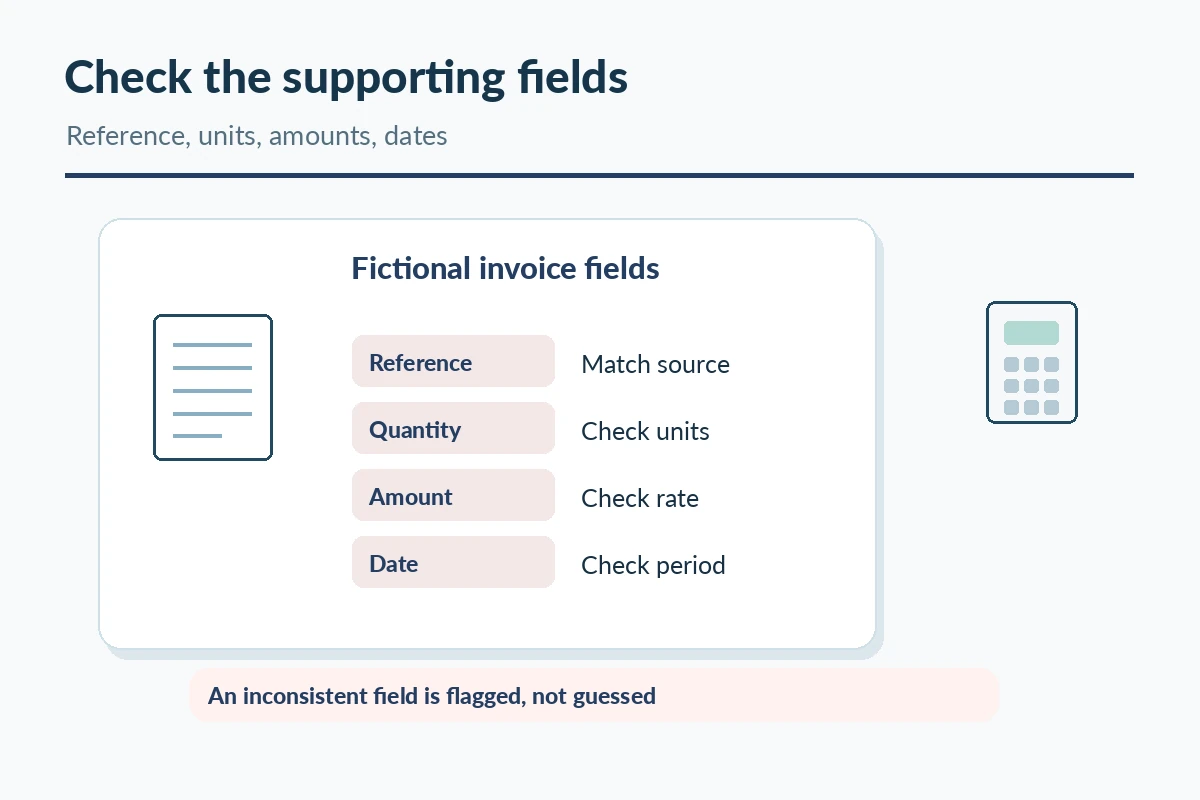
You may be asked, “What would you verify before sending an invoice?” A useful response identifies the order or service reference, correct recipient, item description, quantity or units, rate or amount, relevant date, and supporting documents when required. Do not describe a one-size-fits-all checklist as a legal mandate. Explain that the fields differ by billing setting and that you follow the approved procedure. If an amount looks inconsistent, pause and trace the source instead of adjusting it by intuition.
A hypothetical answer: “I would match the invoice reference to the approved source, check the quantity and unit, verify the delivery or service information, and flag any mismatched field. I would record what I checked and route a correction to the person with the appropriate authority.” It is important not to imply that every clerk independently authorizes credit memos, changes terms, or sends payments. Use examples from the kind of billing described in the vacancy, rather than mixing retail billing with specialized health care claims.
Explain how you would handle a mismatch
A classic prompt is, “An invoice total differs from the order record. What would you do?” Describe comparing the underlying line items and identifying whether the difference comes from quantity, price, tax or another documented field. Record the invoice reference and nature of the discrepancy in the approved queue. If the next step needs an authorized correction, ask for that review. Do not claim that you would erase the original entry or bypass a control to make the totals match.
An interviewer may then ask how you handle your own error. A strong answer acknowledges the error promptly, explains how you stopped any additional inaccurate communication if within your control, and describes informing the appropriate colleague. Discuss updating the record according to procedure after authorization and documenting what changed. Avoid pretending you have never mistyped a number. A believable process for correction is more useful than a guarantee of perfect accuracy in an unfamiliar system.
Answer questions from a confused customer
“A customer says they were charged twice. How do you respond?” is partly a listening test. Start by acknowledging the concern without agreeing that a duplicate charge has already been proven. Verify that you are speaking through an authorized channel, identify the relevant account or reference within your access, and explain what can be checked or escalated. Promise only the next step you can control, not a refund amount, timeline, or final decision that belongs to another role.
Practice a short script: “I understand why that looks concerning. I can confirm the invoice reference and review the supporting entry within my role. If there is a potential duplicate, I will document the discrepancy and send it for the correct review, then explain how you can receive an update.” This is hypothetical, not customer-service policy for every company. Do not ask the person to send full payment details by ordinary email or share someone else’s account information.
Use a real behavioral example of precision
You could be asked, “Tell me about a time you spotted a data error.” Choose an authentic event from data entry, cash handling, accounts support, school work, or volunteer administration. Set up the initial document, the field you checked, the mismatch, your action, and the actual resolution. If another employee approved the correction, say so. You can use the STAR framework, but spend most of the answer explaining the check you performed rather than the background or exaggerated business impact.
If you have only simulated practice, say “In a class exercise using mock invoices” before telling the story. You might have found that the quantity on a sample order did not match the sample bill and marked it for review. This shows a transferable checking habit; it is not professional invoice processing. Do not convert invented numbers into claims of cost savings or accuracy rates. The point of the answer is traceability, not impressive-looking arithmetic.
Describe the records and software you know
An interviewer may ask which billing programs or spreadsheets you have used. Name them accurately and state the specific action: entering a draft, creating a report, tracking exceptions, or reconciling approved information. Do not list software you only recognize by name as proficient. If you learned a feature under supervision, say how you checked it before using it on real records. Employers may use different billing platforms; clear process knowledge is more portable than pretending all systems are identical.
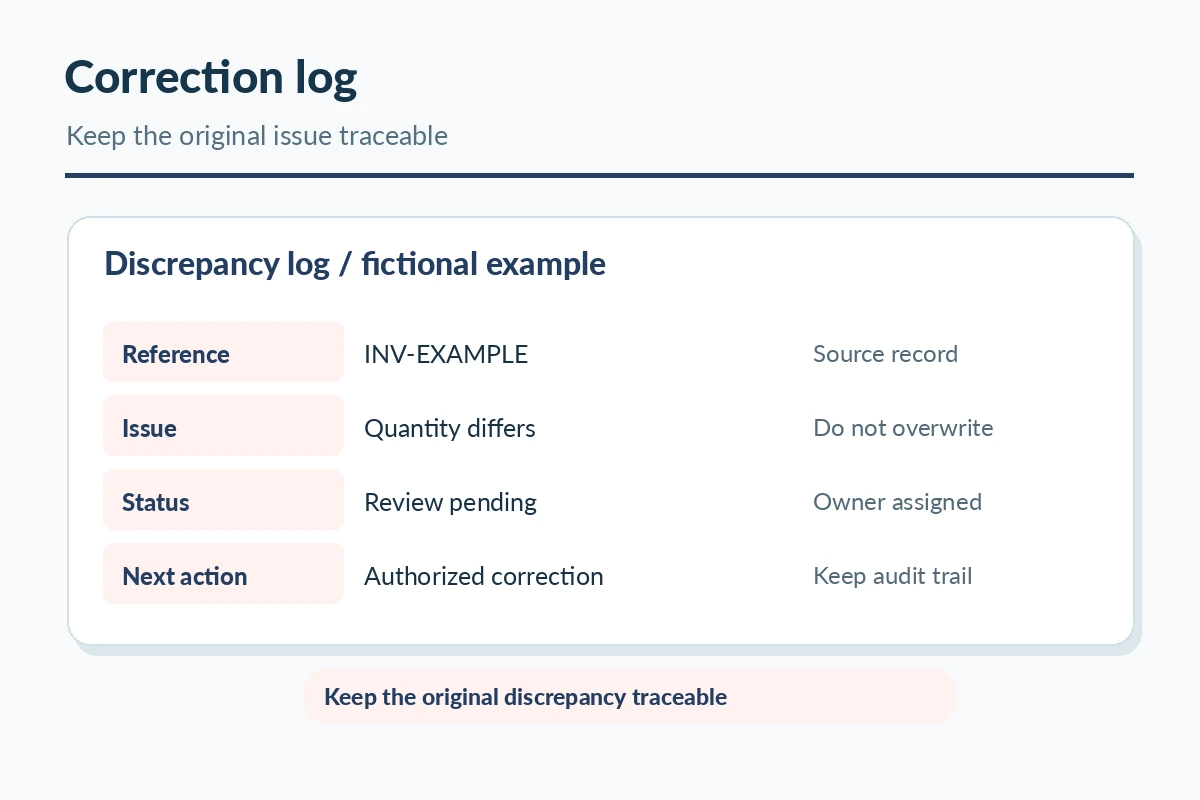
Show understanding of a discrepancy log: reference, date, original issue, current status, person assigned, and next action. Keep real customer data confidential and never bring unredacted invoices to an interview. A fictional example is appropriate to demonstrate a layout as long as it is clearly marked as a practice sample. Distinguish editing your own draft from changing an approved invoice; there can be different responsibilities, audit trails, and permission levels.
Ask the interviewer about correction authority
Good questions include, “Who authorizes invoice corrections or credits?” “What is the usual process for customer disputes?” and “How does the team document an exception before an invoice is sent?” You might ask whether the position mainly prepares invoices, posts transactions, or assists collections, because those functions can be distributed differently. Keep your focus on practical handoffs and required training, not access to confidential finance records or client-specific balances.
Pay attention to whether the role includes industry-specific requirements. A general billing clerk may handle service or goods invoices; a medical biller can have additional privacy, insurance and coding expectations. Do not imply a qualification you lack or assume the same rules apply. When you cannot answer a software-specific question, explain the validation process you know and ask which approved tool the team uses. Honest scope is part of a strong interview answer.

Build a four-part billing practice drill
Prepare four short responses: first, an invoice-field check; second, a disputed charge; third, a mistake you identified; fourth, a new system you learned. For each, identify the source of truth, what you personally checked, who could authorize changes, and what record was preserved. Write one mock invoice with fictional line items only if a visual helps you rehearse. Never bring real customer accounts into a portfolio or claim a test result you did not measure.
Then answer each aloud in about a minute and listen for vague verbs such as “fixed,” “processed,” or “handled everything.” Replace them with precise verbs: compared, flagged, drafted, asked, routed, documented, or updated after review. Your answers should align with your resume and with the position’s level. If an interviewer probes, you should be able to explain what happened before and after your action without inventing approval or payment authority.
How We Research Role-Specific Interview Questions
We checked guidance from U.S. university career centers on practicing interviews and using evidence-based answers, then compared it with O*NET occupational descriptions and, where relevant, official agency guidance. The questions and responses are illustrative; they are not actual employer interview transcripts, hiring tests, or promises of employment. Duties, permissions, and training vary by employer and setting. Adapt each response to genuine, nonconfidential experience and verify the job posting.
Sources checked November 10, 2026: careerservices.fas.harvard.edu; careers.uw.edu; www.onetonline.org. Read our affiliate disclosure for editorial relationship information.
More Interview Preparation Guides
Yes, for roles that accept transferable record accuracy or administrative skills. Explain which tasks you have practiced and where training is needed.
Describe verification, documentation, and routing through the employer’s dispute process. Do not promise an unauthorized refund.
Yes, label them as simulated practice or coursework rather than real customer billing.
Not necessarily. Approval and correction procedures vary by employer, system and document stage.
No. Coding and insurance workflows may require distinct training and responsibilities; do not claim them from general invoicing experience.