
Accounting situational interview questions test what you would do when a realistic problem has incomplete information and more than one person involved. In this guide, the central hypothetical is: “What would you do if an invoice does not match the supporting purchase order?” A strong answer asks what must be checked, describes a responsible action within the role, and explains who makes decisions outside your authority. The examples are invented for rehearsal, not accounts of employer experiences or guaranteed interview questions. State your limits before naming a confident next step.
Explain why the invoice is an exception
The interviewer is testing whether you can resist pressure to process something that does not agree with its records. Start by naming the discrepancy: price, quantity, duplicate invoice number, vendor identity, purchase order reference, or proof of receipt. These are not interchangeable errors. A quantity variance may require receiving confirmation; a vendor-information issue may need a controlled supplier-master review. Describe the evidence you can see and what remains uncertain. Avoid announcing fraud or blaming a vendor without evidence. A focused answer tells the interviewer you understand the accounting workflow without implying you have authority to post every adjustment.

Check supporting documents in a sensible order
Describe a simple comparison of the original invoice with the purchase order, receiving evidence, and current vendor record in the organization’s approved systems. Ask whether a credit memo or revised document exists before proposing a correction. If the document set is incomplete, record what is missing rather than making up a purchase order or quantity. A timed interview answer can explain this in three sentences; you do not need to invent the company’s exact ERP configuration. Acknowledge that some organizations use different approval routing and matching thresholds, so you would follow the employer’s documented control process rather than a universal personal rule.
Separate investigation from payment authority
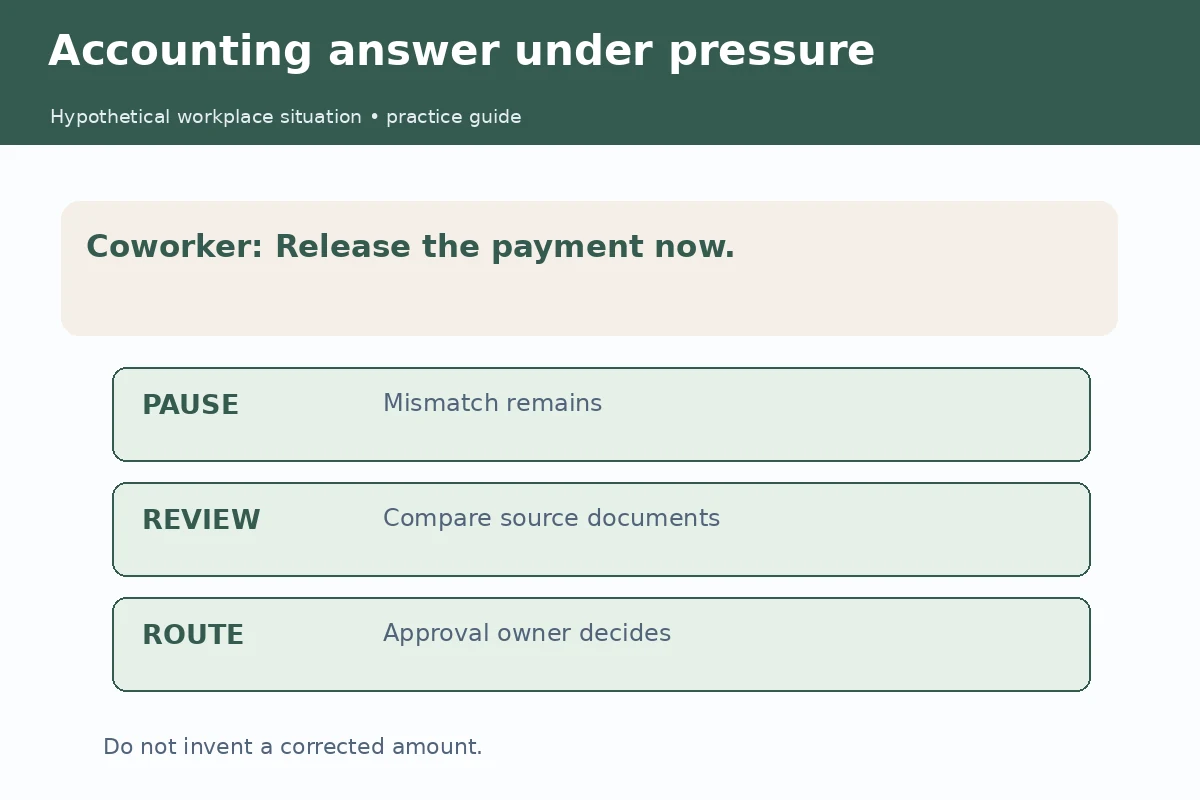
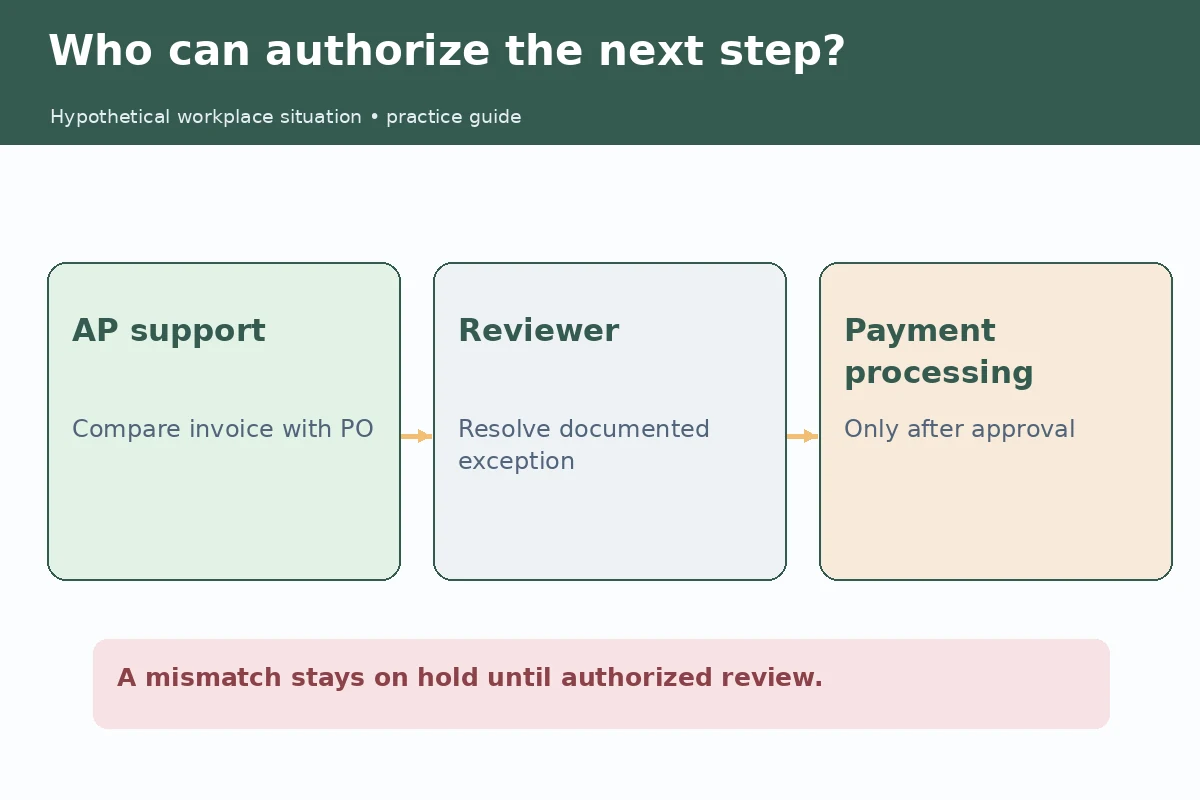
An accounts payable assistant may research a variance but not approve a supplier change, authorize a payment, or erase an audit entry. Good situational reasoning identifies the correct escalation owner. If a coworker presses for immediate release, say you would give the reviewer the discrepancy, supporting references, payment deadline, and any business impact rather than silently processing the invoice. You can be responsive without bypassing approval. A good candidate also avoids implying that the person who keyed the invoice should independently approve their own questionable change. Explain which step you can finish and which step must wait for authorized review.
For this role, avoid the easy but weak answer: “Override for speed.” Instead, identify whether the information is verified, who is affected, and who has the authority to decide. The distinction between a hypothetical situation and a real past event matters: in a hypothetical you describe a responsible plan; in a behavioral question you must tell the truth about what actually occurred. The following sample uses a fictional situation and makes no claim about a past employer.
Answer the central mismatch question step by step
A strong hypothetical answer covers four stages: pause the affected transaction, verify the evidence available, record the difference, and route it for decision. Use the sample below as practice wording only; it is not a claim of real accounting work. Do not invent a recovered dollar amount or a prevented loss. If you have actually handled exceptions, replace the hypothetical with your specific documented responsibilities. If you have only a bookkeeping class project, call it a class project and say which documents were simulated. An interviewer should hear your judgment rather than a story about a fictional system you never used.
Illustrative answer to the central question
Hypothetical interview answer: “I would stop at the point where the mismatch appears rather than guess which amount is correct. I would compare the invoice, purchase order, receiving record, and approved vendor information within my assigned access. I would document the exact difference and contact the designated reviewer or procurement colleague. I would not alter a supporting record to force a match or release a payment beyond my authority. Once the authorized reviewer resolves the exception, I would record the disposition and complete only the next step assigned to my role.” This is a model of reasoning, not a script to memorize verbatim. Replace its workflow with the organization’s actual rules and explain the scope you would have in the advertised position. The interviewer may interrupt to ask who owns the next decision. Use that interruption to make the authorization boundary explicit rather than inventing a result.
Practice pressure from a deadline and from a colleague
Two follow-up prompts sound similar but test different judgment. A same-day payment cutoff tests prioritization and communication; a colleague asking you to delete an audit note tests integrity and record preservation. For the cutoff, state who needs timely information and what cannot be processed before approval. For the note, ask what correction is requested, preserve the approved audit path, and involve a supervisor or designated control function if the request seems improper. Do not threaten coworkers or make unsupported allegations. Stick to observable records, policy, and the limits of your own credentials.
Three follow-up questions to practice
A manager wants a payment sent before it is approved. What now? Explain the missing approval and the cutoff, route the urgent exception to the authorized approver, and avoid bypassing controls. A vendor says you entered the wrong amount. What would you check? Compare the original invoice and purchase order, document the conflicting information, and follow the approved correction process. A teammate tells you to delete an audit note. How do you respond? Preserve the record according to policy, clarify the retention requirement, and escalate an improper instruction through appropriate channels.
Record the discrepancy without exposing live data
A practical answer says what an exception record would contain: invoice reference, date, affected field, comparison document, assigned reviewer, and the current decision status. For interview preparation, create a made-up invoice number and synthetic sample figures; never bring a former employer’s confidential invoice or customer data into a portfolio. If the exception remains open, show it as open. A candidate who says “I resolved the issue” when a controller actually approved the adjustment has overstated the role. Distinguish the research work you performed from the final decision another person signed off.
Tailor the answer to the actual accounting role
Accounts payable, general ledger, payroll, and audit roles encounter different exceptions. Read the job posting before rehearsing. If the opening is for an AP clerk, emphasize receipt verification, coding, communication, and routing; if it is for a staff accountant, connect the question to reconciling accounts and supporting journal entries within actual authority. Do not suggest independent signoff if the position lacks it. Ask how reviewers receive exceptions and which controls the organization uses. Finish your answer by making the record reviewable and the status clear to the person waiting for the result.
Build a short scoring rubric for rehearsal
After a practice response, evaluate it against five observable questions: Did I identify the first missing fact? Did I state the safest immediate action? Did I name the relevant person or office that approves the next decision? Did I describe a usable handoff or status update? Did I avoid claiming a result I cannot know? For the accounting example, this means assessing whether you treated “invoice discrepancy” as a bounded role decision instead of a personal rescue mission. Have a peer ask “What would you do if that information were unavailable?” A convincing answer acknowledges uncertainty, asks for clarification, and keeps the process accountable without turning the interview into a speech about perfect outcomes.
How We Research These Situational Answers
We reviewed APQC invoice processing guidance; Northeastern career guidance; Princeton interview guidance to distinguish the typical responsibilities of the role from decisions that require a supervisor or designated professional. The career-center sources distinguish hypothetical situational reasoning from real behavioral examples. Role-specific sources inform the examples, but no source can confirm what a particular hiring manager will ask. This article does not claim that a fictional outcome happened, or that a reader has a credential or authority they did not earn. We avoid private employee, client, or student information in practice cases. Before relying on any recommendations or sponsored links, see our affiliate disclosure.
More Interview Preparation Guides
Only if the correction is permitted within your assigned role and the supporting documents justify it. Otherwise route the exception.
No. It can result from entry, quantity, timing, or documentation differences. Research the facts before characterizing the cause.
No. Use a clearly fictional practice scenario without presenting made-up losses, savings, or employer outcomes as history.
Identify the missing approval, communicate the urgency, and escalate to the authorized reviewer without processing an unapproved payment.
A clear check of documents, a documented exception, respect for controls, an accountable handoff, and no premature claim that payment was approved.