
An expired job listing can remain visible on a search engine, aggregator, or saved-jobs page after the employer stops accepting applications. The reverse can also happen: an older-looking posting may still be actively recruiting, or a position may be reposted under a new requisition. Do not judge status from one displayed date. Compare the exact employer, job title, location, identification number, closing date, and application route. Use the organization’s official careers site or verified hiring contact as the final check. This guide helps you decide whether to apply, ask for clarification, or archive the listing without inventing a deadline.
Understand which date the job site is showing
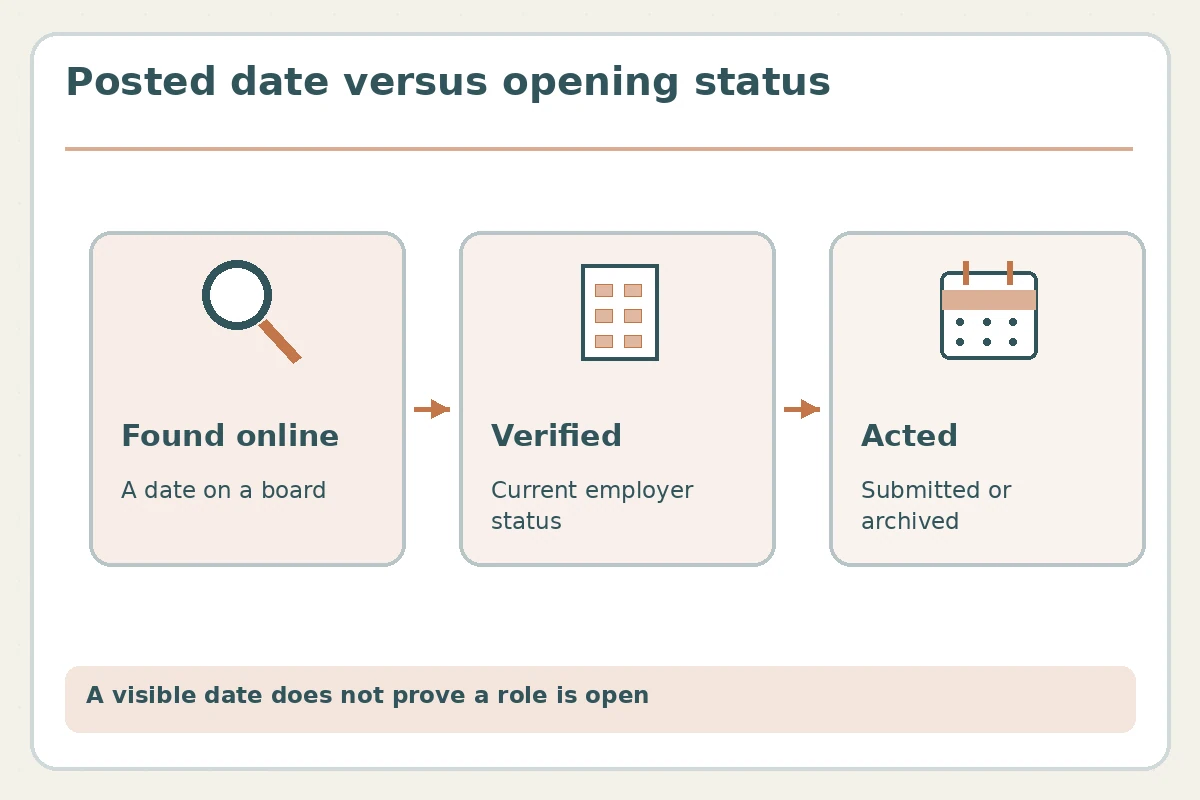
A result might display ‘posted two weeks ago,’ ‘updated yesterday,’ or the date an aggregator first found a listing. These labels are not interchangeable and may reflect different events. A sorting filter that favors recent postings tells you how a website organized results, not necessarily when a hiring manager last approved the position. For federal announcements, USAJOBS separately provides closing information and job status; it also offers sorting by recently posted or closing soon. For private employers, examine the original job description and hiring portal rather than assuming equivalent date conventions.
Write down which date you have actually confirmed. If the board says a role is ‘new’ but the employer page has an older opening date and a future closing date, it may still be valid. If the board says a role is old but the employer system is still accepting applications, the page could remain active. Neither situation proves the job is certain to stay open until you apply. Some hiring processes close early or change requirements. A date stamp should trigger verification, not become a promise about how much time remains.
Find the authoritative employer announcement
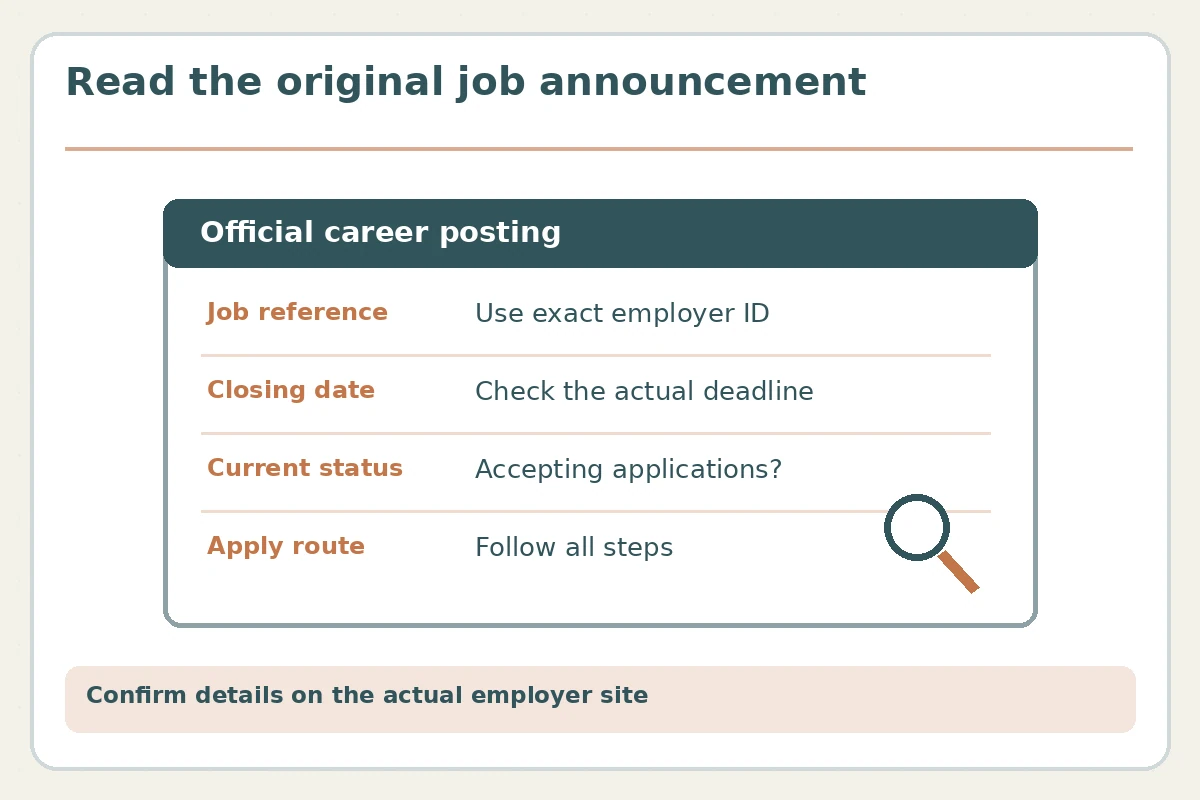
Search the employer’s official careers page using the job title and location. If an exact requisition number is visible, search for it too; IDs are often more reliable than generic titles such as ‘assistant’ or ‘analyst.’ Read duties, work site, qualifications, and required documents in the official posting. Be careful with employer names that are similar to unrelated businesses or fake copycat domains. The FTC has documented scammers who reuse legitimate company details to make altered job advertisements look real. Navigate to the employer’s known domain independently instead of relying only on an unfamiliar email link.
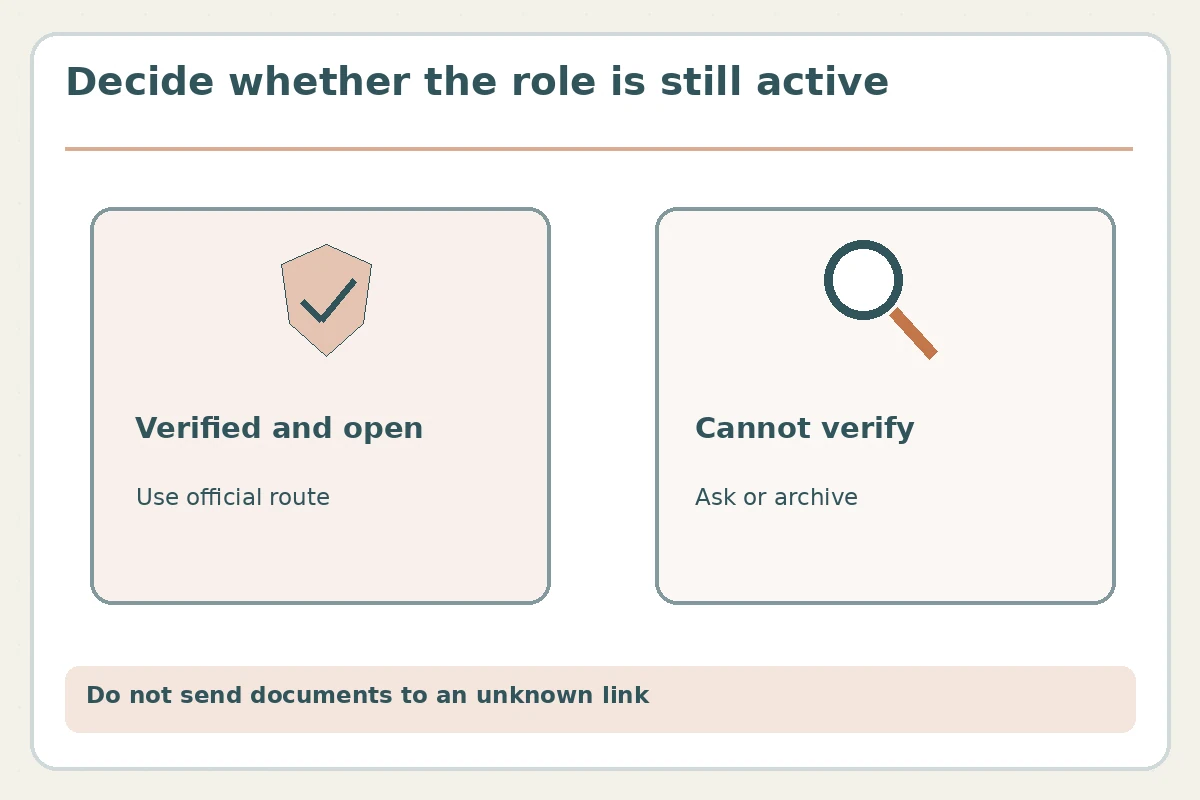
If the company’s careers page lists the same role as accepting applications, use its stated route and make sure you reach the final submission step. If the employer has no matching role, do not automatically conclude a scam: a hiring process could have ended, the position could be managed by a verified staffing partner, or the search function could be poor. Try the company name, department, and exact title in a second search. If still unclear, contact the employer through a published recruitment channel. Never send identity documents to prove interest while you wait for a basic vacancy confirmation.
Compare job status with application status
A posting can be closed while an application you already submitted remains under review. Conversely, seeing an active job listing does not mean your own application was received. USAJOBS makes an explicit distinction between the status of a job announcement and the hiring agency’s status of an application. Other portals use labels differently. Treat ‘accepting applications,’ ‘reviewing,’ ‘canceled,’ and ‘application submitted’ as separate statements supported by different systems. Save any receipt or confirmation number without assuming it tells you when an interview or hiring decision will happen.
For a hypothetical role, your notes might say: board listing seen Monday; employer announcement still open Tuesday; application completed Wednesday; employer confirmation saved Wednesday. Each entry represents a real observable step. If you only clicked the Apply link and left before submitting a questionnaire, your record should say ‘started,’ not ‘completed.’ Where an employer application requires a second site, follow the official instructions to the final confirmation. Federal applications, for instance, can continue on an agency system after leaving USAJOBS.
Choose when to ask the employer for clarification
A brief inquiry is useful when the advertisement is plausible, the official careers page does not clearly show the role, and you have found a verified recruitment contact. Include the position title, location, and requisition number if available. Example: ‘I found a posting for Operations Assistant, requisition 0000, on a job board. Is this position still accepting applications, and which application link should I use?’ The identifier and position are illustrative. Keep the request focused on current status rather than demanding a response about why the site differs.
Do not send an application package attached to an unsolicited message from someone claiming to be the employer. If the organization asks you to use its applicant tracking system, follow that process. A recruiter who cannot explain the employer, role, or hiring channel may be an impersonator. If you cannot independently verify a job before a deadline, it may be safer to pass than provide financial or identity information. There is no requirement to pursue every job result a search website displays.
Record the decision without losing useful details
For an expired or unresolved listing, keep a short record of the title, company, location, search source, employer link, date you checked, and reason for your decision. Use a status such as ‘expired on official site,’ ‘could not verify,’ or ‘reopened under new requisition’ rather than a single vague ‘dead.’ If the job is still open but unsuitable, record the true reason—commute, eligibility, schedule, or duties—so you avoid repeatedly researching the same mismatch.
Avoid circulating screenshots containing your account name or private correspondence. If you retain a description for interview preparation, keep it in a secure location and do not pretend its duties represent a newer posting. Returning to the employer’s portal later is reasonable, but a historic search-engine result should not override updated employer instructions. The purpose of tracking is to conserve attention and preserve accurate evidence about your own applications, not to build a speculative record about a company’s recruiting intentions.
Watch for copied, altered, or paid-application traps
The FTC has warned that fraudulent advertisements can copy a genuine vacancy and add a fake application route. Warning signs include a lookalike career domain, an interview conducted only through an unfamiliar chat app, urgent requests for sensitive details, and demands to purchase equipment through a purported recruiter. Do not equate a high search ranking, a professional graphic, or a familiar company logo with verification. Contact the employer through the company site you find independently.
A genuine listing may still expire, so focus on a grounded decision: verified employer plus active opening plus acceptable role plus legitimate route. If one of those is absent, pause and investigate. If you encounter clear impersonation, report the suspicious job to the hosting platform and FTC. For a real vacancy that has closed, consider checking the employer’s official careers page for a new opening rather than trying to bypass its deadline by emailing private contact information.
How We Research and Verify the Guidance
We reviewed current instructions from the platforms and public agencies cited below, and compared this specific reader task against the topics in the supplied WordPress inventory and previous JobAsk batches. Product controls can change; website examples and identifiers in this page are illustrative rather than live job offers. Sources reviewed on 2026-11-10: FTC source on search and application verification — FTC warns about copied or altered job postings and advises confirming openings through official employer sites. USAJOBS source on search and application verification — USAJOBS explains role keywords, location filters, remote versus telework, and posted-date versus closing-date sorting. USAJOBS source on search and application verification — USAJOBS distinguishes announcement status from the hiring agency’s application status. USAJOBS source on search and application verification — USAJOBS describes job-announcement requirements, required documents, and How to Apply instructions. The factual guidance describes platform features or public fraud prevention, not assurances of employment outcomes.
This page is independent educational guidance, not a representation of the named websites or an endorsement by a hiring organization. Review the affiliate disclosure. Verify the current platform interface, the actual job announcement, and the employer-approved application route before acting.
Related Job Search Guides
No. A displayed posting date is not always the employer’s closing date. Check the original careers page and current application status.
Treat the employer’s current instructions as the primary source. If the discrepancy is important, ask a verified recruitment contact whether a new requisition exists.
Yes. A vacancy may stop accepting applications while the employer continues reviewing submissions already received.
Not without verifying its destination. Find the employer’s official career site independently and confirm the exact opening and requested route.
You can. An exact reference helps distinguish similar roles, but it does not alone prove the employer or recruiter is genuine.