
An interview answer about leaving after your job duties changed should focus on the actual work shift and the type of contribution you want to make next. Employers can reorganize teams, redistribute projects or update tools; a change alone does not establish unfair treatment or a breach of an agreement. A candidate can still describe a genuine mismatch when the main responsibilities diverged from the role in which they were hired or the direction of their career.
For example, if supported by your experience: “The position gradually moved from customer onboarding into full-time inventory coordination. I supported the transition, but my strongest experience and long-term interests are in guiding new users through implementation, which is why I applied for this customer-success position.” This is illustrative, not a claim about an actual employer. It acknowledges useful work while explaining a specific future fit.
Identify the Actual Reason for Leaving
Before deciding how to describe the change, compare an earlier job description, real tasks you performed and your later recurring assignments. A temporary project or occasional cover shift may be ordinary flexibility rather than a new position. Look for a substantial, continuing change in the job’s primary output, audience, schedule or required specialist skills. Avoid saying that your responsibilities were “completely different” when only a small portion changed.
Keep proprietary organizational charts, internal strategy and other workers’ performance records out of the story. You can usually explain your own responsibilities without revealing the employer’s confidential plans. If your title stayed the same, say so. If you were formally promoted, that may be relevant, but new duties alone do not justify inventing a promotion or managerial authority. A resume and an interview should describe the same verifiable role.
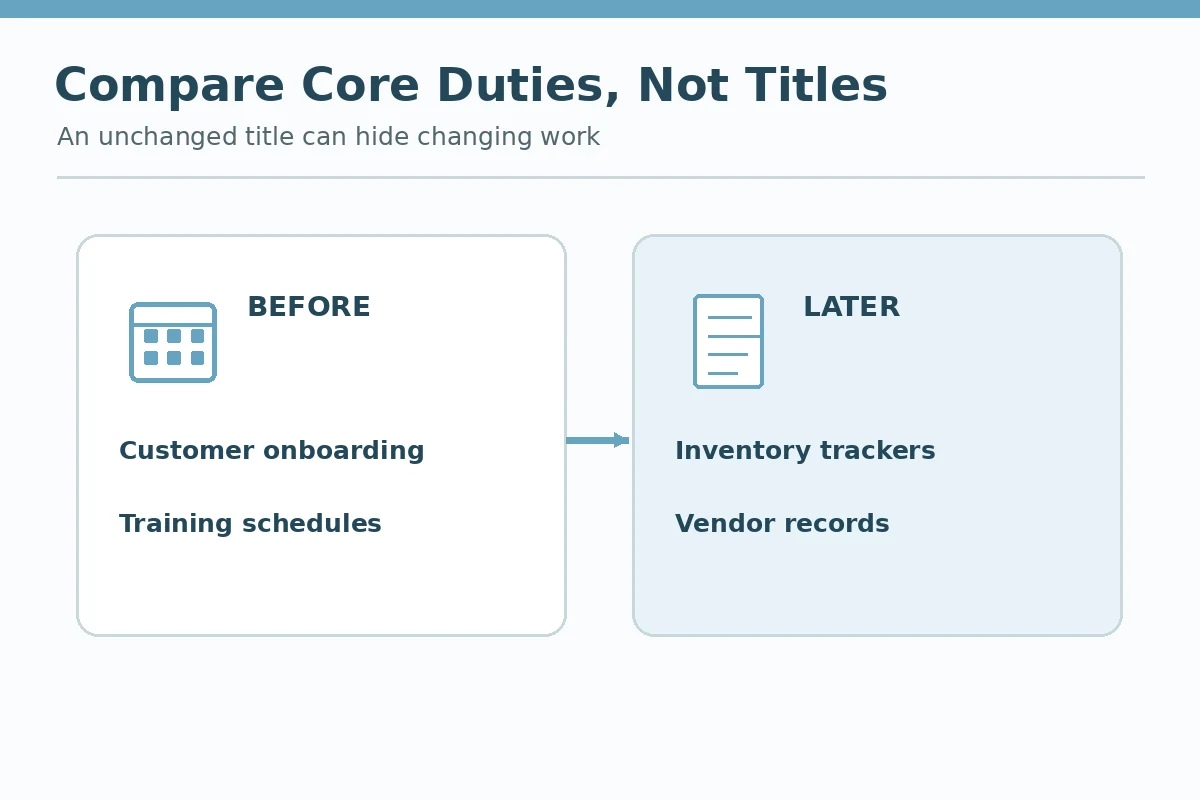
Choose Verifiable Facts, Not Convenient Labels
Choose one or two observable examples. An assistant who previously managed training calendars and then became responsible for a daily stock reconciliation process could say that the new work emphasized inventory records rather than employee coordination. If both types of work remain part of the target job, explain the balance you prefer instead of denying that the second task has value. Fit is about the match between a person and defined responsibilities, not the prestige of a task.
Build the answer with three movements: what the original focus was, what the role became, and why the specific new position is a better match. Keep the wording respectful. “The team’s needs shifted toward vendor administration; I learned that I prefer process training and support” is stronger than “management ruined my role.” The first version provides enough context for an interviewer to ask about your skills; the second asks the interviewer to judge someone they have never met.

Use a Brief Interview Answer Structure
Be ready for the question “How do you handle change?” Give an independent example of adapting constructively: documenting a new procedure, cross-training a coworker or learning a tool, if you actually did it. Do not claim you refused all new work or that the change was unlawful unless you have reliable evidence and that legal issue is necessary to discuss. A well-framed answer can show adaptability and a carefully considered career direction at the same time.
A hypothetical program assistant was hired to coordinate workshops, but the role eventually centered on routine purchasing paperwork. They completed purchase trackers and maintained accurate records, then applied for event operations roles. Their interview response describes the recurring switch in responsibilities and gives an example of workshop support. They should not imply that procurement was beneath them or that the employer failed to pay them for work without a documented basis.
| Situation to verify | What your answer can establish | Do not imply |
|---|---|---|
| Temporary assignment | Describe the limited project | Claim a permanent role elimination |
| Ongoing duty shift | Compare core responsibilities and dates | Suggest the employer was dishonest by default |
| Formal transfer or promotion | Name the documented change | Invent a different title or authority |
Practice a Second Version for Follow-Up Questions
Another hypothetical worker changed teams within a larger company after a reorganization, but remained employed. If applying externally, they might say: “The organization combined two service teams, and my work now centers on reporting rather than direct issue resolution. I am seeking a support role that uses my troubleshooting experience.” This does not turn an internal transfer into a layoff. It distinguishes why the person is looking from whether the previous job has already ended.

Review the New Role and Its Expectations
Check the new job description for its main duties, stakeholder relationships, shifts and opportunity to learn. Ask about how work is divided and how changes are communicated, without demanding an assurance that the job will never evolve. Prepare examples that show how you worked through uncertainty. A concise answer about role change is credible when it acknowledges the work performed and explains a clearly researched, relevant next step.
Keep the Answer Consistent Across Formats
An interview response, a resume and an application form serve different purposes, but they must not contradict one another about whether employment ended voluntarily, through dismissal, by a layoff or because an assignment expired. Keep your position title and dates accurate; complete every employer form according to the actual question. A short interview explanation may omit unnecessary personal details, whereas a form asking for every employer may need a complete account. Do not treat a selective resume as permission to provide false information on an application. Check what a prospective reference can actually verify before offering a person’s contact information.
One practical rehearsal method is to write two versions: a two-sentence explanation and a slightly longer follow-up with a relevant work example. Each should use the same factual cause and neither should drift into unsupported numbers, accusations, legal conclusions or private information about coworkers and family members. Practice ending the answer on your ability to do the next job. If an interviewer asks something you cannot verify, say what you know and avoid guessing. Hiring decisions are not guaranteed by any phrasing; accuracy and clarity are the goals.
How We Research and Verify Interview Advice
We reviewed the following career and government sources on 2026-11-14: www.career.berkeley.edu uC Berkeley guidance on researching the target position and using work examples to explain fit. careerservices.upenn.edu penn career advice on discussing an employer’s new direction without extended criticism. careerservices.upenn.edu penn career advice on maintaining a professional explanation of a departure. All sample answers are hypothetical. Do not infer employer practices, legal rights, document requirements, or outcomes beyond the circumstances described. Readers should check their own offer, separation documents, applicable local rules, and the target job description. JobAsk does not promise an interview or a job. See our affiliate disclosure for editorial transparency.
More Interview Preparation Guides
It can be a real reason, especially if the core work no longer fits your goals. Describe the specific change rather than a general grievance.
Only if that is supported. Focus on the work shift and its practical effect.
Keep the real title and describe the actual duties, without inventing a promotion.
Yes, when you can give concrete evidence. It can show adaptability.
Ask targeted questions about recurring duties, team priorities, and how responsibilities are reviewed.