
A job description can change between an initial screen and a final interview. You might hear about a new reporting line, additional travel, a different schedule, a wider client portfolio or a task that was not in the posting. A change does not by itself prove bad faith or a promotion. It does mean you should clarify which version describes the actual position. Do not make a commitment based on an unverified comment.
Notice the difference before you interpret its meaning
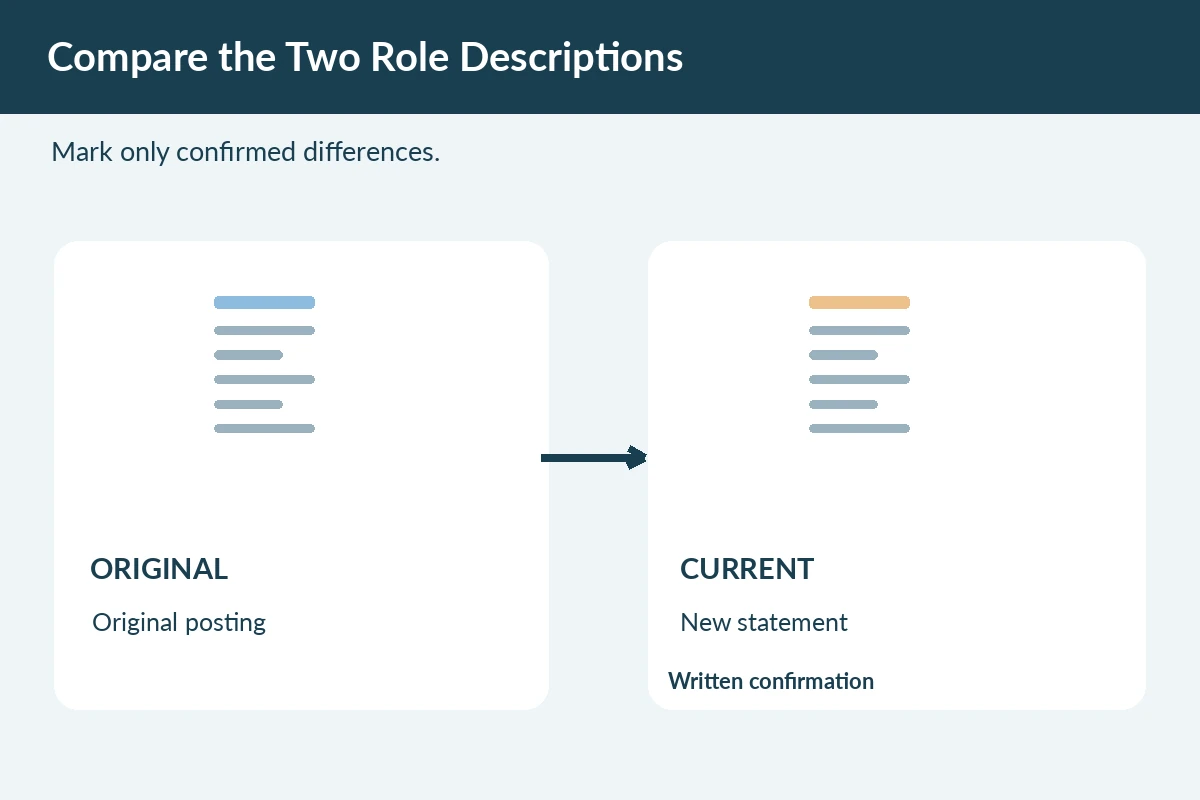
Save the original posting and write down the new wording with the date, the person who said it and the context. Separate what was explicit from what you inferred. For example, “the team may handle evening coverage” is not the same as a confirmed permanent evening schedule. You can ask direct, respectful questions without treating the interviewer as an adversary.
Compare the old and new role dimensions
Make a brief side-by-side table covering the title, core duties, location, schedule, reporting line, travel, level of supervision, access to sensitive systems, required qualifications and decision authority. Mark “not specified” when a detail is missing. Do not fill blanks with assumptions or rely on a former employee’s online description as the employer’s official policy.
If an advertised support role now includes approving customer refunds or financial records, ask who would authorize those decisions and what training is provided. If a hybrid position now sounds fully on-site, confirm the expected attendance schedule and which site is involved. A role may still be acceptable, but you deserve to know what you are considering. Note whether each change is confirmed, optional, temporary or still being discussed, and who has authority to clarify it.
Ask a neutral question in the interview
Use language that identifies the discrepancy without assigning blame: “The posting emphasized maintaining request records. Today I heard that the new hire may also make final approval decisions. Could you clarify which responsibilities this position will own and which require a manager?” That question demonstrates attention to practical scope. It also gives the employer an opportunity to explain a misunderstanding.
Another useful question is: “Has the reporting structure changed since the position was advertised, or is the team considering that adjustment?” The answer helps distinguish a confirmed change from a possibility. If the interviewer is unsure, ask who can verify the current position description.
Determine who can make an official clarification
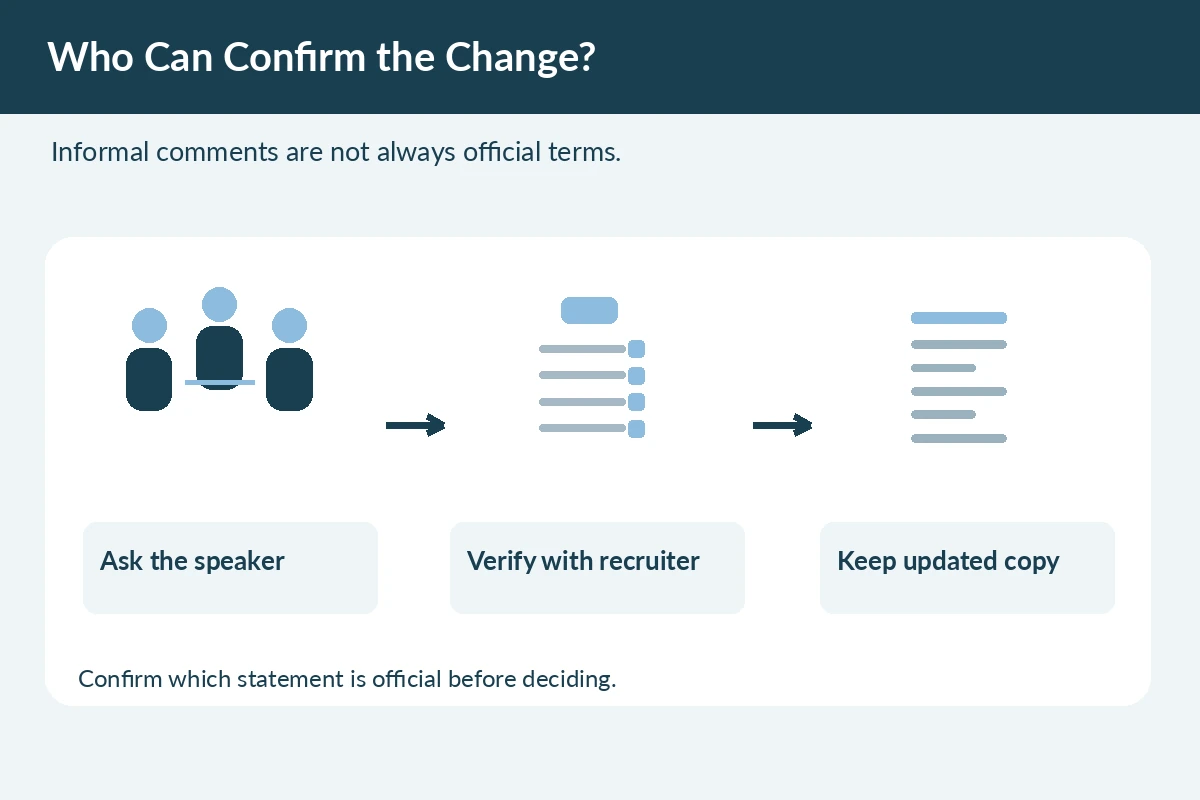
An employee you meet in a second interview may know the real daily workflow but may not have authority to change the job’s official terms. A recruiter or hiring manager may be a better contact for an updated description; an HR partner may handle employment documentation. Different employers assign these responsibilities differently. Ask for the correct person rather than making universal assumptions.
Keep a short record of what each person confirmed, especially where the information affects work location, access, supervision or required qualifications. A verbal conversation can guide questions, but a written updated description helps prevent confusion. Do not treat a casual “that should be fine” as a binding commitment.
Evaluate training and support for newly added tasks
If the revised role includes unfamiliar software, regulated work or additional technical responsibilities, ask what orientation, supervision and access are planned. Saying you are willing to learn is different from claiming an authorization or certification you do not hold. If the duties may affect safety, privacy or funds, be particularly careful about the boundary between preparing information and approving action.
You might ask: “Which parts would I perform independently after training, and which would stay with a designated reviewer?” The response may reveal whether the role is realistic for someone with your experience. Do not accept undefined duties simply to impress an interviewer; a clear fit benefits both parties.
Use an updated email if the interview does not settle it
After the meeting, send a short clarification request to the appropriate contact: “Thank you for today’s conversation. To ensure I understand the current [role title] position, could you confirm whether the duties now include [specific task] and whether the reporting line is [team]? An updated description would help me evaluate the role accurately.” Keep the tone neutral and ask only about consequential changes. If the response is vague, propose a short written summary of your understanding and invite correction rather than sending a confrontational demand.
Do not attach confidential notes from another employer, and avoid sending sensitive personal information as part of this request. If someone pushes for bank details, money or identity documents before an employer and process are independently verified, consult the FTC’s job-scam guidance and verify contact information through known channels.
Make a decision using the confirmed job, not the old headline
Once you have enough facts, compare the current responsibilities with your skills, learning goals, constraints and desired working conditions. A broader role may appeal to you; it may also require training or scheduling that you cannot accommodate. Either conclusion is valid. What matters is that you base it on a real description and not a vague promise of future flexibility.
If you still want the role, state your understanding and the evidence that qualifies you for its actual duties. If it no longer fits, decline or withdraw respectfully without accusing the employer of deliberate deception. Preserve a clear record of the discussion for your own reference.

Close the final interview with one explicit check
Before the final round ends, you can summarize: “I understand that the position now focuses on [responsibility], reports to [team] and has [confirmed arrangement]. Is that accurate, and is there anything still being decided?” Do not invent a term that nobody confirmed. A concise recap helps both sides spot differences while a decision remains open.
Use the recruiting contact for the official next steps. Until you have an actual offer and the information needed to evaluate it, keep alternatives open. A late-stage interview is an information-gathering conversation for the candidate too.
How We Research Second and Final Interviews
For this U.S. audience guide we reviewed University of Alabama, University of Michigan, UC Berkeley, Harvard and University at Buffalo career-center interviewing resources on November 10, 2026. These sources describe common interview practices; individual employers may use a different sequence and assessment process. The scenarios, suggested answers and hypothetical examples here are not reports of real candidates or outcomes. We do not predict hiring success and we distinguish the applicant’s real responsibilities from decisions made by a supervisor, employer or hiring committee.
Sources checked November 10, 2026: career.sa.ua.edu (University of Alabama describes deeper later-round interviews with additional staff, practical demonstrations and the need to review first-round notes.) careercenter.umich.edu (University of Michigan recommends role-specific questions, evidence-based answers and different questions for different interviewers.) www.career.berkeley.edu (UC Berkeley describes interview preparation and post-interview evaluation of duties, work environment, and fit.) careerservices.fas.harvard.edu (Harvard career guidance provides behavioral prompts and questions about employer challenges and priorities.) consumer.ftc.gov (The FTC warns job seekers against payments for jobs and other fraudulent recruitment practices.) Educational discussion examples require adaptation to the reader’s own facts. No career center or employer has endorsed this article. Review our affiliate disclosure.
More Interview Preparation Guides
Not necessarily. Roles can evolve. Ask for the current scope and confirm the differences before making a decision.
No automatic acceptance is needed. Clarify the tasks, supervision, location and training first, and consider whether the role still fits.
Yes. A concise request for an updated position description or written summary of changes is reasonable.
Ask who can confirm it and when. Keep separate notes about provisional information and verified responsibilities.
That is your decision. Compare the confirmed role with your needs and capabilities; you may ask questions or withdraw professionally.