
If you left a job to care for a family member, a job interview does not have to become a discussion of the family member’s health. You can accurately describe a caregiving-related departure or time away and then focus on whether you can meet the duties and schedule of the position under discussion. Use the word “resigned,” “leave of absence,” or “employment ended” in ways that match what actually happened. A planned break is not the same as being laid off.
A brief hypothetical answer is: “I stepped away from full-time employment for family caregiving responsibilities. My situation now allows me to commit to the listed daytime schedule, and I am ready to return to administrative coordination work.” This example gives the relevant timeline and present availability without naming a diagnosis or disclosing another person’s private records. It should be adapted to a candidate’s real circumstances, not repeated as a claim of guaranteed future availability.
Identify the Actual Reason for Leaving
First, check whether the resume, application and interview show the same employment dates. A period of approved leave is not automatically a resignation; if you remained an employee while away, state the employment relationship accurately. If the employer ended the relationship after a leave, do not recast that as a voluntary quit. Distinguish a reduced schedule, a formal leave and an extended gap after departure. The distinction matters more than an elaborate personal explanation.
Caregiving can involve children, parents, partners or others. The specifics usually are not needed to demonstrate a candidate’s skills. You can say “family caregiving responsibilities” and decline to volunteer who received care, the condition involved or treatment information. That protects both your privacy and theirs. If the job involves a defined schedule or travel, consider how you can confirm the requirements in practical terms without revealing details about household arrangements.

Choose Verifiable Facts, Not Convenient Labels
The EEOC advises employers to avoid stereotypes about caregiving and to evaluate applicants based on qualifications. Federal protections can depend on discrimination involving protected characteristics; caregiving status by itself is not a general federal protected class. Do not interpret this general article as individualized legal guidance. State and local rules and other laws may be relevant to particular situations. In an interview, practical job-relevant discussion is usually more productive than an unsolicited legal argument.
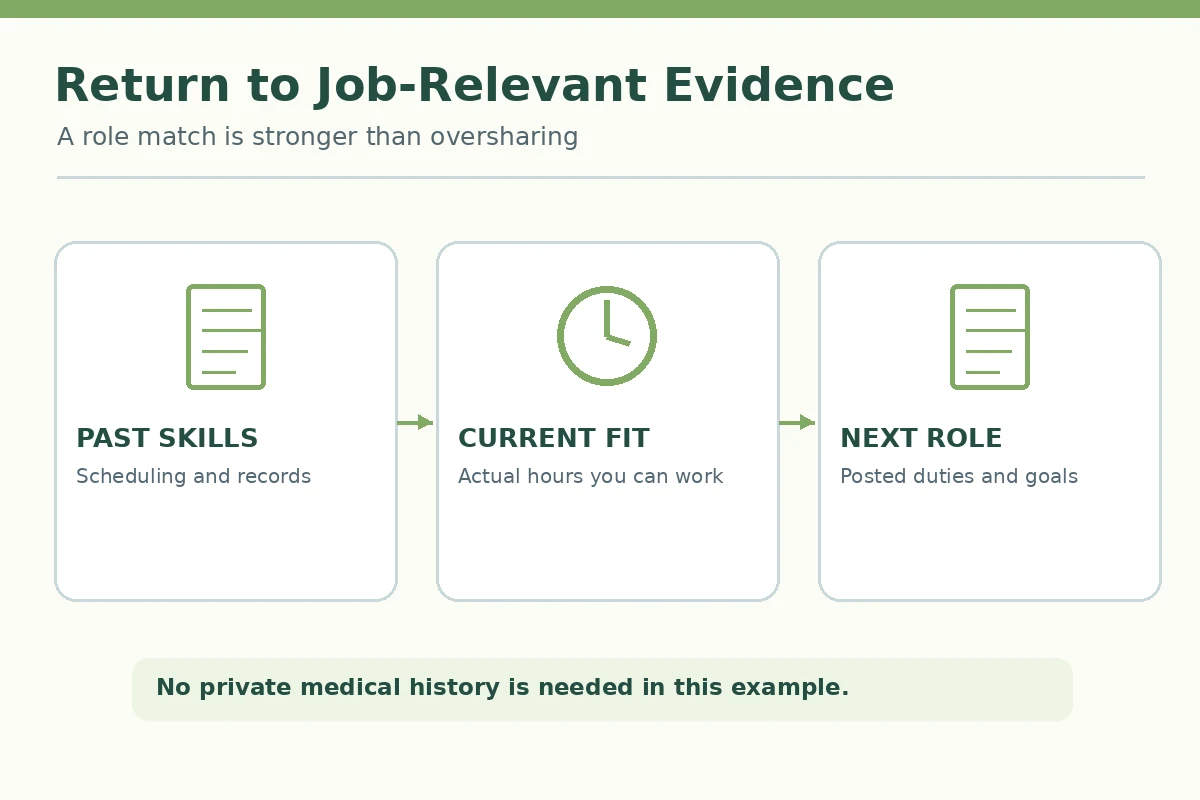
Build your reply around three pieces: the legitimate reason for the time away, a current statement about availability or interest you can genuinely support, and a skill example from earlier work. You might mention coordinating schedules, maintaining records or supporting stakeholders if those were actual responsibilities. Being a caregiver can involve meaningful work, but do not present private family experience as paid professional employment or a formal credential that you never held.

Use a Brief Interview Answer Structure
If the interviewer asks for intimate family medical details, you can redirect to the requirements of the position: “I prefer to keep family medical information private, but I can explain my availability for the shift and the coordination experience I bring.” Keep the tone matter-of-fact. If you need an accommodation for the interview process itself, that is a separate issue from explaining the job history; consult the employer’s stated process and authoritative applicable guidance.
Consider a hypothetical former office assistant who resigned to provide family care and later returned to the job market. Their answer notes the completed caregiving period and describes past calendar and records work. It does not suggest that all obligations disappeared forever or promise unlimited overtime. If the opening has variable hours, the candidate should clarify the actual schedule before saying the role is workable. An accurate fit decision supports both sides.
| Situation to verify | What your answer can establish | Do not imply |
|---|---|---|
| Voluntary resignation | Accurate end date and general reason | A leave disguised as separation |
| Approved leave | Employment continued during leave | A fictitious exit and rehire |
| Family information | Only broad context you choose to share | Another person’s diagnosis or records |
Practice a Second Version for Follow-Up Questions
A second hypothetical candidate had a leave of absence and then resumed work for the same employer. On a future application, they should not invent a separation during the leave. If discussing a gap in active duties, they can say it was an approved leave and pivot to relevant experience. Specific payroll and benefits details usually are not necessary. Explain only what is asked, consistent with the record and the privacy of other people.
Review the New Role and Its Expectations
Prepare a clear account of dates and a few current job-relevant examples before the interview. Read the posting carefully for shift, attendance, travel and essential tasks; ask clarifying questions where needed. Practice a response that ends by discussing the work you want to do. You do not need to portray caregiving as a weakness, a heroic achievement or a promise about the future. It is one factual part of your work history, not your entire professional identity.
Keep the Answer Consistent Across Formats
An interview response, a resume and an application form serve different purposes, but they must not contradict one another about whether employment ended voluntarily, through dismissal, by a layoff or because an assignment expired. Keep your position title and dates accurate; complete every employer form according to the actual question. A short interview explanation may omit unnecessary personal details, whereas a form asking for every employer may need a complete account. Do not treat a selective resume as permission to provide false information on an application. Check what a prospective reference can actually verify before offering a person’s contact information.
One practical rehearsal method is to write two versions: a two-sentence explanation and a slightly longer follow-up with a relevant work example. Each should use the same factual cause and neither should drift into unsupported numbers, accusations, legal conclusions or private information about coworkers and family members. Practice ending the answer on your ability to do the next job. If an interviewer asks something you cannot verify, say what you know and avoid guessing. Hiring decisions are not guaranteed by any phrasing; accuracy and clarity are the goals.
How We Research and Verify Interview Advice
We reviewed the following career and government sources on 2026-11-14: www.eeoc.gov eEOC recommendations to focus employment decisions on qualifications and avoid stereotyped assumptions about caregiving. www.eeoc.gov eEOC clarification that caregiver status alone is not a federal protected class, though other legal protections may apply. www.career.berkeley.edu uC Berkeley guidance on concise preparation and showing fit for the target position. All sample answers are hypothetical. Do not infer employer practices, legal rights, document requirements, or outcomes beyond the circumstances described. Readers should check their own offer, separation documents, applicable local rules, and the target job description. JobAsk does not promise an interview or a job. See our affiliate disclosure for editorial transparency.
More Interview Preparation Guides
No need to volunteer private health details to explain a work-history transition. Focus on dates and role-related capacity.
Yes when a break accurately describes the timeline and employment status.
Only if it was actually paid or formally held in that capacity; otherwise label the experience truthfully.
Caregiver status alone is not a standalone protected category under federal EEO laws; other protections can apply depending on facts.
Discuss the actual job schedule and what you can commit to without sharing unnecessary household or medical details.