
Quick answer. A farewell note belongs after the appropriate manager has been informed and the team announcement is coordinated. Keep the message brief: thank colleagues for specific genuine collaboration, name only approved work contacts and offer optional ways to stay connected. This guide shows two wholly hypothetical messages for different audiences. They are not substitutes for formal resignation or permission to copy internal contact lists or customer information.
Send the farewell after the departure is known
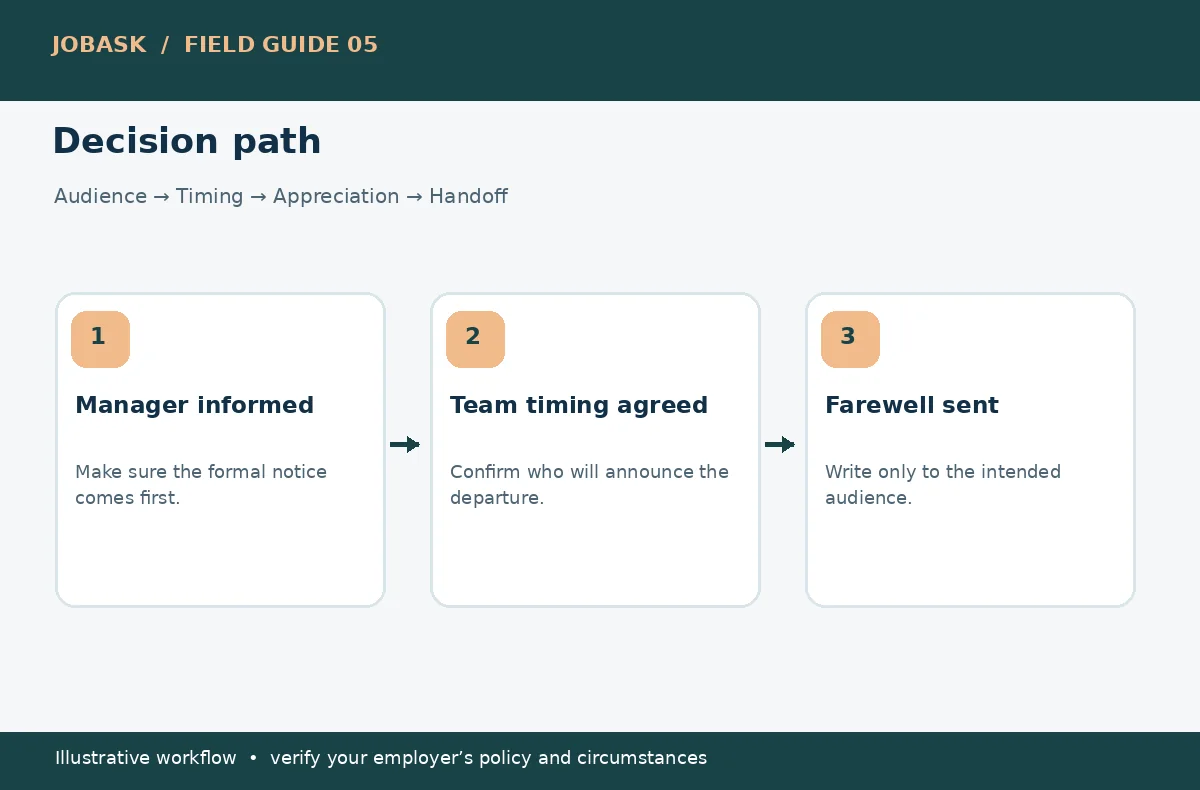
A farewell letter to colleagues is not a substitute for a resignation notice. First complete the appropriate manager or HR communication. Then agree when teammates should hear the news and who will tell them. Sending a goodbye message to a large list while your manager is still unaware can create avoidable confusion about schedules, clients and open responsibilities.
A farewell note generally serves two purposes: express sincere appreciation and explain how teammates can stay connected if they wish. It is not an official claim that all duties have transferred or that everyone is aware of your exit. If your workplace has strict communication rules, use the approved process before posting in a shared channel.
Choose the audience before drafting the words
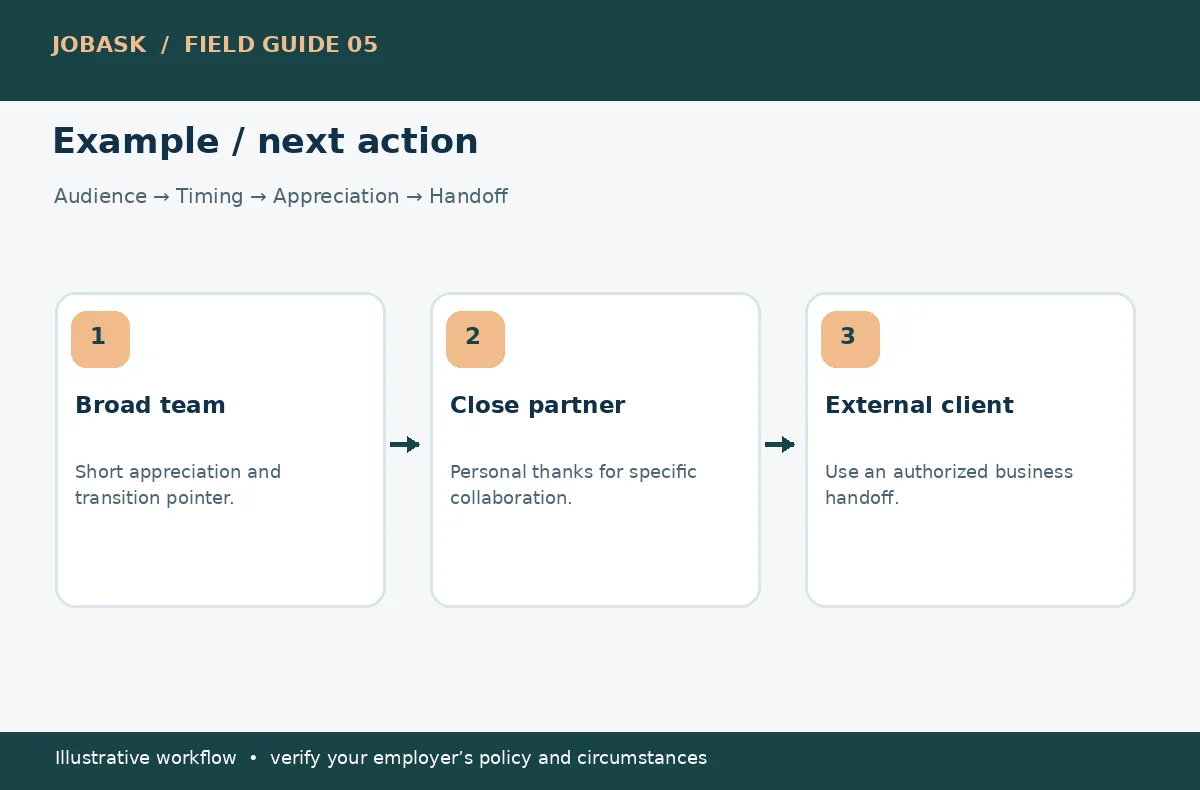
Separate a broad department note from messages to people you worked with closely. In a large organization, a brief general email may be enough for the wider team, while personal thanks are better sent individually. Your coworker in another time zone may need the handoff contact more than your personal career plans; a mentor may appreciate a specific sentence about a shared project.
Use an audience grid: coworkers who need logistics, collaborators who deserve thanks, and external partners whose contact information must be managed by the organization. Avoid mailing everyone in the company to increase visibility. Do not copy customer mailing lists or turn your farewell into unsolicited personal networking.
Start with gratitude that names a real contribution
Write one or two sentences about what you valued, grounded in your actual experience. “I appreciated the clear feedback on our weekly planning meetings” is more credible than calling every moment unforgettable. You do not need to mention every coworker; a short sincere description can include the team without ranking people or inventing memories.
If your experience was mixed, a neutral tone remains available: “Thank you for working with me on the operations handoff this year.” Avoid sarcastic thanks, public criticism or inside jokes that only a few recipients will understand. The farewell message may be forwarded, so choose language you would be comfortable having the wider team read.
Mention the last day and only confirmed coverage
Give the final working day if it is appropriate and already communicated through the right channels. For unfinished work, identify a replacement or group address only if the manager has approved that contact. Do not promise “Jordan will manage everything” when Jordan has not agreed, and never forward passwords, client details or private links in the farewell note.
A small practical detail can be helpful: “For routine project updates after [date], please use the team’s usual support inbox.” If there is no confirmed owner, simply say the team will share updated contact information separately. Avoid publishing internal staffing arrangements or confidential project status in a broad message.
Use a brief hypothetical team email
Original invented example for a broad team: “Subject: Thank you and farewell. Hi team, My last working day with [organization] is [full date]. Thank you for your collaboration on [real type of shared work]. I have appreciated the patience and thoughtful feedback you brought to the work. For ongoing items, please follow the team’s usual handoff process. I wish everyone the best in the next projects. Warmly, [name].”
This example does not represent any real team or approved handoff. Replace the bracketed project with a truthful detail; remove the last-day line if the timing is not yet agreed for wider disclosure. The strength of the message is its short, recognizable purpose. You do not need to announce your new employer, personal reasons or expected salary.
Write closer colleagues a different note
For a teammate with whom you worked closely, add a specific recollection that is appropriate to share. A hypothetical note might say: “I appreciated how you helped me clarify the release checklist when our team redesigned its review process. Your patience made the work easier to understand. I would be glad to stay in touch if that works for you.” The example describes an invented interaction and should not be reused as a claimed memory.
Do not turn gratitude into a request for an immediate recommendation, referral or favor. If you would like to connect later, give an optional professional networking profile or personal email that you are comfortable sharing. Do not distribute private phone numbers or ask coworkers to move employer business to personal channels.
Review timing across shifts and remote teams
Colleagues may learn the news at different times if they work rotating shifts or across regions. Ask which announcement route reaches the relevant people without disrupting service. A short note sent on the final workday may be appropriate for a close team, while an approved earlier message may help with a complex transition. There is no universal day-and-hour rule for all workplaces.
If you have already lost access to the company account, do not bypass security controls to send a farewell. You may be able to connect later through channels you legitimately hold, without copying the employer’s address book. For clients and business contacts, respect the organization’s disclosure and handoff procedure rather than treating them as personal mailing recipients.
Finish with a final proofread and privacy check
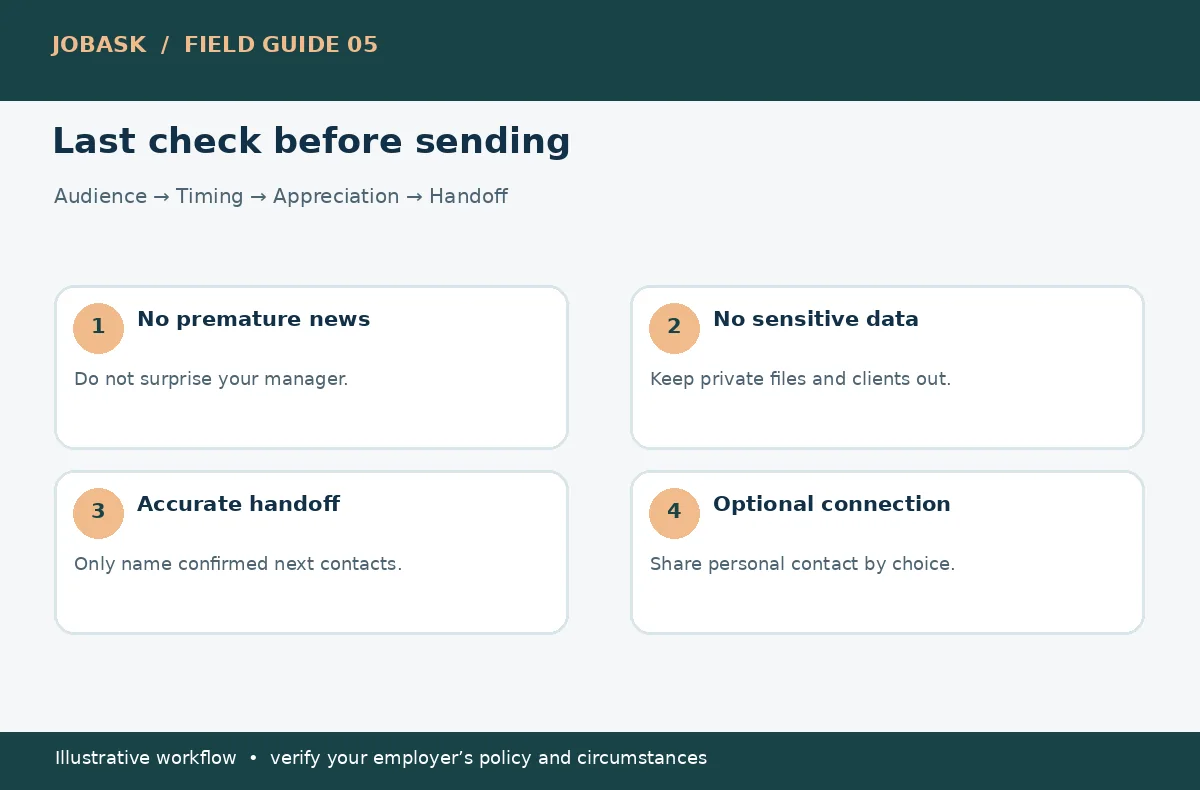
Check names, department distribution lists, departure date and any mentioned handoff contact. Read the note once as a recipient who does not know your backstory: would they understand whether you are thanking them, directing work or asking for something? If the message mixes all three, shorten it and separate important operational instructions into the official handoff.
Avoid attachments of internal decks, photographs of colleagues without consent, unapproved client lists and negative assessments of coworkers. A farewell message should be a respectful personal communication, not a backup of work records. The safest final test is simple: does every statement belong in this audience’s inbox and reflect something you actually know?
How We Research This Resignation Question
For a farewell to colleagues, we reviewed current editorial guidance on goodbye emails alongside university email-etiquette resources. The audience and timing matrix is an original decision aid, not a mandatory workplace rule. Any project names, gratitude lines and example correspondence are hypothetical, and employer-approved handoff information should be used.
Sources and Transparency for Readers
Sources reviewed on 2026-10-20: Indeed career guidance. UNLV Career Services. UNLV Career Services. The workplace communication sources inform message etiquette; the farewell guidance provides background on gratitude and ongoing professional relationships. Our audience matrix and sample notes are original illustrations rather than verified workplace announcements. An employer’s confidentiality and handoff instructions take priority. We have no confirmed affiliate relationship with the linked resources. Read JobAsk’s affiliate disclosure for relationship transparency. This article is educational content, not individualized legal advice.
Explore Related Career Guides
- Immediate Resignation Letter: What to Say When You Cannot Give Notice
- How to Give Two Weeks Notice: Conversation, Date, and Letter
- Short Notice Resignation Letter With a Realistic Handover Plan
- One-Month Resignation Notice Letter: Dates, Sample, and Transition Plan
- One-Week Notice Resignation Letter: Confirm the Date and Prioritize Handoff
Generally coordinate resignation notice and internal announcements first, then send a farewell through an appropriate team channel.
Keep it concise enough to read quickly; a few thoughtful sentences can be more useful than a detailed career history.
You can share truthful information if you wish and if appropriate, but you do not need to disclose a new employer or personal plans.
You may offer contact details you choose to share, subject to workplace policies, but do not copy confidential work data or private contact lists.
Only name confirmed handoff contacts approved for that audience; otherwise point colleagues to the existing team process.