
A lawyer informational interview helps you compare practice areas and day-to-day work before you make education or career decisions. It is not a consultation about your own dispute and not a request for confidential case details. Start by selecting a type of practice or workplace—such as a law firm, public-interest organization, government office, or in-house legal team—and ask what kinds of tasks fill a normal week. The attorney’s perspective is valuable but not a universal account of legal careers.
The American Bar Association suggests informational interviews for people who want to understand what attorneys actually do, including those still choosing a practice area. The U.S. Bureau of Labor Statistics describes legal research, client communication, and preparation of legal documents among lawyers’ responsibilities. These sources support better questions, but state-specific licensing requirements and individual employers’ expectations still need to be checked with current official sources.
Choose the Practice Setting You Want to Compare
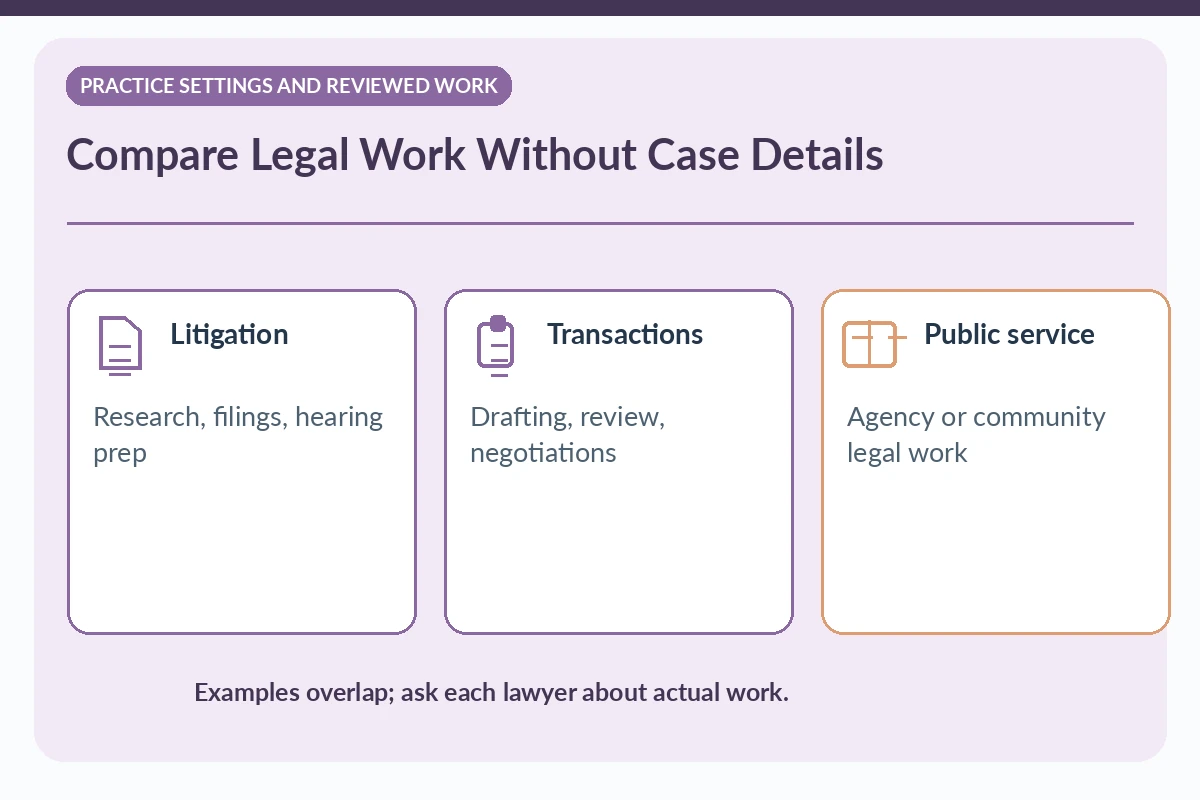
Before contacting an attorney, narrow the comparison. If you are considering litigation versus transactional practice, ask about research, drafting, preparation and communication rather than requesting stories about specific clients. If you want to compare public-interest and corporate settings, explore the kinds of problems and stakeholders they serve. Read the attorney’s public biography or organization profile first so your request has a genuine reason. Do not pretend to share a school or professional connection.
Two lawyers with the same broad title can spend their days differently depending on experience and employer. Ask whether junior attorneys focus on research memos, drafting, client communication, negotiation preparation, hearings or team coordination. Then ask what work a new employee performs under review. This teaches you about the workflow without assuming that a student, paralegal or new graduate can independently provide legal advice.
| Conversation topic | Useful question | Appropriate takeaway |
|---|---|---|
| Practice setting | What kinds of matters are typical? | Publicly describable work only |
| Daily tasks | What does a junior person draft or review? | Generic assignments and supervisor role |
| Career path | Which authority explains requirements? | Official licensing or school resources |
| Confidentiality | What case examples are unsuitable? | No privileged or client details |
Ask About Research, Writing, and Client Work
Ask: “When a new legal question arrives, how is research assigned, reviewed and turned into a client-ready explanation?” Follow with: “Who approves the final document or decision?” This can reveal the relationship among legal research, writing, proofreading and supervision. Ask what makes a memo useful and how feedback is delivered. Avoid requesting copies of client memos or a real file to study unless the attorney directs you to material already public and appropriate to share.
A second useful line of inquiry concerns communication. What makes a client meeting productive? What is difficult about translating complex rules into plain language? How does the team divide client contact, factual investigation and document preparation? The attorney can discuss general methods without identifying clients or revealing advice. If the person works in a different jurisdiction, do not assume their licensing route or workplace rules apply to your location.

Protect Privileged and Confidential Information
Never ask for names, nonpublic case facts, privileged communications, confidential settlement terms, or work product that the attorney is not authorized to disclose. If you are curious about a matter reported publicly, ask how practitioners study that *type* of legal issue in general. Do not pressure the lawyer to validate a confidential rumor. The safest questions concern tasks, training, work environment and the process for verifying legal research.
Keep personal legal issues outside this conversation. An attorney who agreed to talk about careers has not necessarily agreed to represent you, analyze a case or provide individualized advice. If you need legal help, use an appropriate professional referral channel, not an informational interview. You can explore the differences among practice areas without discussing your own dispute, another person’s legal status or private documents.
Invite an Attorney Without Seeking Free Case Advice
Illustrative message, not an actual correspondence: Illustrative invitation: “Dear [Name], I am researching the differences between [practice area A] and [practice area B]. Your public profile describes work in [specific area], and I would appreciate 15–20 minutes to learn about daily tasks and useful preparation. I am seeking career information only and will not ask about clients, confidential matters, or personal legal advice. If this is not convenient, I understand. Sincerely, [Name].”
Choose four questions that fit the attorney’s practice. You could ask what a typical junior assignment looks like, how research is reviewed, what skills matter most, and where a student can read public materials. Leave room for the lawyer to explain a surprising aspect of the work. Maintain the agreed meeting length and do not record it without permission. Treat any guidance as one perspective to compare with law school and bar resources.
Compare Legal Career Routes With Official Sources
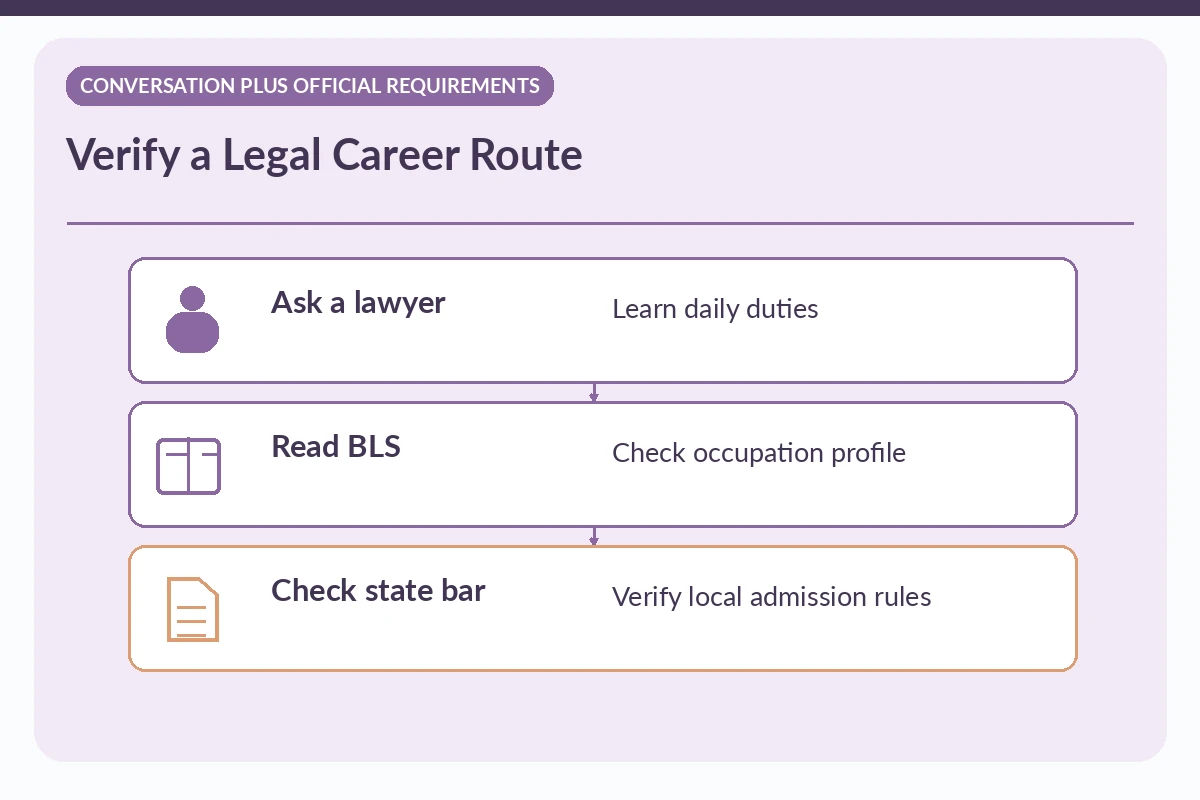
After the conversation, verify education and licensing information independently. BLS gives a national occupational overview, but requirements vary by jurisdiction and type of legal role. For any specific state, consult the applicable bar admission authority and recognized school resources. Do not infer that an attorney’s path taken years ago is still the current route. Also distinguish lawyers from paralegals and other legal-support professionals when researching entry-level tasks.
Use public writing samples or exercises to learn whether you enjoy legal research and clear argumentation. You might analyze a publicly released court opinion and draft an educational summary, clearly labeled as coursework or independent study. Do not publish confidential documents or claim that a mock memo was a client deliverable. For practice-area comparisons, record the skills and environment you found attractive as well as the work you would rather avoid.
Close With Accurate Notes and Next Steps
Make a side-by-side note of practice area, typical assignments, review structure, public resources and unanswered questions. Mark which statements came from the individual attorney and which came from BLS or bar authorities. A single conversation should not decide an expensive education commitment. If the two settings remain very different, talk with another attorney in a distinct practice rather than treating the first account as definitive.
Thank the attorney for one specific explanation, such as how research becomes a reviewed document, and ask for public reading suggestions only if time allows. Do not request private introductions to clients or a recommendation you have not earned. The result should be a more informed question about legal work and its requirements—not a promise of admission, employment or legal advice.
How We Research Informational Interview Guidance
Sources checked on 2026-11-15: www.americanbar.org (The American Bar Association recommends informational interviews to learn lawyers’ day-to-day work and practice areas.); www.bls.gov (Lawyers conduct research, advise and communicate with clients, and prepare legal documents.); career.utdallas.edu (Purposeful questions and concise professional follow-up for informational interviews.). These sources support general career-conversation practices or occupational facts, not promises about any individual employer, recruiter, legal practice or business. Every proposed conversation and example is hypothetical. No relationship with an interviewer or service provider is claimed. Review Affiliate Disclosure.
Related Job Search Guides
Not during a career informational interview. Seek legal advice through an appropriate professional channel, and do not assume this conversation creates representation.
Use public information cautiously and ask general questions about practice. Do not request confidential facts, privileged communications or unauthorized documents.
No. Review the relevant jurisdiction’s current admission rules and accredited program information rather than relying on one person’s experience.
Ask about typical assignments, research, writing, client communication and review in each setting, then compare multiple perspectives.
Only if the context makes it appropriate or the attorney requests it. The main purpose is learning about the work, not pressuring someone for a referral.