
A nonprofit program informational interview can show you how teams turn a mission into daily services, coordinate people and resources, and report results. Ask a program coordinator or manager about workflows and role boundaries—not client identities, donor lists, grant applications under review, or a promised opening. Prepare a focused twenty-minute discussion about service delivery, reporting, and supervision. The goal is to determine whether program operations match your skills and what evidence employers expect, not to obtain confidential program details or an informal hiring commitment.
Choose a contact close to the work you want to understand
A large nonprofit may separate frontline casework, program coordination, fundraising, compliance, data reporting, and executive decisions. A small organization may combine some duties, but that does not make the underlying permissions interchangeable. BLS describes social and community service managers as coordinating services, staff, community needs, and programs; individual job titles and responsibilities still vary. If you want to learn about program delivery, contact someone who supervises or coordinates activities rather than expecting a development officer to explain every service process. Read the organization’s public mission and program description before asking for time.
Your request can be specific and modest: “I am exploring community program coordination and would appreciate twenty minutes to learn how teams organize services, track progress, and train new staff.” State what you want to learn, not that you expect an introduction to the executive director. If the person cannot meet, thank them and move on. A public events page, professional network, or career-center introduction may help you find an appropriate contact. Do not send a participant story or donor details to demonstrate your interest in nonprofit work.

Separate service activities from program outcomes
Ask what happens from a community request or referral to the delivery of an approved service. Which team checks eligibility? Who schedules staff? How does the organization know that a service was delivered as planned? What happens when a case needs to be referred to another specialist? These are process questions, not invitations to reveal actual files. If a professional describes confidential client support, request a generalized workflow or publicly described program instead. Program coordination often involves balancing capacity, participant needs, access, and reporting without exposing private identities.
The most useful distinction may be between output and outcome. An output might be the number of workshops delivered; an outcome concerns whether the intended change occurred and what reliable evidence supports that conclusion. Ask how the organization chooses indicators, checks their limitations, and avoids overclaiming. You should not assume that a count of participants proves lasting social impact. For a practical worksheet, record planned activity, staff owner, documented output, possible outcome measure, and limitations. It is a decision aid, not a real performance report.
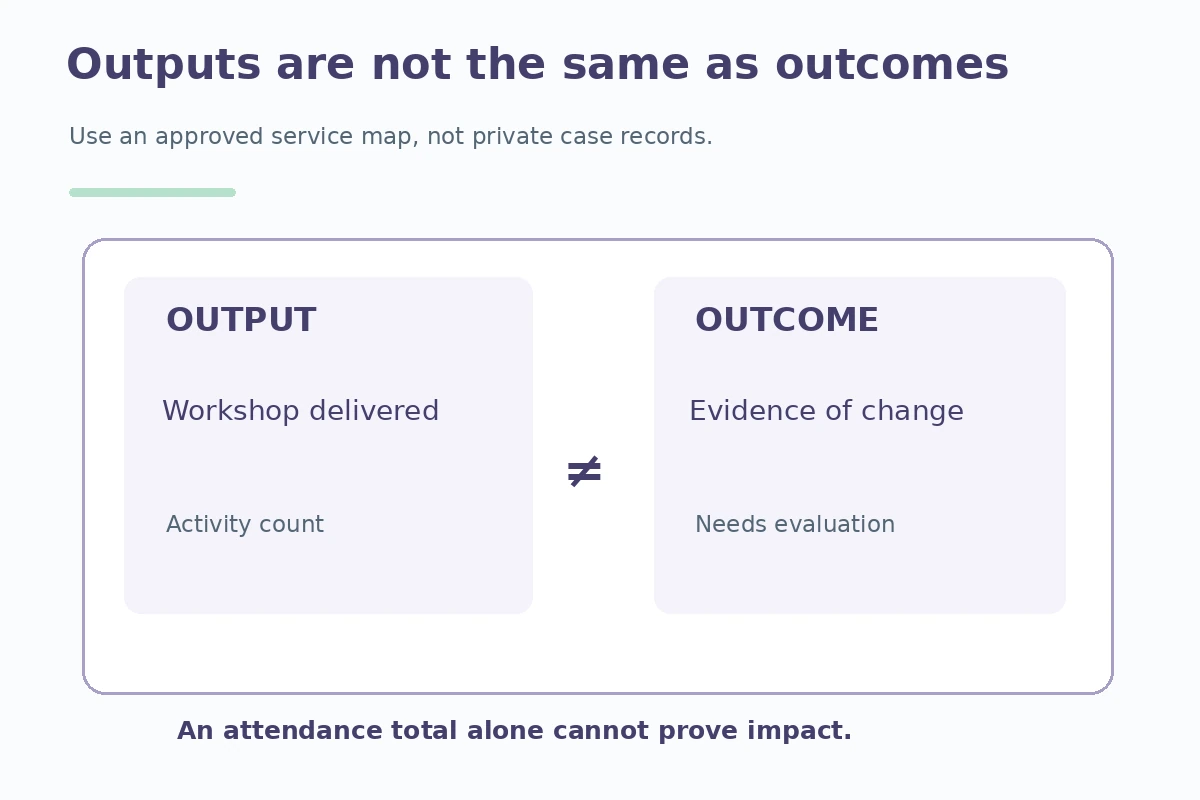
Explore funding terms without soliciting private budgets
Ask how program commitments are translated into staff schedules, reporting duties, purchasing requests, and service timelines. A manager may explain that a grant requires particular reports or approved spending categories; this does not mean a coordinator can unilaterally reallocate funds or approve purchases. Distinguish preparing a request from the person who authorizes it. Do not ask for unpublished grant proposals, donor contribution records, or internal budget gaps. If you want to understand funding structures, look for published annual reports or grant announcements and ask how public requirements shape general workflow.
A good question is “What changes for the team when a funding period ends or reporting requirements change?” Follow by asking which records are reviewed before a report is issued and who signs off. The professional may describe quality checks, reconciliations, and escalation steps rather than financial details. Keep that boundary visible in your notes. Being able to organize attendance data or draft a status update is not the same as having grant compliance authority. Some programs rely on volunteers or outside partners, which introduces additional coordination needs but does not erase data-access restrictions.
Ask what credible entry-level experience looks like
Prepare five questions: What does a program coordinator own each week? Which tasks are supervised? What data can assistants handle? How are services and participant feedback documented safely? What would distinguish an applicant who is ready to contribute? If you have volunteered, provide an accurate one-sentence example of what you did: scheduled an event, logged approved attendance totals, or distributed public materials. Do not claim to have designed a program or managed a grant if you only assisted with logistics. Ask what training and documentation the next step would require.
An illustrative example: a volunteer helped build a fictional sign-up spreadsheet for a neighborhood workshop. The useful career question is, “How does your organization confirm attendance records and decide which information is restricted?” A qualified manager may discuss general privacy and access controls without showing live participant records. Turn the answer into a practice exercise using invented names and counts, not copies of actual enrollment data. If the speaker recommends evaluation skills, seek public methods resources rather than asking for a real program dataset.
| Conversation topic | What to record |
|---|---|
| Service task | Ask who performs it and who reviews completion. |
| Data | Request public or invented examples, never participant records. |
| Funding | Distinguish report preparation from spending approval. |
| Impact | Compare documented outputs with evidence of outcomes. |
Follow up and decide where you fit in the mission
End the meeting by repeating one practical insight and asking for one public resource: a program description, annual report, or career pathway overview. Send a thank-you note that names what you learned: for example, “Your explanation of how service records are checked before aggregate reporting clarified the program coordination role for me.” Do not attach a job application unless you are invited or applying through the normal process. CareerOneStop explains that informational interviews are for learning, not for turning the contact into a recruiter. Respect confidentiality in the notes you retain.
Use what you learned to distinguish program assistant, coordinator, manager, development, and evaluation roles. Pick a skill to demonstrate honestly: a fictional shift plan, a public-resource tracker, or a basic output-versus-outcome matrix. Compare actual job descriptions for supervision, reporting, and educational requirements. It may turn out that your strengths fit volunteer coordination rather than grant administration, or data review rather than direct service. That narrower choice is the value of a focused informational interview, even if it never produces an immediate job lead.

How We Research This Career Conversation
This guide compares the profession-specific duties described by primary sources with recommended informational-interview practice. Sources reviewed: Cos; Depaul; Nonprofit. The scenarios, example statements, and proposed questions are hypothetical; they are not interviews with actual employees and do not verify any employer’s hiring policy. The organization and role determine access permissions, requirements, and daily responsibilities. Review the affiliate disclosure. No paid referral or employer partnership is asserted.
Related Job Search Guides
No. A career-learning meeting does not authorize access to donor or participant information.
Not necessarily. Work may overlap, but service delivery and development have different goals and permissions.
Not alone. They describe a type of output, not necessarily a verified outcome.
Yes, if you describe exactly what you did without overstating authority or results.
Thank the contact for a concrete insight and state one learning action, not a demand for a referral.