
A final interview with a CEO calls for concise explanations of how your actual work supports the business: customers, quality, reliable operations, cost discipline, or responsible growth, depending on the role. Prepare a genuine example in which you weighed alternatives, explain your part in the decision, and ask which priorities matter most to the position. A CEO meeting is not necessarily ceremonial and does not guarantee an offer.
Research the organization’s public information and the job posting before deciding what to emphasize. A candidate for a service role should not deliver an invented corporate turnaround plan; a candidate for a leadership role should be ready to explain scope, stakeholders and constraints. If you do not know a company fact, say so and ask a focused question rather than presenting speculation as inside knowledge.
Translate Your Role Into One Business Need
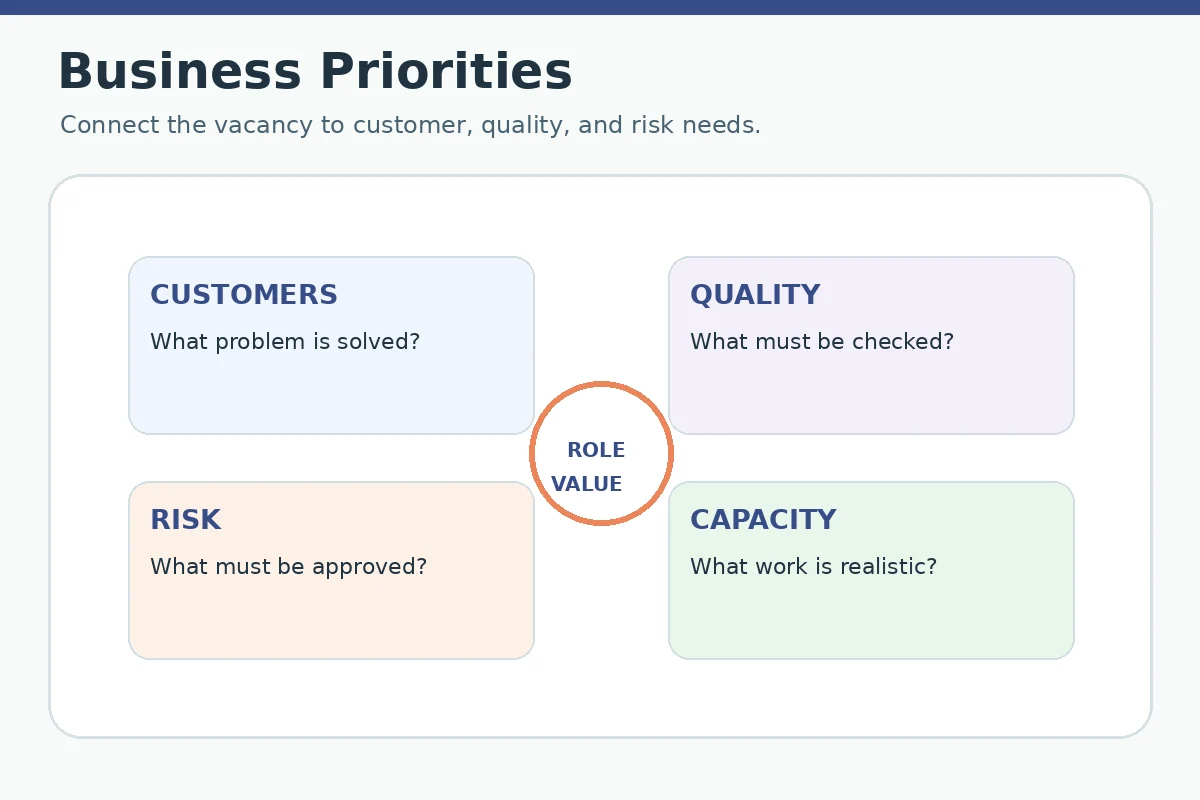
Start with the work the vacancy exists to support. For an operations role, that may be predictable handoffs and quality checks. For a product role, it may be a clear understanding of customer problems and trade-offs between speed and reliability. For a finance-support role, it may be accurate records and reviewable decisions. Use the job description to link your contribution to the business outcome without claiming sole credit.
Prepare a 45-second explanation: the business need you understood, the work you personally owned, what constraint mattered, and how the decision was checked. Do not claim you “grew revenue” unless you have defensible attribution. It is better to say “I kept the rollout checklist current while the team reviewed customer feedback” than to invent a commercial result.
Explain a Real Choice Between Competing Goals
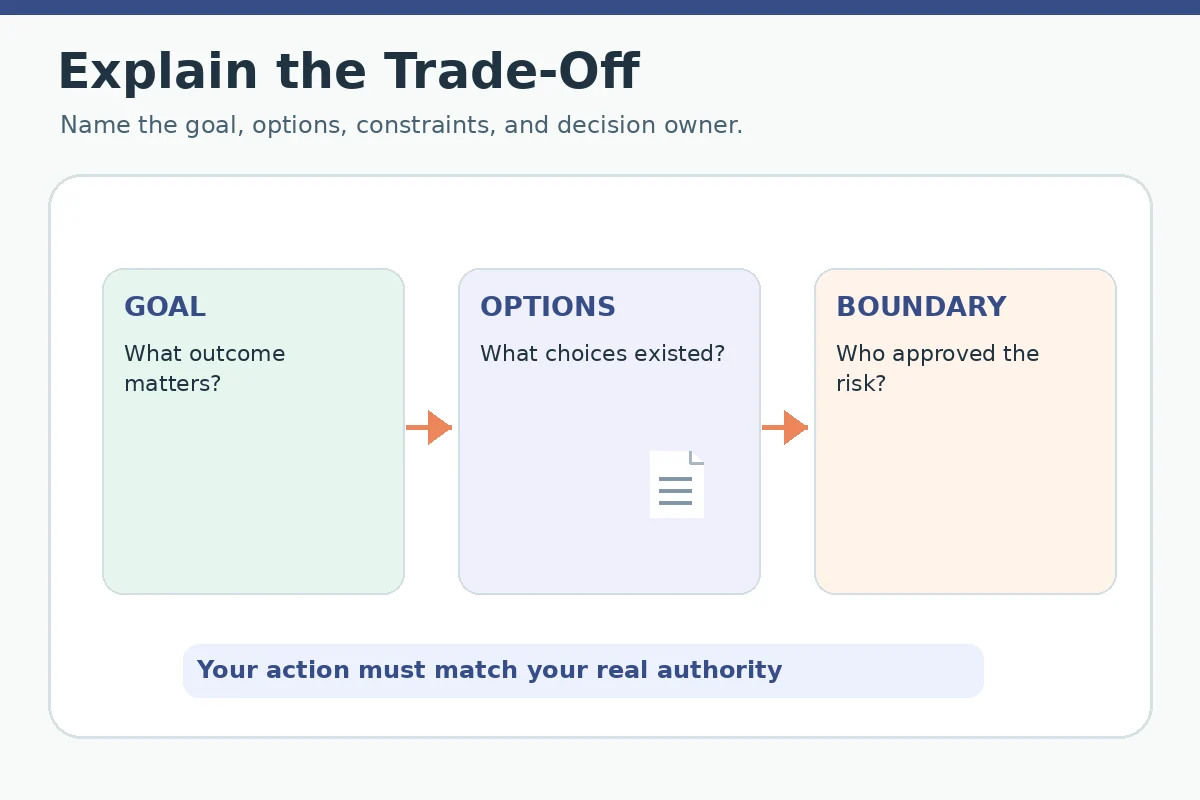
Executives may care about judgment when goals conflict. Choose a decision you genuinely took part in: speed versus accuracy, access versus privacy, cost versus service, or schedule versus risk. State the available options and what information you used. If you only recommended a choice, say who approved it. A sound answer makes decision rights visible rather than treating authorization as a small detail.
Consider a hypothetical support deployment: the team could ship a change immediately or pause for a quality review. A candidate might say they summarized the unresolved issue, tested the documented use cases, and escalated the decision. This is an illustration, not a claim about an actual employer. Emphasize the reasoning, not an invented victory rate.
| Business concern | Evidence-based answer | Avoid claiming |
|---|---|---|
| Quality vs. speed | Describe the review you performed and approval you sought | That you unilaterally accepted risk |
| Customer needs | Explain a customer issue you examined and documented | An unverified revenue impact |
| Role priorities | Connect the public job scope with a real capability | Inside knowledge of the CEO’s strategy |
Research Public Priorities Without Pretending Certainty
Review the company’s own published description of customers, products or mission, and note recent public statements if relevant. Separate the official fact from your inference: “The company highlights reliable service; I would like to learn how this role measures reliability.” Avoid presenting rumors, confidential staff opinions, or a single headline as proof of the CEO’s current plan.
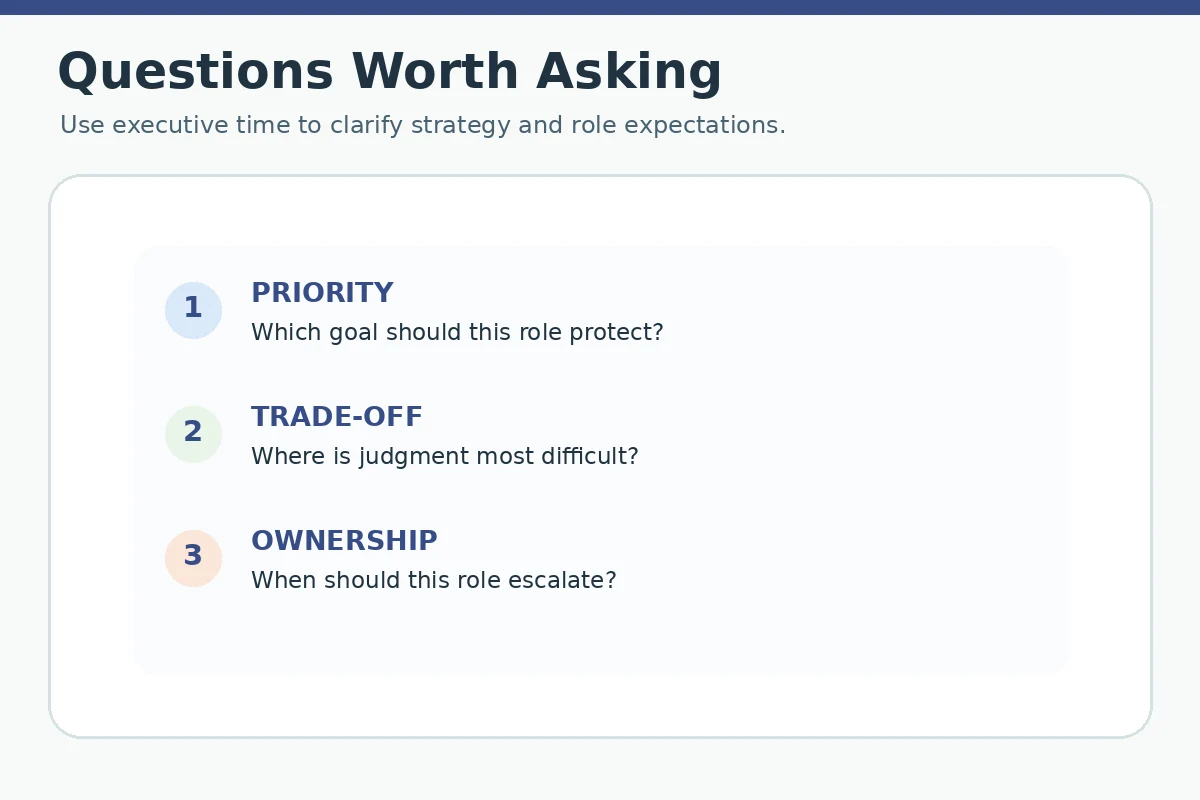
A strong question is answerable by an executive: “Which trade-off is hardest for this function as the organization grows?” or “What outcome would make this role valuable to the company a year from now?” A weaker question asks for facts available in the job listing or assumes the CEO will share nonpublic budgets or hiring deliberations.
Show Scope and Accountability Clearly
Distinguish between acting, recommending, reviewing and approving. If you coordinated a proposal for senior approval, say precisely that. If you changed a process within your own responsibility, name the checks you used. Do not inflate project size, invent a budget, or describe colleagues’ achievements as personal decisions. OPM’s competency-oriented interview model is a useful way to prepare clear evidence.
The NACE definitions of critical thinking, communication and leadership give a practical vocabulary for the behaviors involved, but a CEO is not required to use those labels. Translate the competency into behavior: you gathered information, involved the right stakeholders, made a bounded recommendation and followed up on the result. That is more credible than listing abstract executive traits.
Ask About Priorities and Decision Rights
Prepare two executive-level questions and one role-level question for whoever owns daily management. Examples include “What should this function protect when speed and quality pull in different directions?” and “Which decisions are expected to be escalated rather than made in the team?” For the day-to-day question, ask your potential manager about specific workflow ownership.
Do not ask a CEO to promise a promotion, reveal a competitor’s confidential information, or decide an HR policy on the spot. If the CEO does not know a detail, accept a referral to the right person. A thoughtful question should help you understand the job, not merely prove you researched vocabulary.
Close Without Treating the Meeting as an Offer
At the end, restate the relevant business problem and one experience that shows you can contribute within the defined role. Thank the interviewer for the conversation and ask the recruiting contact about remaining stages. Do not try to force a decision or infer acceptance from an encouraging closing remark.
If you send a follow-up, mention one genuine priority discussed and your role-level contribution in a few sentences. Avoid repeating every question or implying insider endorsement. Compensation, offer conditions and start dates should be reviewed through the authorized hiring process, with written confirmation when appropriate.
How We Research Interview Guidance
We reviewed the linked career and public-interest guidance on 2026-11-14: U.S. Office of Personnel Management (The U.S. Office of Personnel Management explains that structured interviews assess job-related competencies through behavior and hypothetical situations.); National Association of Colleges and Employers (NACE defines and illustrates communication, teamwork, professionalism and leadership competencies.); Indeed CEO interview guide (Indeed career advice discusses candidate questions and role priorities when meeting a chief executive.). We also compared candidate topics with the WordPress title inventory supplied by the site owner, the preceding local package and the original JobAsk content plan. Interview formats and employer procedures differ; all sample scenarios here are hypothetical, not verified employment histories, interview transcripts, promises of hiring outcomes or a substitute for employer policy. For transparency, see the JobAsk affiliate disclosure; this article does not claim an endorsement or paid partnership.
More Interview Preparation Guides
Not necessarily. Hiring steps differ, and meeting a CEO does not itself mean a decision has been made.
Ask about organizational priorities, trade-offs affecting the function, and what successful contribution from this role would look like.
Only when requested or clearly relevant. Do not present speculative figures or confidential material as evidence.
Use a genuine small-scale example of reliable work, customer awareness, thoughtful escalation or a checked decision.
Follow the organization’s process; HR or the hiring contact may be better positioned to confirm complete written terms.