
To find your first job, choose two realistic entry-level role types, write down what you can already demonstrate, and apply to verified openings that match your schedule. You do not need to invent professional experience. School assignments, volunteering, clubs, and genuine responsibility can show how you communicate, show up, organize work, and learn with supervision.
Your first filter is not prestige or the size of a job board; it is whether you can legally and practically do the advertised tasks. Look for wording such as trainee, assistant, entry-level, or training provided, but inspect the actual responsibilities. “Entry-level” does not guarantee that a company accepts applicants without a work history. Separate required credentials from skills a new hire can be trained to use.
Build a two-role shortlist before applying
Start with two job families that share an attainable set of tasks, such as store support and visitor service, or clerical intake and event support. Write down the work setting, schedule, commute, physical demands, and basic tools. Next, read several real postings and mark requirements as essential, trainable, or unclear. Ask an employer about unclear items rather than assuming that a beginner is allowed to perform restricted work without training.
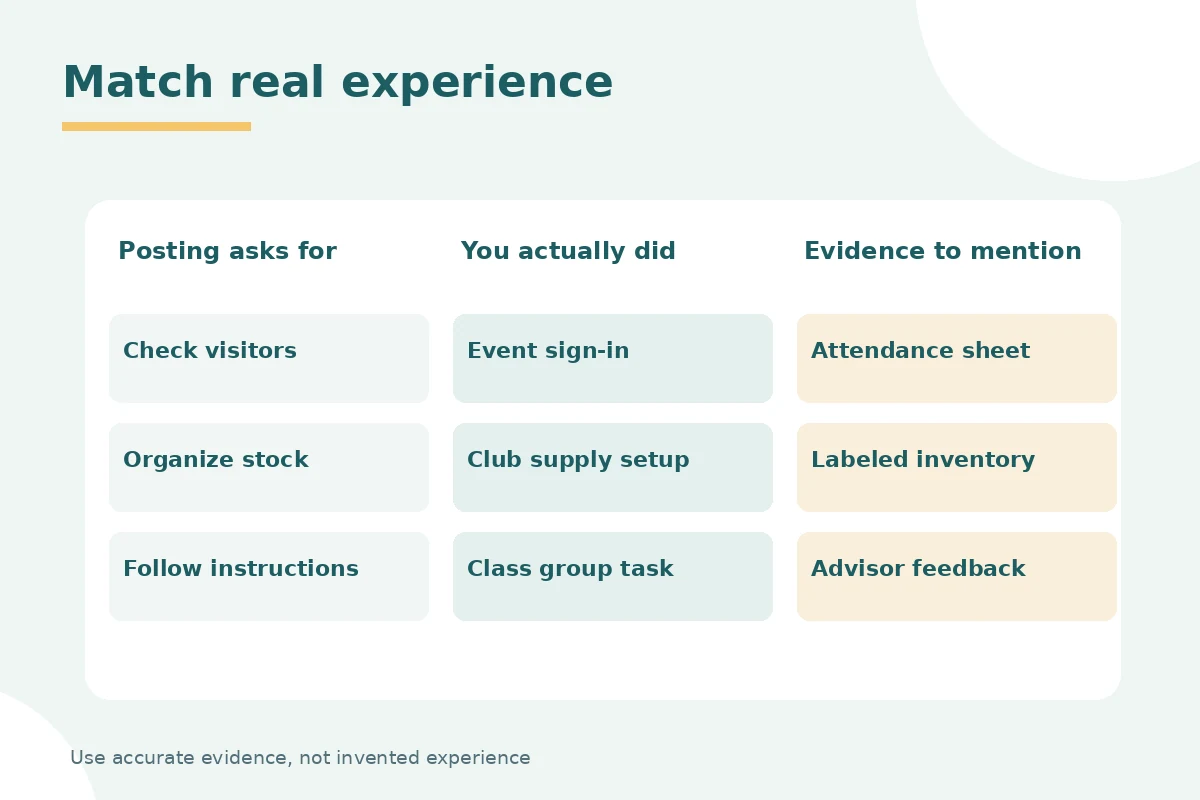
For example, a school club treasurer might have reconciled receipts with an adult advisor, but that does not automatically qualify them to authorize business payments. A person who helped at a community event may have checked visitors in, while someone else handled payment or security. Give credit for the task you actually performed and avoid upgrading an informal role into an invented job title.
Create a proof list from unpaid responsibilities
For each posting, copy one real duty into a private worksheet and add a matching event from your own experience: the situation, your actions, any available evidence, and what was handed off. If you helped organize a school fundraiser, you can describe scheduling volunteers, labeling supplies, or confirming attendance—only if you did those things. For confidentiality, summarize the work rather than uploading classmates’ contact details or an internal roster.
Use ordinary titles on your resume, such as School Project, Volunteer Event Helper, or Club Member. Include dates you can defend and an honest description of the scope. If you never handled a cash register or worked with patients, do not claim that you did. Instead, explain the preparation you bring and which procedures you would need the employer to teach.

Search openings from identifiable employers
Use the official careers pages of employers you can identify, the state job bank, or the Job Finder tools on CareerOneStop. Search for task-focused titles rather than only “no experience”; “library page,” “store associate trainee,” or “office assistant” can produce different results from an overly broad phrase. Match the actual posting to the official employer and keep the date, location, work hours, and original link in your tracker.
Be cautious of unsolicited messages promising immediate work, large pay for trivial tasks, or payment required to unlock earnings. The FTC warns that fake recruiters can imitate legitimate employers and collect money or identity information. Do not treat a logo or interview invitation as proof. Verify using contact information independently located on the employer’s own site.
Submit a complete application, not a generic blast
Before submitting, read the employer’s instructions, check your contact information, confirm dates and availability, and test the file you attach. Tailor the first few sentences of a cover letter only when a letter is requested or provides a useful explanation. A simple message is stronger than a generic assertion about being passionate: describe one requirement, one real example, and why the schedule or location works.
Sample, fictional and adaptable: “I helped coordinate sign-in for a neighborhood event, checked the attendance sheet with the organizer, and passed unresolved questions to the supervisor. I can work the posted afternoon shifts and would welcome training on your check-in process.” Replace every example with something you personally did. If a field asks for past employers and you have none, follow its instructions rather than inventing one.
Use a first-week checklist and adjust your evidence
On day one, choose two role types and document your realistic availability. On day two, list five to eight verifiable organizations and inspect their job pages. Next, assemble a resume from actual evidence, then submit a small batch of targeted applications across several days. Afterward, note which requirements repeat, prepare two truthful interview stories, and revisit your search terms. The goal is a controlled process, not an invented promise of a fast offer.
If applications receive no response, examine the match before increasing the count: did you miss a mandatory credential, leave a required question blank, or apply beyond your available hours? An American Job Center or public library may offer free assistance with applications and resume tools. Services vary by location; check before visiting.

Check what the job actually trains you to do
If training is advertised, read whether it covers basic customer handling, equipment, records, or specific safety procedures. A beginner should not guess the limits of authority. Ask who reviews unfamiliar tasks and what a new worker does when something goes wrong. “Training provided” cannot be treated as permission to do licensed work or use restricted equipment without proper authorization.
Think about the interview as a chance to test the vacancy, not just prove your interest. Useful questions include: “Which tasks do new hires learn first?”, “Who checks early work?”, and “Which shifts are essential?” These questions are concrete and easy for an employer to answer. Record the response in your tracker rather than relying on memory.
Verify the offer and protect your information
For any attractive listing, independently find the employer’s official site and confirm that the vacancy or recruiting contact is legitimate. Use a personal, accurate application and share sensitive identity or banking data only through a verified and appropriate hiring process. The Federal Trade Commission’s job-scam guidance warns about impostor recruiting, fake checks, fees, and misleading promises. No response, message, or invitation alone proves a genuine employment offer.
Use a simple four-column review: actual role requirement, evidence you have, uncertainty to resolve, and next action. Apply only when the fit is defensible; otherwise contact the employer or seek more training. Track the source and submission date. The CareerOneStop application guide recommends keeping records of the vacancies and organizations you have contacted, rather than relying on memory or automatic notices.
How We Research This Job Search Guide
We compared the stated beginner job-search task with public guidance from the U.S. Department of Labor’s CareerOneStop, relevant government resources, and role-specific material where useful. The examples above are illustrative, not real applicant histories, employer promises, verified openings, or guaranteed results. Requirements, schedules, and available services must be checked against the specific employer and location on the date you apply.
Source notes: CareerOneStop lists job, occupation, skill, youth, and local-support tools useful to first-time seekers. CareerOneStop recommends tracking applications and using employer and networking contacts. The FTC documents recruitment impersonation and requests for payment or sensitive information. We may review or update these resources as public guidance changes. Read our affiliate disclosure; no paid endorsement or affiliate relationship is implied by these links.
Related Job Search Guides
Yes, some employers hire and train new workers. Verify each posting’s actual requirements and use truthful examples from school, volunteering, projects, or responsibilities rather than inventing employment.
Include a project if it demonstrates a relevant task. State your individual contribution, identify it as coursework or a project, and avoid disclosing other people’s private information.
It is a label, not a guarantee of no prerequisites. Read the qualifications and distinguish training provided from licenses or required experience.
There is no universal number. Start with a manageable set you can tailor, verify, and track, then improve your targeting using what you learn.
CareerOneStop links to American Job Centers and other local resources; some public libraries also assist job seekers. Contact the local provider for available services.