
If an interviewer asks what you would do in your first 30 days, explain how you would understand the role, learn required procedures, confirm priorities with your manager, and contribute within the responsibilities actually assigned. Do not promise to redesign a department or deliver a numerical improvement before knowing the systems, people and approval rules. A credible plan is conditional: learn first, check expectations, then complete and review appropriate work.
You are not submitting an operating plan for a team you have never joined. The question explores your judgment, initiative and willingness to take direction. The University of Pennsylvania recommends asking what onboarding and training look like, while NACE identifies accountability and timely communication as observable professional behaviors. The framework below helps you answer without pretending to know an employer’s private first-month schedule.
Start With Actual Duties and Unknowns
Read the vacancy and highlight recurring responsibilities, tools, customers, review requirements and any explicitly stated training. Sort your notes into what you can prepare for before joining and what you must learn on site. You can review general terminology or public product information now. You cannot claim access to an internal system, a client list or a team process you have never seen. Keep the first-month answer anchored to the job description rather than a generic productivity slogan.
In the interview, state your assumptions briefly: “Assuming the normal onboarding and required access are available, I would first learn the team’s priority tasks and approval process.” That sentence makes room for regulated or high-risk work where permission and supervision matter. Do not announce that you will independently change a safety, privacy or financial workflow in week one. The employer can then explain what the role actually allows.
Phase One: Learn the Workflow and Identify Owners
For the opening stretch, describe listening, observing and asking specific questions. Find out what a successful day looks like, where procedures are documented, who reviews work, and which systems you are authorized to use. Learn how the team handles urgent requests and errors. A new employee who knows the escalation path can avoid expensive mistakes; the goal is not to ask no questions but to ask them in a timely, organized way.
A hypothetical administrative assistant might say: “I would learn the calendar approval process, note which meetings need a manager’s decision and check how confidential files are stored.” A warehouse support applicant could focus on equipment permissions and shift handoffs instead. Neither should claim that completion of a generic online tutorial grants authorization to handle restricted data, equipment or money. Early preparation should match actual training rules.
| First-month phase | What to demonstrate | Must confirm |
|---|---|---|
| Learn | Understand tasks and owners | Access and training |
| Practice | Complete assigned work | Review and permission |
| Contribute | Suggest a small improvement | Responsible owner approval |
| Check in | Discuss gaps and priorities | Manager expectations |
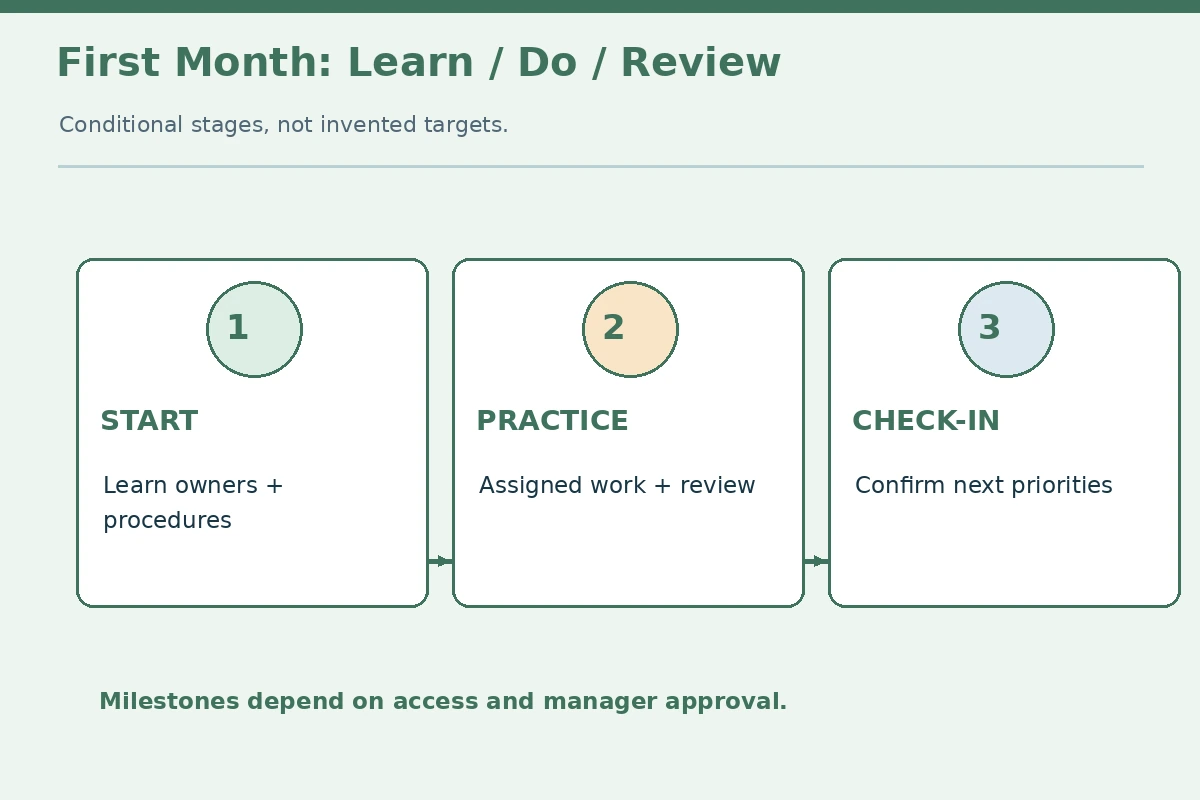
Phase Two: Perform Assigned Tasks and Request Review
Once the manager identifies appropriate entry tasks, explain how you would complete them, check the results and invite feedback. For example, a new support agent could practice using an approved response guide under supervision, while a records assistant might validate permitted file fields against a checklist. Emphasize that success means reliable work at the expected scope, not inventing a dramatic improvement in a month.
Say which information you would track for your own learning: questions still open, instructions clarified, and mistakes corrected with permission. This is not a plan to collect private customer data into a personal spreadsheet. If the employer has an approved issue tracker or training record, use it as instructed. If you see a process gap, document the observation and consult the responsible owner before suggesting a change.
Phase Three: Suggest One Small Improvement With Permission
By the latter part of the month you may have enough context to notice a recurring confusion, a missing checklist step or an unclear handoff. Describe how you would test the observation: ask whether the issue is already known, review the documented process and propose a small change to the proper person. Be explicit that implementation requires the relevant owner’s consent. A prospective employee cannot guarantee that a proposal will be adopted.
For example, an incoming scheduling assistant might suggest a clearer field label after seeing approved examples of incomplete requests. A healthcare trainee, however, must not promise to adjust clinical workflow independently. The same basic discipline applies: understand the consequences, gather limited nonconfidential evidence, seek authorization, and record what actually happens. It is fine for your first month to center on doing established work accurately rather than launching improvements.

Use a Role-Specific Answer Instead of a Script
A reasonable hypothetical answer for a junior operations role is: “First I would learn the team’s daily priorities, tools and exception-handling rules. Then I would take on assigned requests, verify my work against the current checklist and check in about anything unclear. Once I understand the handoffs, I would share one improvement idea if the lead thinks it is useful.” Replace those tasks with true requirements from the actual posting.
This structure works only if it describes the position. A research assistant might prioritize approved protocols and documentation; a marketing coordinator might focus on campaign briefs and review cycles. Avoid vague claims like “I will transform your workflow in 30 days” or “I will hit every KPI immediately.” You have not seen the baseline or agreed on a target. Interviewers can judge adaptability and awareness of limits without a promise of exceptional performance.
Ask About Onboarding When Expectations Are Vague
If the employer has not described training, ask: “What would you want the new hire to be comfortable doing independently by the end of the first month?” You could also ask who checks early deliverables and how priorities are communicated. These are practical questions, not demands for special treatment. They also help you evaluate whether the employer provides the access, supervision or documentation necessary to do the job well.
Be prepared for different timelines. Some organizations have a formal orientation; others introduce tasks gradually. A role with licensing or security requirements may restrict activity until credentials and authorization are verified. Your answer should name dependencies without appearing unwilling to learn. Saying you will confirm training before operating restricted equipment shows judgment. Saying you expect a fixed promotion or ownership change in 30 days does not.
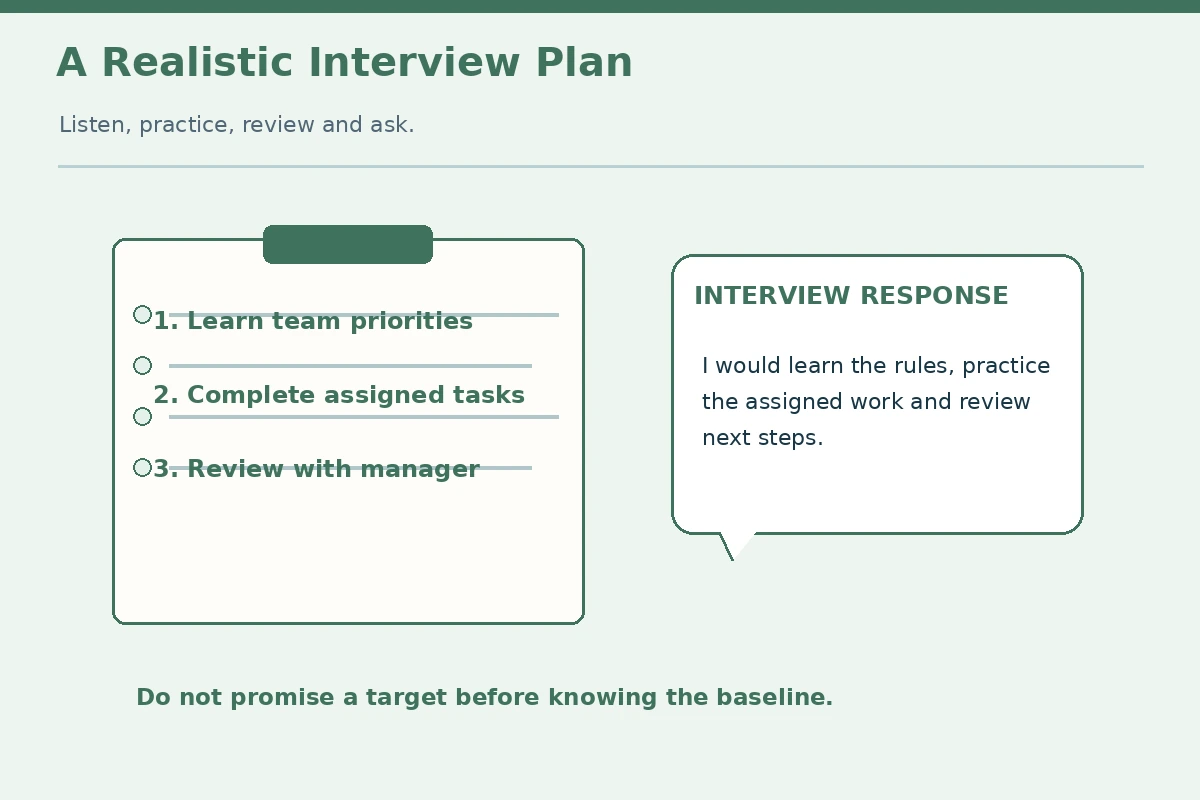
Rehearse a Plan You Can Defend in Follow-Ups
Practice responding if an interviewer asks how you would handle an unclear request in week two. A defensible answer is to review the approved instructions, identify the specific ambiguity, ask the assigned manager or reviewer and confirm the next action. If the task is urgent or high risk, escalate sooner. Do not claim you could solve every unfamiliar situation by searching online or by guessing at an internal policy.
Close with one modest, measurable-by-observation contribution: completed assigned work with review, documented questions resolved, or a handoff explained accurately. Do not attach invented counts or promise a hiring outcome. The most credible first-month plan is flexible enough to change when the real manager, schedule and permissions are known. That is why it can be useful in both an interview and an actual onboarding conversation.
How We Research Interview Advice
On 2026-11-14, we reviewed official and university career resources: U.S. OPM: Structured Interviews — OPM explains that structured interviews focus on job-related competencies and actual or proposed behavior.; Penn Career Services: First Job Interview — University of Pennsylvania career services recommends researching the role and organization and asking about training and expectations.; NACE: Career Readiness Competencies — NACE defines communication, critical thinking, professionalism and teamwork through observable work behaviors and appropriate requests for guidance.; Harvard FAS: Interviewing — Harvard FAS advises candidates to research the employer, understand the job and connect relevant experience to contribution.. We compared these questions with the supplied WordPress title exports and available JobAsk draft packages. All answer examples and illustrated scenarios are hypothetical, not a report of an employer interview, actual candidate results or hiring success. Interview formats and job boundaries depend on the employer. Verify policies and job facts before claiming them. Review our affiliate disclosure; no paid recommendation or employer partnership is claimed.
More Interview Preparation Guides
Usually a concise learning-and-contribution outline is more credible unless the employer specifically requests a detailed planning exercise.
Only when you have a legitimate basis and agreed goals. Avoid inventing baseline figures or guaranteed business outcomes.
Name training and authorization as prerequisites. Focus early milestones on approved learning and supervised practice.
Yes. Asking about early tasks, review and realistic expectations helps both parties clarify the position.
Connect transferable habits to the advertised role, then describe how you will learn unfamiliar systems and ask for review.