
For “How would your former manager describe you?” name one or two job-relevant behaviors that a supervisor actually had a chance to observe, then give a brief example. Do not put words in a manager’s mouth or claim they promised a glowing reference. If you do not know how they would answer, use a careful phrase such as “Based on the feedback I received, I believe they would mention my organized handoffs.”
The question is not a request for an imaginary recommendation letter. It tests self-awareness and how you understand your contribution to a team. OPM’s structured-interview guidance favors job-related behavior, and NACE names reliability, communication and accountability as observable workplace skills. The observation worksheet below helps you distinguish feedback you received from praise you are merely hoping to hear.
Choose Behaviors the Supervisor Could Have Seen
List tasks your supervisor reviewed or worked near: meeting a handoff deadline, organizing shared materials, escalating a discrepancy, training a new teammate under direction or asking for clarification before updating a sensitive record. Select one behavior relevant to the vacancy. If your manager rarely observed a skill, avoid asserting that they would name it. A former manager’s opinion can be different from your self-image, so anchor the answer in shared work rather than private assumptions.
For example, “dependable” is stronger when tied to actual scheduled shifts or consistently completed checklists. “Visionary leader” is unsupported if you never supervised or led a project. You may describe your own positive intention, but the interviewer asked what a supervisor could reasonably say. Choose a quality that connects to the advertised tasks, such as accuracy for records work or clear communication for a support role.
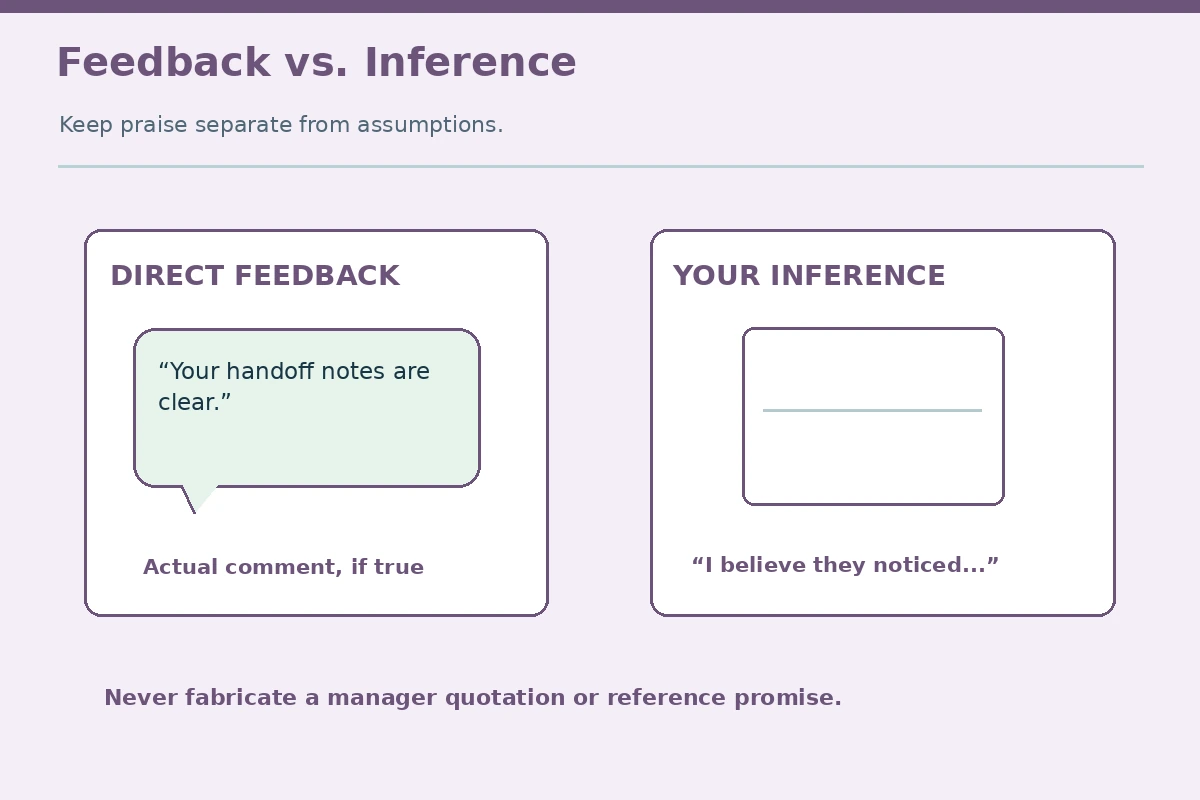
Separate Direct Feedback From Your Inference
Make two columns: “what I actually heard” and “what I infer from the work.” Direct feedback includes a genuine performance-review note, a documented coaching comment or an explicit verbal observation you remember accurately. An inference could be that your supervisor relied on you for routine closeout notes. Do not turn that reliance into a fabricated sentence like “My manager called me the best employee on the team.”
If you received mixed feedback, you can still answer positively and precisely. Suppose you were told that your updates were accurate but sometimes late. You might say your supervisor valued your attention to detail, while explaining how you improved the timing of status messages. This is more credible than pretending the criticism never occurred. Avoid sharing confidential review documents, coworker information or anything your former employer restricts.
| Evidence level | Safe answer wording | Avoid |
|---|---|---|
| Actual feedback | “My supervisor noted…” | Invented quotation |
| Observed task | “They saw me…” | Unseen achievement |
| Reasoned inference | “I believe they would…” | Guaranteed testimonial |
| No paid manager | Name true coordinator role | Fake employment title |
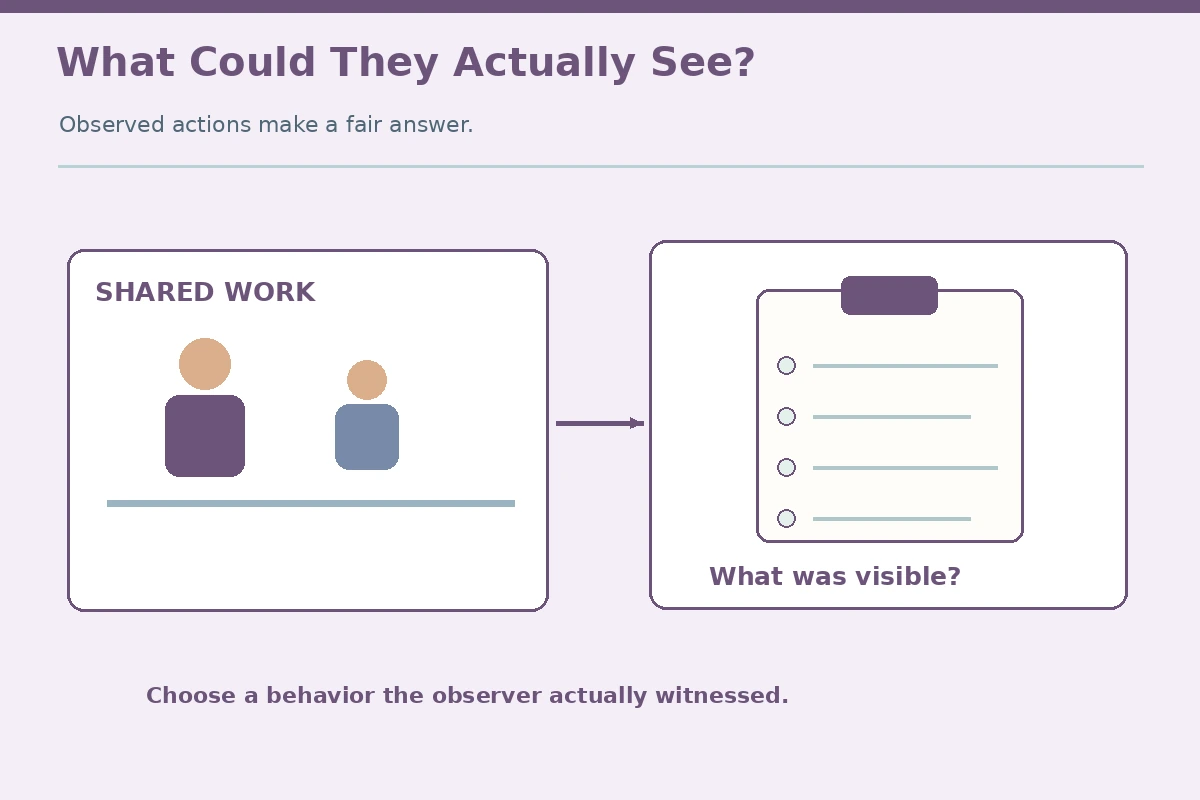
Tell One Small Example With Visible Actions
Use an example with a setting, your action and an observable outcome. A hypothetical applicant might say: “I think my shift supervisor would describe me as careful with handoffs. When a delivery note did not match the receiving log, I flagged the mismatch for review rather than adjusting the record myself.” The sample demonstrates an action and a boundary. It does not claim a real supervisor said those words.
If you are moving to a customer-support job, you might describe confirming the details of an issue, recording an approved response and handing off cases that needed another team. State who actually resolved the problem. Avoid inventing satisfaction scores or numbers of customer accounts. Penn career guidance recommends concrete stories about what you did and the result you can explain; an honest process outcome can be useful even without a metric.
Avoid Making a Reference Promise You Cannot Guarantee
This interview question does not establish that your former manager has agreed to be a reference. Do not state “They will definitely tell you I am exceptional” unless there is a real basis, and even then you cannot control their future words. The answer is your best defensible assessment of observable work, not permission to list their contact details. Ask a person before using them as a reference and follow the employer’s reference-request process.
If you left after a disagreement, do not use the question to criticize the manager or make a sweeping accusation. You can shift to what was demonstrated: “They saw that I documented changes thoroughly and followed the agreed review route.” Be truthful if you cannot support a positive inference. If the relationship is too strained to make that statement, select another appropriate supervisor or project lead only if the interviewer asks whose feedback you are discussing.
Use a Different Observer When You Have No Paid Manager
Students, caregivers, independent workers and people returning to work may never have had a traditional direct manager. Do not invent one. Explain the closest accountable observer: an instructor who reviewed a group project, a volunteer coordinator, a client who approved work, or an internship supervisor. State that person’s real relationship to you rather than calling every organizer your “former boss.”
For example: “I have not had a paid supervisor yet, but my volunteer coordinator observed how I prepared the event checklist and updated others when supplies were missing.” You can then explain what feedback was actually provided or what behavior was visible. If the application later requires professional references, read its definition separately. This interview answer should not mislabel an academic recommendation or imply formal employment.
Prepare for a Follow-Up About Weaknesses or Growth
An interviewer may ask what the same manager would say you needed to improve. Pick a genuine area connected to your work and describe the response. Maybe you learned to send earlier status notes, structure a meeting handoff or identify which questions needed faster escalation. Avoid a fake weakness disguised as perfectionism unless that is a meaningful, supported issue in your experience.
A useful answer admits a boundary and names the next step: “My coordinator asked for clearer updates when a task was delayed. I began sending an earlier note when a dependency was unresolved.” Do not claim that the process eliminated all delays or earned a promotion unless you can prove it. Show that feedback changed behavior. The quality an interviewer can trust is not flawless self-praise; it is a clear account of work and learning.
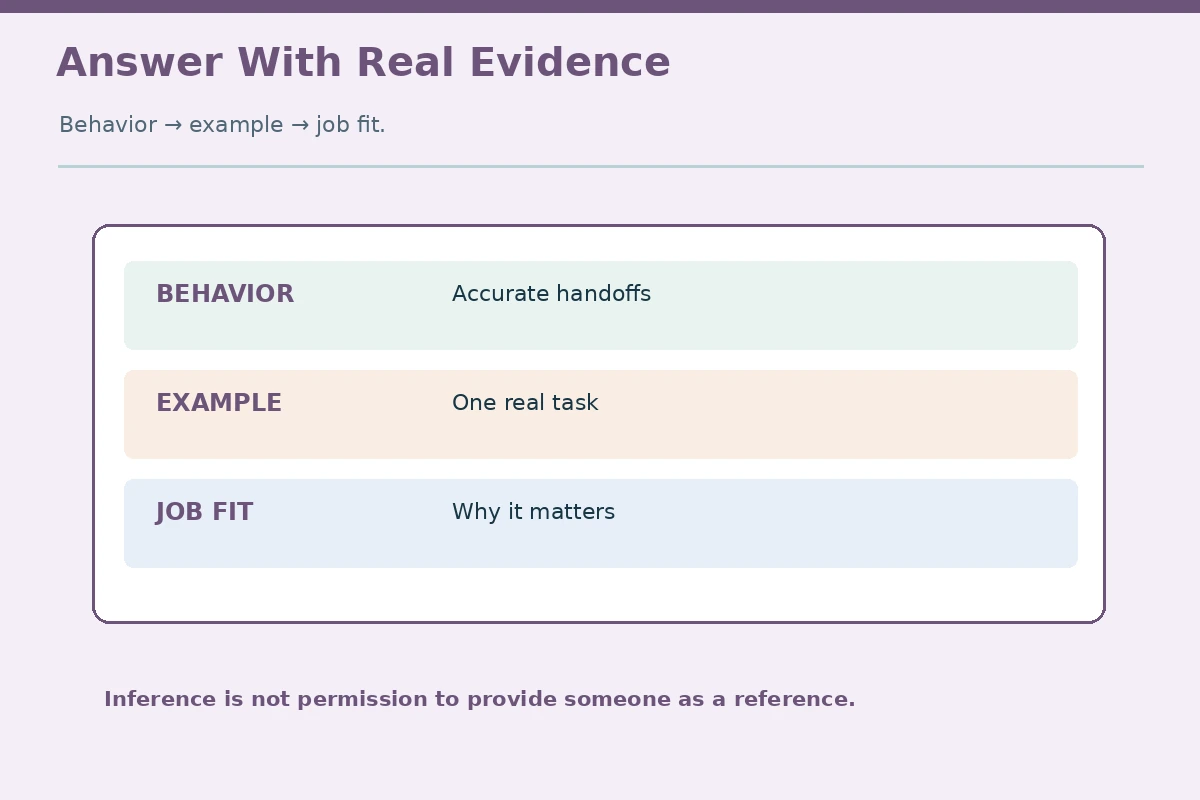
Rehearse With a One-Minute Evidence Check
Before the interview, say the proposed quality aloud, name the observer and identify a specific instance of the behavior. Ask yourself whether that person actually saw the task. If not, revise the wording to “I aim to” or use another example. Then check whether the story connects to the position. A detailed tale about personal hobbies is usually less useful than a simple workplace handoff that mirrors the role’s requirements.
Finally, make sure the statement matches your resume and your true dates, titles and responsibilities. You cannot predict what a reference might disclose, and you should never promise that an employer will give positive feedback. A credible self-assessment allows the hiring team to ask for detail without finding that your example was exaggerated. End with a plain sentence showing how the observed habit could help in the new job.
How We Research Interview Advice
On 2026-11-14, we reviewed official and university career resources: U.S. OPM: Structured Interviews — OPM explains that structured interviews focus on job-related competencies and actual or proposed behavior.; NACE: Career Readiness Competencies — NACE defines communication, critical thinking, professionalism and teamwork through observable work behaviors and appropriate requests for guidance.; Penn Career Services: Interview Examples — Penn career services advises specific examples of actions and outcomes in interview responses.; Harvard FAS: Interviewing — Harvard FAS advises candidates to research the employer, understand the job and connect relevant experience to contribution.. We compared these questions with the supplied WordPress title exports and available JobAsk draft packages. All answer examples and illustrated scenarios are hypothetical, not a report of an employer interview, actual candidate results or hiring success. Interview formats and job boundaries depend on the employer. Verify policies and job facts before claiming them. Review our affiliate disclosure; no paid recommendation or employer partnership is claimed.
More Interview Preparation Guides
Only if you accurately remember actual feedback and can represent the quote fairly; paraphrasing with context is usually safer.
Use demonstrable behavior and honest self-assessment; do not pretend that a manager praised you.
Yes, where appropriate. Clearly describe the person as an instructor or project supervisor rather than a paid manager.
No. Seek permission separately before listing contact information or implying a person agreed to speak for you.
Focus on truthful observed work and learning without making accusations or inventing praise.