
A first-year teacher cover letter should show what you learned and actually did during student teaching, not pretend you already held a full-time classroom position. Identify the grade level or subject in the opening, describe one planned and delivered lesson or support activity, explain how you used feedback, and state your current license or certification stage accurately. The requirements for public-school teaching vary by state and level. This guide provides a fictional sample, an evidence map, and a check for claims about assessment and student information.
Start with the grade, subject, and position
An elementary posting, a high-school mathematics opening, and a special-education vacancy ask for different preparations. Copy the actual position title and grade or subject area into the opening. Mention one real connection to the school’s publicly stated instructional focus only if you can verify it, such as an advertised literacy program or project-based approach. Do not claim to know the school’s internal classroom needs from an old press release.
For most public-school teaching roles in the United States, BLS notes that state licensing or certification requirements apply and vary by state. A candidate should say “licensed in [state]” only after the credential is actually issued. If the application or examination is pending, use the status shown by the official state credentialing authority, not a guessed completion date. The cover letter should agree exactly with the resume and the district application.
Choose one supervised lesson with evidence
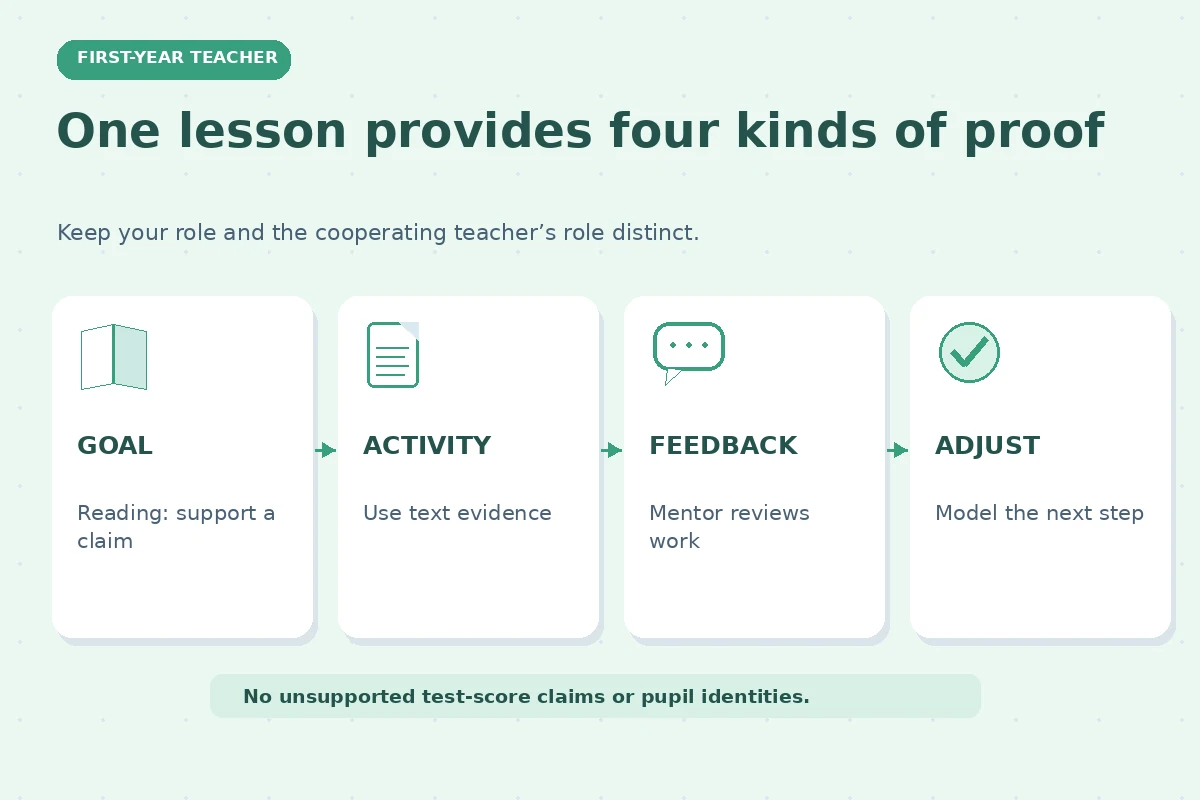
Think of a student-teaching placement where you prepared an objective, chose an activity, reviewed student responses under supervision, and changed the next lesson after feedback. This is concrete evidence of emerging instructional judgment. Say the grade band and subject, what you personally designed, and what your cooperating teacher reviewed. Avoid transforming “helped deliver a science lesson” into “managed the science curriculum.” Your letter can be compelling without inflating responsibility.
A useful note has four parts: instructional goal, lesson adaptation, mentor feedback, and observed follow-up. For example, a student teacher might notice students confusing two vocabulary terms, ask their mentor to review a small-group activity, and adjust the next practice sheet. Do not invent student test score gains, promise improved academic outcomes, or attach pupils’ work with names visible. Use de-identified descriptions only where permitted by the school and applicable privacy policy.
Study this fictional first-year teacher letter
This entire example is hypothetical. It describes supervised training, not an actual applicant’s history; substitute your true placement, activities, and credential status.
Dear Hiring Committee, I am applying for the posted fourth-grade teacher position. My teacher-preparation coursework and supervised elementary practicum have helped me develop a practical approach to lesson planning, checking understanding, and adjusting instruction. I am currently [insert your verified state certification status] and will provide the documents requested by the district.
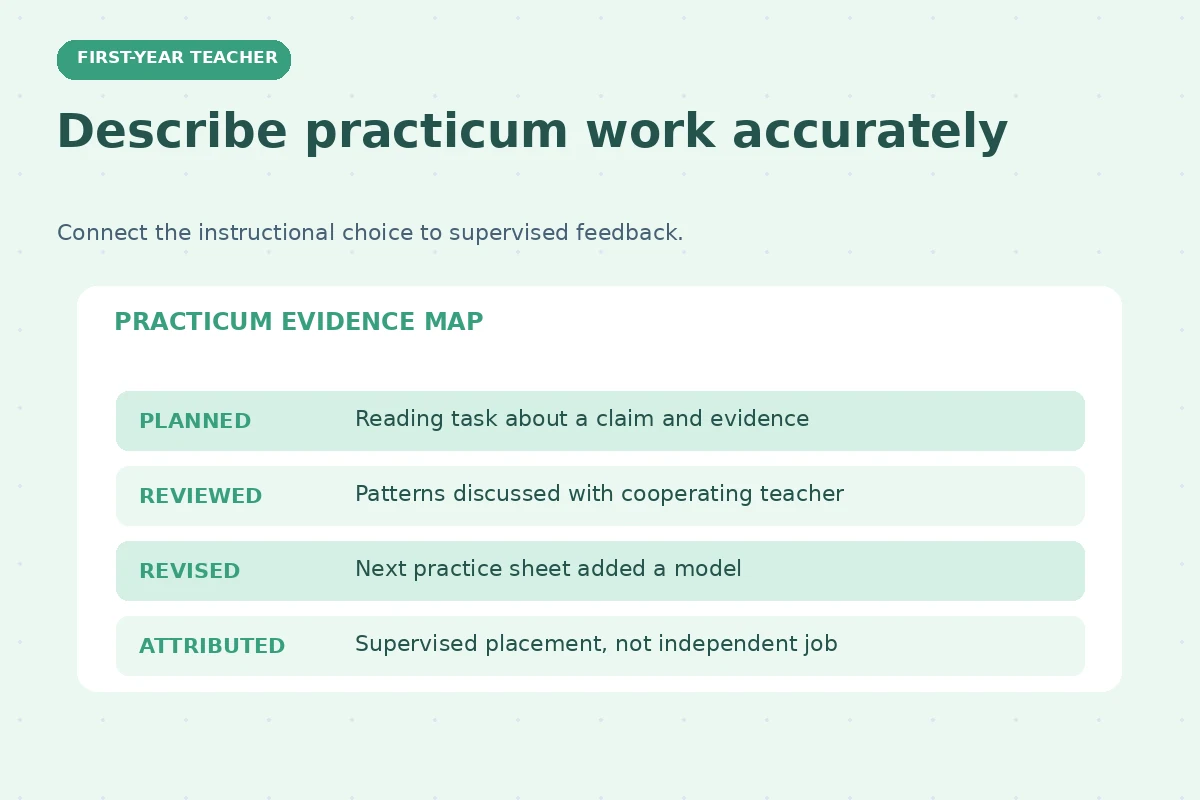
During my student-teaching placement, I planned a reading lesson that asked students to support a claim with details from the text. After reviewing anonymized exit-ticket patterns with my cooperating teacher, I revised the next practice activity to model that step more clearly. This experience strengthened my habit of using student work carefully and seeking feedback before changing instruction. I would value the opportunity to discuss how my preparation fits your fourth-grade team. Thank you for your consideration. Sincerely, [Your Name]
Keep mentor feedback and privacy boundaries clear
Do not present an entire class’s work as your independent research project. Explain what was part of your field placement and what decisions the cooperating teacher made. If you used anonymized samples in a portfolio, verify that the school permits that use; de-identification is not a license to disclose any record. The Department of Education provides FERPA guidance about personally identifiable information in education records. For applications, it is generally safer to describe the instructional method than to attach real student-level records.
Mentor feedback is useful evidence. You could write, “My cooperating teacher suggested adding a worked example, and I revised the practice activity,” if that happened. It shows reflection and responsiveness. Do not claim that the change raised scores without valid, appropriately shareable measurements. Make clear whether you designed, co-taught, observed, or independently delivered a lesson. Those are not interchangeable levels of responsibility.
Adapt your letter for the intended classroom
For an elementary role, connect the practicum to reading routines, classroom transitions, age-appropriate directions, or formative checks. For a secondary subject, use a disciplinary example: how you broke down a math method, checked understanding of a lab procedure, or facilitated evidence-based discussion. For a special-education position, do not claim specialized credentials or independent IEP authority you lack. Read the advertised endorsement requirements and discuss only legitimate training and supervised exposure.
If you have fewer practicum opportunities than the posting prefers, write about what you did learn rather than filling the gap with generic passion. Volunteering, tutoring, or a university microteaching project may help, but those contexts must be named. A hypothetical student-teaching paragraph should never become a true-sounding account of a district that you did not attend. Make the letter speak in the voice of your actual preparation.

Do a final credential and document review
Check the school and district names, the grade or subject, and the required credentials. The wording in your cover letter must match any licensing evidence in the application. If you are awaiting confirmation, follow the district’s stated instructions and use an accurate pending status. Do not represent an expected certificate as already issued. Keep the letter readable and usually no longer than one page for a routine nonacademic K–12 application unless the district asks otherwise.
Have a trusted mentor review whether your lesson description accurately separates your work from the cooperating teacher’s decisions. Proofread for student-identifying information, unsupported percentages, and overly specific claims about school policy. Save the requested file type, inspect the PDF or portal preview, and confirm that all uploads were completed. The employer should be able to see a teachable, reflective applicant without relying on inflated employment history.
How We Research First-Job Cover Letters
We checked U.S. university career-center guidance on writing targeted cover letters and examined occupation-specific descriptions from U.S. Bureau of Labor Statistics or O*NET, as relevant to this role. Where privacy, credentials, or scam risks matter, we consulted relevant public guidance. We used these sources to check task descriptions and reasonable limits on candidate claims; they do not confirm any particular vacancy. The sample letter is wholly hypothetical, not a report of employment or a promise of hiring outcomes.
Sources reviewed November 13, 2026: careerservices.upenn.edu — University of Pennsylvania career advice supports tailored cover letters with illustrative experiences rather than generic enthusiasm.; www.bls.gov — BLS outlines teacher duties and notes that U.S. public-school licensure and certification requirements vary by state.; studentprivacy.ed.gov — The U.S. Department of Education explains FERPA requirements on access and disclosure of personally identifiable education record information.; careers.usf.edu — USF recommends evidence-based middle paragraphs and not merely repeating a resume..
This page offers general U.S. career-document guidance; individual employers may request a different format or credential. Read the JobAsk affiliate disclosure. The navigation links above are informational and do not imply affiliate partnerships, employer endorsements, or an approved job offer.
More Resume and Cover Letter Guides
Yes, with the qualification that it was a supervised student-teaching or practicum placement. Do not call it an independent contracted teaching role.
Use the exact stage confirmed by the appropriate state or district authority. Do not present it as an issued license or promise a date you cannot verify.
Only if they are accurate, contextualized, permitted to disclose, and do not expose protected information. A lesson adaptation and mentor-reviewed work can be sufficient.
Not without revising it to show transferable instructional skills and fit for the particular subject, grade, and credential requirements.
Label tutoring as tutoring, describe the subject and learner support honestly, and address any required licensure or training separately.