
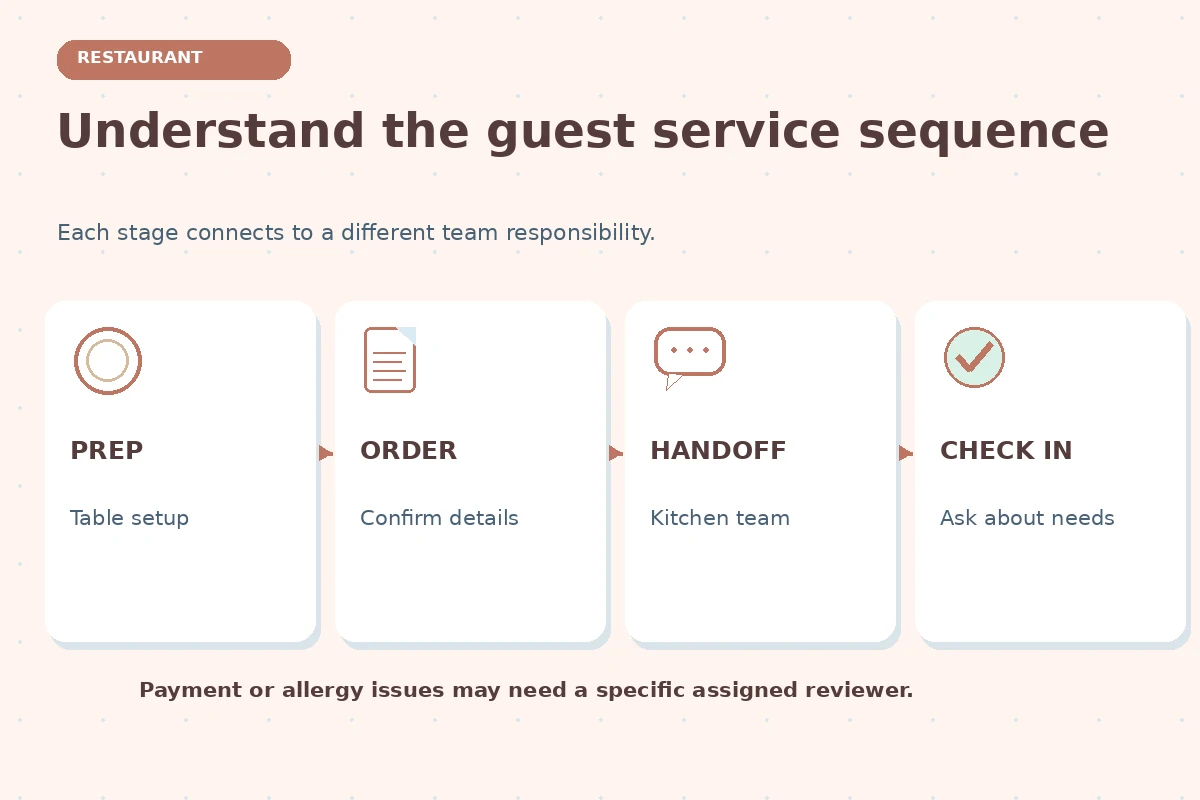
A restaurant server cover letter with no experience should connect the job’s actual service sequence to work you have really done: welcoming people, listening to requests, communicating details, keeping a station organized, and asking for help when uncertain. There is no need to invent restaurant shifts or say you know every food handling rule. Use a school fundraiser, community meal, retail counter, or volunteer event as transferable evidence and state the setting plainly. This guide offers a fictional sample letter, role-specific editing advice, and a practical handoff map.
Read the restaurant listing as a service sequence
The server job involves more than being friendly. The Bureau of Labor Statistics describes taking orders, coordinating delivery with the kitchen, checking on guests, and preparing checks. The particular establishment may also require opening tasks, cleaning, stocking, reservations, or beverage service. A person applying for a first server position should read the restaurant’s posted duties rather than assuming that every location divides work identically.
Identify what the entry role specifically calls for. If it emphasizes guest greetings and teamwork, look for a real public-facing project. If it names point-of-sale equipment, do not say you used that system unless you actually did. You can express readiness to train. If a role involves alcohol service, food safety, or allergy-related decisions, procedures and requirements vary with the job and location; your letter should not imply authority or credentials you do not have.

Find transferable proof beyond paid waiting tables
Perhaps you organized seating at a community event, handed out printed menus at a volunteer dinner, kept a refreshment table stocked, or coordinated meal counts for a campus club. Those activities are not the same as serving paying restaurant customers, but they can demonstrate attention to timing and clear communication. Select the example that most closely matches the advertised opening, and say what you actually did instead of treating a one-day event as years of service experience.
Useful details include confirming a participant’s request, checking that instructions were current, passing information to the assigned organizer, and keeping a common area ready for the next group. If you worked on a school team, name your share of the task. You may say you “helped prepare the serving area” if you did. Do not say you “ran front of house operations” when a teacher or supervisor made the operational decisions.
Read this fictional first server cover letter
This is a hypothetical model, not a letter from an actual employee or evidence of restaurant performance. Replace each line with your own legitimate experience.
Dear Hiring Team, I am applying for the Restaurant Server opening on your careers page. I would like to begin in a team where accurate guest communication and reliable service preparation matter. Although I have not yet worked as a restaurant server, I have helped with a school community dinner that required careful coordination with others.
At that event, I welcomed guests, directed questions to the organizer, and helped the team prepare place settings and track which tables were ready. When someone asked about food ingredients, I did not guess; I passed the question to the person responsible for the menu. That experience helped me understand how much clear handoffs and attention to detail contribute to service. I am ready to learn your menu, order process, and workplace procedures under training. Thank you for considering my application. Sincerely, [Your Name]

Explain what this sample actually proves
The opening makes a role-specific connection rather than claiming that kindness alone qualifies someone to handle a full section of tables. The middle gives three concrete tasks: a guest greeting, preparation with coworkers, and routing an ingredient question to someone authorized to answer. It does not say the applicant independently checked allergens, certified food safety, or issued a refund. That boundary is intentional; uncertainty handled responsibly can be a sign of readiness.
When rewriting, choose an example that really happened to you. A family gathering may show informal hospitality, but it is weaker evidence for professional timing than a structured volunteer or paid activity. If you do mention informal experience, label it as such. If you have retail or cashier work, a concise explanation of accurate transactions and busy-period communication may be stronger than a made-up school dinner.
Tailor the paragraph to different service settings
At a cafe, the job may mix counter orders, cleaning, and preparation. At an event venue, banquet servers may follow assigned seating plans and timed meal service. A hotel restaurant may emphasize handoffs between kitchen, dining room, and room service. Do not copy the same paragraph to all three. Scan for what the specific team asks, choose a corresponding example, and explain that connection in a sentence or two.
Write “I helped prepare the event service area and checked supply levels” only if true. You do not need to claim proficiency with tray carrying, point-of-sale systems, age verification, or tips. If you have no direct experience, express willingness to complete required training. Food-allergy requests and alcohol-service decisions should follow the establishment’s procedures and applicable requirements; never claim to independently guarantee that an item is allergen-free.
Finish with a clean and believable application
Keep the letter concise enough for a hiring manager to read quickly and follow the exact submission instructions. Use the role name from the listing, the right restaurant name, and a professional contact address. A hiring committee greeting is reasonable when no individual is identified. Keep the header consistent with your resume and do not include personal details unrelated to job readiness.
Before sending, ask whether each action verb is defensible. “Helped,” “confirmed,” “recorded,” and “referred” have different meanings. Check that you have not transformed voluntary help into a paid title or a training willingness into an earned credential. Preview the PDF if you upload one and make sure the contact line is visible. The practical goal is to give the employer a real reason to discuss your ability to learn the team’s service process.
How We Research First-Job Cover Letters
We checked U.S. university career-center guidance on writing targeted cover letters and examined occupation-specific descriptions from U.S. Bureau of Labor Statistics or O*NET, as relevant to this role. Where privacy, credentials, or scam risks matter, we consulted relevant public guidance. We used these sources to check task descriptions and reasonable limits on candidate claims; they do not confirm any particular vacancy. The sample letter is wholly hypothetical, not a report of employment or a promise of hiring outcomes.
Sources reviewed November 13, 2026: careerservices.upenn.edu — Career Services at Penn recommends targeted, evidence-based cover letters and direct links from transferable experience to role needs.; www.bls.gov — BLS explains server tasks such as order taking, delivery, table preparation, guest check-ins, and payment handling.; www.onetonline.org — O*NET identifies order recording, kitchen communication, and customer follow-up as waiter and waitress responsibilities..
This page offers general U.S. career-document guidance; individual employers may request a different format or credential. Read the JobAsk affiliate disclosure. The navigation links above are informational and do not imply affiliate partnerships, employer endorsements, or an approved job offer.
More Resume and Cover Letter Guides
Yes, but label it as informal experience and make a modest connection to preparation or communication. A structured volunteer event may offer clearer evidence.
Only if you have actually used a comparable system. Otherwise mention that you are willing to learn the employer’s ordering tools.
No. State only credentials you actually hold; follow the restaurant’s training and applicable local requirements.
Describe asking the designated staff member and following the employer’s procedure. Do not guarantee food safety or claim medical expertise.
Revise the letter for table clearing, setup, timing, and team coordination. Do not present a server-focused letter as a perfect match to a different position.